Coredex
Contents
OverviewEvidenceMechanismStatusCheckedSourcesWhere it sitsStudies

Fenfluramine

Pondimin, Ponderax, the “fen” in fen-phen, now Fintepla

Fenfluramine is a serotonin-releasing amphetamine derivative. As half of fen-phen it was widely prescribed for weight loss until its withdrawal in September 1997, after five surveys found heart-valve damage in 32.8% of 284 exposed patients against a background estimated at 5% or less.

Restricted or investigational

Fenfluramine is a prescription-only medicine for rare childhood epilepsies. It is on this site as a worked example of a weight-loss drug whose harm was found only after it had been taken by millions of people, and of what was required to bring it back. No score and no price, because for the reader there is no decision to make here.

  • Filed under: Restricted or investigational
  • Authorised by the FDA and EMA, as of 10 Nov 2026
  • Valve damage in a third of those surveyed
  1. Compounds
  2. Other investigational and specialist drugs
  3. Serotonin releasing agents
  4. Fenfluramine

23 sources 4 registered trials named in the sources last source read 6 Nov 2026 page reviewed 22 Nov 2026

Overview

The FDA approved it again in June 2020 for seizures in Dravet syndrome and Lennox-Gastaut syndrome, with a boxed warning for valve disease and pulmonary hypertension and a mandated echocardiogram schedule.

In its favour

At a lower exposure than in the weight-loss era it is an effective antiseizure medicine: a 62.3% greater reduction in convulsive seizures than placebo in a randomised trial in Dravet syndrome, and licensed on that basis in the United States, the European Union and Great Britain

Recorded harm

Heart-valve disease and pulmonary arterial hypertension. Valve lesions in 32.8% of 284 people surveyed on weight-loss use against a background estimated at 5% or less, and a 23-fold odds ratio for pulmonary hypertension with more than three months of use. Both sit in a boxed warning on the current US label

Not settled

Whether the lower exposure is safe over decades is not settled. No valve disease or pulmonary hypertension appeared in the trials or in open-label follow-up to three years, and the label records that cases have been reported since approval. The question has an answer for children watched by echocardiogram and none for other groups

A serotonin-releasing amphetamine relative, and the name covers a racemate.

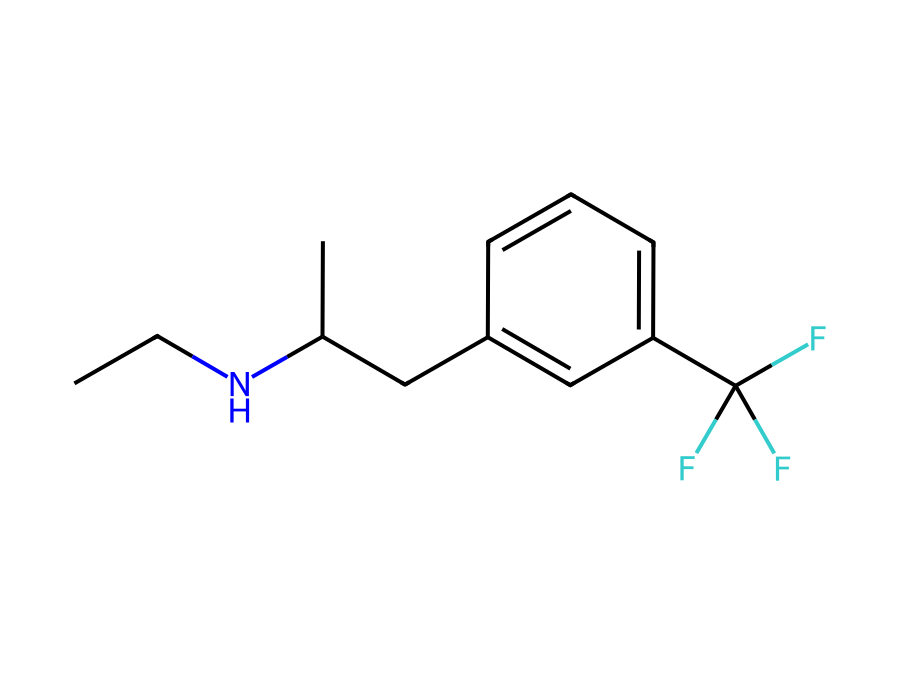
Fenfluramine is a small molecule of 231 daltons: an amphetamine skeleton carrying a trifluoromethyl group on the ring and an ethyl group on the nitrogen.⁠23 It releases serotonin rather than dopamine, which is why it suppresses appetite without being a stimulant in the way its structural relatives are.

For researchers

Three names, three different molecules. Fenfluramine is the racemate, the 50:50 mixture, which is what both Pondimin and Fintepla contain. Dexfenfluramine, sold as Redux and Adifax, is the single S-enantiomer and a separately registered substance. Norfenfluramine is neither: it is the metabolite the body makes from either of them, and it is the one that turned out to matter for the heart.⁠23

Compound data

ClassSubstituted amphetamine; serotonin releasing agent⁠18
FormulaC12H16F3N, 231.26⁠23
InChIKeyDBGIVFWFUFKIQN-UHFFFAOYSA-N⁠23
CAS458-24-2⁠23
UNII2DS058H2CF⁠23
StereochemistryA racemate. Dexfenfluramine is the single enantiomer, a separate substance⁠23
Active metaboliteNorfenfluramine, over 75% of a dose⁠14
Half-lifeParent 20 h; metabolite about 30 h1418
Oral bioavailabilityAbout 68 to 74%⁠14
Harm receptorSerotonin 2B, via the metabolite⁠78
Valve 2B receptor abundanceAt least 300x the 2C subtype⁠8
Withdrawn in the US15 Sep 19975
Valve lesions when surveyed32.8% of 284 (CI 27.7 to 38.9)⁠5
Background rate estimate5% or less⁠5
Pulmonary hypertension odds6.3, and 23.1 beyond 3 months⁠4
Re-approved, US25 Jun 2020, Dravet syndrome⁠15
EU authorisation18 Dec 2020⁠16
GB statusPrescription only, PLGB 00039/0804⁠18
Licensed indicationDravet and Lennox-Gastaut seizures, age 2+⁠18
Boxed warningValve disease and pulmonary hypertension⁠14
EchocardiogramsRequired before, 6-monthly for 2 years, and after⁠18
US controlled statusSchedule IV 1973; removed 23 Dec 202219
AuthorisationBy country, with sources
WADA 2026Named, S6.A, in competition⁠21

Evidence

Eighteen million prescriptions for a combination that was not approved as one.

Fenfluramine had been a US controlled substance since 15 June 1973 and an unremarkable appetite suppressant for two decades.⁠19 What changed was a 1992 randomised trial that ran it alongside phentermine in 121 adults for 34 weeks, with diet, exercise and behaviour work. The combination arm lost 14.2 kg, or 15.9% of starting weight, against 4.6 kg on placebo.⁠1

For researchers

That result, plus a series of open-label continuations from the same cohort, is usually credited for the popularity of fen-phen. The attribution is stated cautiously, because the papers themselves do not make the claim, the sources that do are secondary, and the paper reporting the programme's conclusions carries no abstract in the index.⁠12 The scale that followed is documented. The 1997 case series that ended it opens with the number: “in 1996 the total number of prescriptions in the United States for fenfluramine and phentermine exceeded 18 million”.⁠3

⚠ The combination had never been approved as one. The same sentence records that the fenfluramine-phentermine combination “has not been approved by the FDA”. Two separately licensed drugs were prescribed together, at a scale of millions, on the strength of a 121-person trial and the practice that grew around it.⁠3

The first signal was not the valves. It was the lungs. A case-control study across 35 centres in four European countries, published in 1996, found that appetite suppressants, “mainly derivatives of fenfluramine”, carried an odds ratio of 6.3 (3.0 to 13.2) for primary pulmonary hypertension, rising to 23.1 (6.9 to 77.7) where use exceeded three months.⁠4

Twenty-four women, then two hundred and eighty-four, then withdrawal.

In August 1997 a cardiology group reported 24 women with no history of cardiac disease who had taken fenfluramine-phentermine, assessed a mean of 12.3 months after starting. Verbatim: “Echocardiography demonstrated unusual valvular morphology and regurgitation in all patients. Both right-sided and left-sided heart valves were involved. Eight women also had newly documented pulmonary hypertension. To date, cardiac surgical intervention has been required in five patients.” The tissue finding is the detail that made it credible: “The histopathological features were identical to those seen in carcinoid or ergotamine-induced valve disease.”3

For researchers

⚠ That paper carries a published erratum whose content could not be retrieved. The quotations above are from the abstract as indexed, and the corrected article may differ for specific figures.⁠3

What settled it was five echocardiographic prevalence surveys of people who had actually taken the drugs, collected by the American regulator and published by the public health agency in November 1997.⁠5

The five surveys, pooledFinding
People examined284, 87% women, median age 48⁠5
Median exposure14 months⁠5
Met the valve-disease case definition32.8% (95% CI 27.7% to 38.9%)5
Range across the five surveys30.0% to 38.3%⁠5
Expected in the general populationEstimated 5% or less5

The consistency of the surveys was decisive. Five surveys run by different people with different methods gave a prevalence between 30 and 38 percent in every one of them. On that basis the regulator asked for a voluntary withdrawal, and “on September 15, the manufacturers and FDA announced the withdrawal of the drugs”.⁠5 The regulator's own press release of that date could not be opened, so the withdrawal and its date are cited from the public health agency's report.⁠6

⚠ 32.8% is not a population risk. The agency's report says the five surveys used convenience, confidence and random sampling, that their methods differed, and that they were unpublished at the time. People who volunteer for an echocardiogram after a drug scare are not a random sample of users. It is also not a refuted number: the manufacturer argued in 1999 that serious valve disease among former users was rare and the real prevalence “far lower than was suggested”, which is an interested party's statement in a document announcing a settlement. The surveys established a large signal and were not the right instrument for measuring its exact size.⁠520

A separate stream of 113 spontaneous case reports gives the clinical shape rather than the rate: 98% were women, median age 44, median nine months of use, 77% had symptoms, and 24% needed valve replacement surgery.⁠5

Mechanism

The harm was linked to a metabolite rather than the parent drug.

The order of events: the drug was withdrawn in 1997 on epidemiology alone, with no known mechanism. The explanation arrived in 2000, three years after withdrawal.

For researchers
Fenfluramine
Binds the serotonin 2B receptor only weakly. On its own it is not the problem⁠8
Norfenfluramine
The metabolite, which more than 75% of a dose becomes, and which has high affinity for the serotonin 2B receptor and acts as a partial-to-full agonist at it⁠78
Heart valves
Carry serotonin 2B receptor transcripts at least 300-fold more abundantly than the 2C subtype, so the metabolite finds its target concentrated in exactly the wrong tissue⁠8
Growth, not poisoning
In cells expressing the receptor the metabolite triggers calcium release and the mitogen-activated protein kinase cascade, the growth pathway linked to the receptor’s mitogenic effects. The valve thickens rather than being injured⁠8

The strongest line of the argument is a control group of molecules. Researchers tested eleven serotonin receptor subtypes against drugs that do and do not cause valve disease. Those that do, including norfenfluramine and two ergot drugs, all had high affinity and agonist activity at the 2B receptor. Those that do not, phentermine among them, along with fluoxetine, its metabolite and trazodone, did not.⁠7

⚠ This is an inference from cloned receptors in a dish. The authors conclude that activation of the 2B receptor is necessary to produce the valve disease, a strong claim resting on in vitro pharmacology plus the clinical pattern. It is the best available explanation and has not been demonstrated in a human.⁠7

FDA approval in 2020 for two severe childhood epilepsies.

Fenfluramine had been noticed decades earlier to reduce seizures in photosensitive epilepsy, and that observation was eventually tested properly. Three randomised trials now support the current licence.

For researchers
TrialnPopulationPrimary result
Dravet syndrome, 14 weeks119Mean age 9.0 years62.3% greater reduction in monthly convulsive seizures than placebo (95% CI 47.7 to 72.8, p<0.0001)⁠9
Dravet, on stiripentol regimens, 15 weeks87Age 2 to 1854.0% greater reduction (95% CI 35.6 to 67.2, p<0.001); 54% of patients halved their seizures against 5% on placebo⁠10
Lennox-Gastaut syndrome, 20 weeks263Age 2 to 35, median 1319.9 percentage points greater median reduction in drop seizures (95% CI 31.0 to 8.7, p=0.001); 25% halved them against 10%⁠11

In the first of those trials the median seizure reduction was 74.9% in the higher-exposure arm against 19.2% on placebo, with monthly counts falling from about 21 seizures to about five.⁠9

And the valves were watched, closely. Every trial and every open-label extension put patients through serial echocardiography. Across the randomised trials and the extensions, in 341 patients with Dravet syndrome and 263 with Lennox-Gastaut syndrome followed for up to three years, the regulator’s own label records that two patients showed mild aortic regurgitation with no symptoms, no structural change and no valve disease, and no case of valve disease or pulmonary arterial hypertension was observed.⁠141213

⚠ Two qualifications, both from the label. The first: “cases of valvular heart disease and pulmonary arterial hypertension have been reported during use of FINTEPLA in the postmarketing setting”. The clean trial record is a trial record. The second: every one of those trials was funded by the developer, with company employees among the authors.⁠14910

The drug is now licensed in the United States, the European Union and Great Britain, under constraints. In Great Britain the MHRA authorisation is for seizures associated with Dravet syndrome and Lennox-Gastaut syndrome as add-on therapy from the age of two, dispensed through a controlled access programme.⁠18 The United States added a boxed warning and a risk management programme, and removed the drug from the controlled-substance schedules in December 2022, having listed it since 1973.⁠1419

Exposure, population and monitoring differ between the two uses.

The maximum exposure under the epilepsy licence is substantially lower than the exposure at which valve lesions were found in the 1997 surveys and in the trial that made the combination popular.⁠51 Echocardiography is required before treatment, every six months for two years, annually after, and after the last exposure; no monitoring was specified in the weight-loss era.⁠18

For researchers

Dose is not the only variable. Three things changed at once: the exposure fell, the population changed from adults taking it for years to children watched by a cardiologist, and the monitoring became a condition of the licence. Attributing the improved safety record to the lower exposure alone is a guess. The pharmacology points that way, because the harm is driven by a metabolite acting at a receptor in a dose-dependent manner, which is a mechanism-shaped argument rather than a measurement.⁠78

One pharmacokinetic detail: the parent drug has a half-life of about 20 hours; the metabolite that acts on the valve receptor lasts about 30 hours. The metabolite responsible for the damage persists longest.⁠1418

Phentermine was not withdrawn in the United States.

Fen-phen had two components and only one of them left the market. Phentermine remains a prescription medicine in the United States, on its own and in a combination product licensed in 2012.⁠22

For researchers

Two independent lines of evidence are relevant. In the pharmacology, phentermine was one of the negative controls: it did not bind or activate the serotonin 2B receptor that the fenfluramine metabolite hits.⁠7 In the clinical data, of the 113 reported valve cases, “None of the cases used phentermine alone”.⁠5

Europe took a different view of it, and on different grounds. In 1999 the European committee recommended withdrawing fenfluramine and dexfenfluramine by consensus, on “an unacceptable safety profile under normal conditions of use and limited therapeutic efficacy”. In the same opinion it recommended withdrawing phentermine and other appetite suppressants too, by majority rather than consensus, and for lack of efficacy rather than for harm. The same document notes that the fenfluramine products had already been off the European market since 1997.⁠17

The two removals were different findings. One drug was removed because of harm to people; its partner was removed, in one jurisdiction, because a committee was not persuaded it did enough.

Regulatory status

Status by country

Where regulators list this compound, country by country. Each line names who listed it, the date it was read and the source. A country with no line has not been checked yet.

North America 2 of 3 checked

CountryStatusDetail
CanadaListed as withdrawn by Health Canada, as of 10 Nov 2026. Source: Health Canada Drug Product Database source dated 31 Dec 1991Drug Product Database lists only cancelled products with fenfluramine as the single active ingredient: Pondimin Tab 20Mg
United StatesListed as authorised by the FDA, as of 10 Nov 2026. Source: Drugs@FDA (openFDA) source dated 25 Jun 2020Drugs@FDA lists fenfluramine as the single active ingredient of Fenfluramine, Fintepla (2 applications with a single-ingredient prescription or over-the-counter product)

Europe 1 of 10 checked

CountryStatusDetail
European Union (central authorisation)Listed as authorised by the EMA, as of 10 Nov 2026. Source: EMA medicines table source dated 18 Dec 2020Products on the EMA table: Fintepla

Not yet checked. North America: Mexico. South America: Argentina, Brazil. Europe: Belgium, France, Germany, Italy, Netherlands, Russia, Spain, Switzerland, United Kingdom. Africa: Egypt, Nigeria, South Africa. Asia: China, India, Japan, South Korea, Thailand, United Arab Emirates. Oceania: Australia, New Zealand.

Sport (WADA) applies worldwide, not a country

WADA Prohibited List 2026Not yet checked

Information only, not legal advice. Not verified for any individual situation. Status changes; check the date and the source.

The same records as data: JSON and CSV, with a version and a change log.

Checked and missing

Three observations that apply beyond this drug.

One. The harm was in a tissue nobody was examining. Fenfluramine's weight data were good, its common side effects were known, and the valve finding came from clinicians noticing something years into mass use. Nothing in the trial programme was designed to find it, because an echocardiogram was not part of obesity trials. The relevant question is not whether a compound has side effects but whether anyone has examined where the mechanism says they should occur.35

For researchers

Two. Metabolites are separate drugs. A comparison of compounds by receptor binding can be correct about the parent molecule and wrong about what the body circulates. The valve affinity belongs to norfenfluramine, which is not what was swallowed.⁠8

Three. Withdrawal is not a finding about a molecule on its own. It is a finding about a molecule at a dose, in a population, for an indication, with a given amount of monitoring. Change all four and the same compound can return as a medicine. The rimonabant page is a counter-example: withdrawn for a harm that followed the mechanism everywhere it was tried, and no exposure or population has rescued it.⁠1418

What this page does not carry, and why.

Signature score, deliberately absent

A Signature score is not given. The evidence is strong, and it concerns a childhood epilepsy population rather than body composition.

Material that could not be retrieved.

The 1997 case series carries an erratum whose content was not retrieved. Its record lists a correction published in December of that year. Every quotation from it on this page comes from the indexed abstract.⁠3

For researchers

Trial figures come from abstracts and from the two regulators’ own product information. No trial paper was read in full. Where a figure appears in both a paper and a label, the label is quoted.⁠14

The British withdrawal of the 1997 products was not dated here. A safety bulletin recording it exists and could not be opened, and the only date available was secondary, so this page gives no United Kingdom date for the first withdrawal. The European committee’s own 1999 document confirms the products had been off the market across the Union since 1997.⁠17

The upper end of the old weight-loss exposure range is not given. A higher figure circulates but could not be traced to a primary document and is left out.⁠15

The anti-doping entry is quoted from a national agency's translation, not from the gazette text normally used, because the usual route was unreachable. Fenfluramine is named as a non-specified stimulant, prohibited in competition.⁠21

Not checked in this pass: the content of the most recent American risk-programme supplement, whether the 1999 European recommendation on phentermine was ever implemented, the litigation history beyond one corporate filing, and the pharmacovigilance analyses published since 2020. Recorded as unchecked rather than as clear.⁠2017

Sources23

This page cites 23 sources, numbered to match the small numbers in the text above. Each one links to the paper or record. Where a source states its design, a tag says so (a human trial, an animal study, a cell study, a review); the tag names the design and is not a grade. Each source also links back to where it is cited above.

  1. 01
    Weintraub M, Sundaresan PR, Madan M, Schuster B, Balder A, Lasagna L, Cox C. Long-term weight control study. I (weeks 0 to 34). Clinical Pharmacology and Therapeutics 1992;51(5):586-94.Human RCTPMID 1587072DOI 10.1038/clpt.1992.69no read date recorded
    Full text
    Weintraub M, Sundaresan PR, Madan M, Schuster B, Balder A, Lasagna L, Cox C. Long-term weight control study. I (weeks 0 to 34). Clinical Pharmacology and Therapeutics 1992;51(5):586-94. PMID 1587072, DOI 10.1038/clpt.1992.69. A 34-week double-blind randomised trial of fenfluramine plus phentermine against placebo, with behaviour modification, diet and exercise in every arm, in 121 adults at 130 to 180 per cent of ideal body weight. Quoted from the abstract: "By week 34, participants receiving active medication lost an average of 14.2 +/- 0.9 kg, or 15.9% +/- 0.9% of initial weight (n = 58), versus a loss of 4.6 +/- 0.8 kg or 4.9% +/- 0.9% of initial weight by subjects taking placebo (n = 54; p less than 0.001)." The dose was 60 mg of extended-release fenfluramine with 15 mg of phentermine resin. This paper is the head of a series of open-label continuations running to week 210 (PMIDs 1587072 to 1587079). Correction check: no update relation in Crossref and nothing in the Europe PMC record. Abstract only.
    Cited 4 times, back to the text1234
  2. 02
    (Reserved.) The 1992 series conclusions paper, Weintraub M, Long-term weight control study: conclusions, Clinical Pharmacology and Therapeutics 1992;51(5):642-6, PMID 1587079, was located and carries no abstract in the index, so nothing on…PMID 1587079DOI 10.1038/clpt.1992.76no read date recorded
    Full text
    (Reserved.) The 1992 series conclusions paper, Weintraub M, Long-term weight control study: conclusions, Clinical Pharmacology and Therapeutics 1992;51(5):642-6, PMID 1587079, DOI 10.1038/clpt.1992.76, was located and carries no abstract in the index, so nothing on this page is taken from it.
    Back to the text1
  3. 03
    Connolly HM, Crary JL, McGoon MD, Hensrud DD, Edwards BS, Edwards WD, Schaff HV. Valvular heart disease associated with fenfluramine-phentermine. New England Journal of Medicine 1997;337(9):581-8.Human observationalPMID 9271479DOI 10.1056/NEJM199708283370901read 6 Nov 2026
    Full text
    Connolly HM, Crary JL, McGoon MD, Hensrud DD, Edwards BS, Edwards WD, Schaff HV. Valvular heart disease associated with fenfluramine-phentermine. New England Journal of Medicine 1997;337(9):581-8. PMID 9271479, DOI 10.1056/NEJM199708283370901. Quoted from the abstract, read from the Europe PMC record on 6 November 2026: that the combination "has not been approved by the FDA", that "in 1996 the total number of prescriptions in the United States for fenfluramine and phentermine exceeded 18 million", the identification of valvular heart disease "in 24 women treated with fenfluramine-phentermine who had no history of cardiac disease", that "Echocardiography demonstrated unusual valvular morphology and regurgitation in all patients. Both right-sided and left-sided heart valves were involved. Eight women also had newly documented pulmonary hypertension. To date, cardiac surgical intervention has been required in five patients", and that "The histopathological features were identical to those seen in carcinoid or ergotamine-induced valve disease". Mean age 44 plus or minus 8 years, assessed a mean of 12.3 months after starting. Correction check, both methods, 6 November 2026: Crossref records no update relation; the Europe PMC record lists an "Erratum in" entry, published New England Journal of Medicine 1997;337(24):1783.
    Cited 6 times, back to the text123456
  4. 04
    Abenhaim L, Moride Y, Brenot F, et al, for the International Primary Pulmonary Hypertension Study Group. Appetite-suppressant drugs and the risk of primary pulmonary hypertension. New England Journal of Medicine 1996;335(9):609-16.Human observationalPMID 8692238DOI 10.1056/NEJM199608293350901no read date recorded
    Full text
    Abenhaim L, Moride Y, Brenot F, et al, for the International Primary Pulmonary Hypertension Study Group. Appetite-suppressant drugs and the risk of primary pulmonary hypertension. New England Journal of Medicine 1996;335(9):609-16. PMID 8692238, DOI 10.1056/NEJM199608293350901. A case-control study of 95 cases and 355 matched controls across 35 centres in France, Belgium, the United Kingdom and the Netherlands. Quoted from the abstract: appetite-suppressant use, "mainly derivatives of fenfluramine", carried an "odds ratio with any anorexic-drug use, 6.3; 95 percent confidence interval, 3.0 to 13.2"; for use in the preceding year 10.1 (3.4 to 29.9); and "When anorexic drugs were used to a total of more than three months, the odds ratio was 23.1 (95 percent confidence interval, 6.9 to 77.7)." Correction check, both methods: no update relation, comments and letters only, nothing in a title search. Clean.
    Cited 2 times, back to the text12
  5. 05
    Centers for Disease Control and Prevention. Cardiac valvulopathy associated with exposure to fenfluramine or dexfenfluramine: US Department of Health and Human Services interim public health recommendations, November 1997. Morbidity and…read 6 Nov 2026
    Full text
    Centers for Disease Control and Prevention. Cardiac valvulopathy associated with exposure to fenfluramine or dexfenfluramine: US Department of Health and Human Services interim public health recommendations, November 1997. Morbidity and Mortality Weekly Report 1997;46(45):1061-6. Read in full from the agency’s own page on 6 November 2026. Supports: the five echocardiographic prevalence surveys in Florida, Minnesota, Wisconsin, Indiana and Pennsylvania; 284 patients in total, 87 per cent female, median age 48, median fenfluramine dose 40 mg a day and median exposure 14 months from Table 1; the case definition of documented aortic regurgitation of mild or greater severity or mitral regurgitation of moderate or greater severity; the finding that prevalence was "similar in all five survey populations, ranging from 30.0% to 38.3% (overall: 32.8%; 95% confidence interval=27.7%-38.9%)"; that preliminary population-based studies put the expected prevalence at "an estimated less than or equal to 5% and may be lower among obese persons than among nonobese persons"; that the surveys used differing methods and were unpublished at that date; that "Based on data from the five prevalence surveys, FDA requested the voluntary withdrawal of fenfluramine and dexfenfluramine from the U.S. market; on September 15, the manufacturers and FDA announced the withdrawal of the drugs"; and, from the separate stream of 113 spontaneous case reports, that 111 (98 per cent) were women, median age 44, median duration of use nine months, 87 (77 per cent) symptomatic, 27 (24 per cent) requiring valve replacement surgery, and that "None of the cases used phentermine alone".
    Cited 16 times, back to the text12345678and 8 more
  6. 06
    (Reserved.) The regulator’s own press release of 15 September 1997 could not be opened in this pass (an archived copy returned a certificate error), so the withdrawal request and its date are cited from reference 5 and reference 21 instead.no read date recordedBack to the text1
  7. 07
    Rothman RB, Baumann MH, Savage JE, Rauser L, McBride A, Hufeisen SJ, Roth BL. Evidence for possible involvement of 5-HT(2B) receptors in the cardiac valvulopathy associated with fenfluramine and other serotonergic medications. Circulation 2000;102(23):2836-41.PMID 11104741DOI 10.1161/01.cir.102.23.2836no read date recorded
    Full text
    Rothman RB, Baumann MH, Savage JE, Rauser L, McBride A, Hufeisen SJ, Roth BL. Evidence for possible involvement of 5-HT(2B) receptors in the cardiac valvulopathy associated with fenfluramine and other serotonergic medications. Circulation 2000;102(23):2836-41. PMID 11104741, DOI 10.1161/01.cir.102.23.2836. Quoted from the abstract: "(+/-)-, (+)-, and (-)-Norfenfluramine, ergotamine, and methylergonovine all had preferentially high affinities for the cloned human serotonin 5-HT(2B) receptor and were partial to full agonists at the 5-HT(2B) receptor", with the drugs not associated with valve disease, namely "phentermine, fluoxetine, its metabolite norfluoxetine, and trazodone and its active metabolite m-chlorophenylpiperazine", serving as negative controls, and the conclusion that activation of the 5-HT(2B) receptor "is necessary to produce" valvular heart disease. ELEVEN serotonin receptor subtypes were screened. Correction check, both methods: clean. Abstract only.
    Cited 6 times, back to the text123456
  8. 08
    Fitzgerald LW, Burn TC, Brown BS, et al. Possible role of valvular serotonin 5-HT(2B) receptors in the cardiopathy associated with fenfluramine. Molecular Pharmacology 2000;57(1):75-81.PMID 10617681no read date recorded
    Full text
    Fitzgerald LW, Burn TC, Brown BS, et al. Possible role of valvular serotonin 5-HT(2B) receptors in the cardiopathy associated with fenfluramine. Molecular Pharmacology 2000;57(1):75-81. PMID 10617681. Quoted from the abstract: "Fenfluramine binds weakly to 5-HT(2A), 5-HT(2B), and 5-HT(2C) receptors. In contrast, norfenfluramine exhibited high affinity for 5-HT(2B) and 5-HT(2C) receptors"; and "In cells expressing recombinant 5-HT(2B) receptors, norfenfluramine potently stimulated the hydrolysis of inositol phosphates, increased intracellular Ca(2+), and activated the mitogen-activated protein kinase cascade, the latter of which has been linked to mitogenic actions of the 5-HT(2B) receptor." On tissue distribution: expression of "5-HT(2B) and 5-HT(2A) receptor transcripts in heart valves was at least 300-fold higher than the levels of 5-HT(2C)". Models: recombinant cells plus human and porcine valve tissue. Correction check: the Europe PMC comment and correction list is empty; the Crossref query for the constructed identifier did not return usable data, so method (a) is partly unconfirmed for this paper and is recorded as such. Abstract only.
    Cited 8 times, back to the text12345678
  9. 09
    Lagae L, Sullivan J, Knupp K, et al, for the FAiRE DS Study Group. Fenfluramine hydrochloride for the treatment of seizures in Dravet syndrome: a randomised, double-blind, placebo-controlled trial. The Lancet 2019;394(10216):2243-54.Human RCTPMID 31862249DOI 10.1016/S0140-6736(19)32500-0read 6 Nov 2026
    Full text
    Lagae L, Sullivan J, Knupp K, et al, for the FAiRE DS Study Group. Fenfluramine hydrochloride for the treatment of seizures in Dravet syndrome: a randomised, double-blind, placebo-controlled trial. The Lancet 2019;394(10216):2243-54. PMID 31862249, DOI 10.1016/S0140-6736(19)32500-0. ClinicalTrials.gov NCT02682927 and NCT02826863. Abstract read in full from Europe PMC on 6 November 2026. Supports: 119 patients randomised of 173 assessed, mean age 9.0 years, across three arms over 14 weeks as add-on therapy; median seizure reduction of 74.9 per cent on the higher dose (from a median of 20.7 to 4.7 convulsive seizures per 28 days) against 42.3 per cent on the lower dose and 19.2 per cent on placebo; the primary endpoint met, "with fenfluramine 0.7 mg/kg per day showing a 62.3% greater reduction in mean MCSF compared with placebo (95% CI 47.7-72.8, p<0.0001)"; and that "Echocardiographic examinations revealed valve function within the normal physiological range in all patients during the trial and no signs of pulmonary arterial hypertension." Funded by the developer. Correction check, both methods: clean.
    Cited 3 times, back to the text123
  10. 10
    Nabbout R, Mistry A, Zuberi S, et al. Fenfluramine for treatment-resistant seizures in patients with Dravet syndrome receiving stiripentol-inclusive regimens: a randomized clinical trial. JAMA Neurology 2020;77(3):300-8.Human RCTPMID 31790543DOI 10.1001/jamaneurol.2019.4113no read date recorded
    Full text
    Nabbout R, Mistry A, Zuberi S, et al. Fenfluramine for treatment-resistant seizures in patients with Dravet syndrome receiving stiripentol-inclusive regimens: a randomized clinical trial. JAMA Neurology 2020;77(3):300-8. PMID 31790543, DOI 10.1001/jamaneurol.2019.4113. ClinicalTrials.gov NCT02926898. 87 patients aged 2 to 18, mean age 9.1 years, over 15 weeks. Quoted from the abstract: a "54.0% (95% CI, 35.6%-67.2%; P < .001) greater reduction in mean monthly convulsive seizure frequency than those receiving the placebo", with "54% of patients demonstrated a clinically meaningful (>=50%) reduction ... vs 5% with placebo", and "no clinical or echocardiographic evidence of valvular heart disease or pulmonary arterial hypertension". Developer employees and shareholders are among the authors. Correction check, both methods: clean. Abstract only.
    Cited 2 times, back to the text12
  11. 11
    Knupp KG, Scheffer IE, Ceulemans B, et al. Efficacy and safety of fenfluramine for the treatment of seizures associated with Lennox-Gastaut syndrome: a randomized clinical trial. JAMA Neurology 2022;79(6):554-64.Human RCTPMID 35499850DOI 10.1001/jamaneurol.2022.0829no read date recorded
    Full text
    Knupp KG, Scheffer IE, Ceulemans B, et al. Efficacy and safety of fenfluramine for the treatment of seizures associated with Lennox-Gastaut syndrome: a randomized clinical trial. JAMA Neurology 2022;79(6):554-64. PMID 35499850, DOI 10.1001/jamaneurol.2022.0829. ClinicalTrials.gov NCT03355209. 263 patients aged 2 to 35, median 13 years, over 20 weeks. Quoted from the abstract: the trial "met its primary efficacy end point: patients in the 0.7-mg/kg/d fenfluramine group achieved a -19.9 percentage points (95% CI, -31.0 to -8.7 percentage points; P = .001) estimated median difference in drop seizures from baseline vs placebo", with 22 of 87 (25 per cent) halving their drop seizures against 9 of 87 (10 per cent), and "No cases of valvular heart disease or pulmonary arterial hypertension were observed." Correction check, both methods: clean for this paper. A title search returned a correction notice belonging to a DIFFERENT fenfluramine paper, which is recorded here so it is not mistaken for this one. Abstract only.
    Back to the text1
  12. 12
    Lai WW, Galer BS, Wong PC, et al. Cardiovascular safety of fenfluramine in the treatment of Dravet syndrome: analysis of an ongoing long-term open-label safety extension study. Epilepsia 2020;61(11):2386-95.Human RCTPMID 32809271DOI 10.1111/epi.16638no read date recorded
    Full text
    Lai WW, Galer BS, Wong PC, et al. Cardiovascular safety of fenfluramine in the treatment of Dravet syndrome: analysis of an ongoing long-term open-label safety extension study. Epilepsia 2020;61(11):2386-95. PMID 32809271, DOI 10.1111/epi.16638. 232 patients aged 2 to 18 on a mean dose of 0.41 mg/kg/day for a median of 256 days, with serial echocardiography: "No cases of valvular heart disease or PAH were observed." Correction check, both methods: clean. Abstract only.
    Back to the text1
  13. 13
    Agarwal A, Farfel GM, Gammaitoni AR, Wong PC, Pinto FJ, Galer BS. Long-term cardiovascular safety of fenfluramine in patients with Dravet syndrome treated for up to 3 years: findings from serial echocardiographic assessments. European…PMID 35640431DOI 10.1016/j.ejpn.2022.05.006no read date recorded
    Full text
    Agarwal A, Farfel GM, Gammaitoni AR, Wong PC, Pinto FJ, Galer BS. Long-term cardiovascular safety of fenfluramine in patients with Dravet syndrome treated for up to 3 years: findings from serial echocardiographic assessments. European Journal of Paediatric Neurology 2022;39:35-9. PMID 35640431, DOI 10.1016/j.ejpn.2022.05.006. 327 patients, median age 9.0 years, median treatment duration 23.9 months and up to 42.6 months, with blinded serial echocardiography: "No patient demonstrated VHD or PAH at any time during the OLE." Valvular heart disease was defined as moderate or greater mitral regurgitation, or mild or greater aortic regurgitation combined with physical signs or symptoms; pulmonary arterial hypertension as a systolic pulmonary artery pressure above 35 mmHg. Sponsor employees among the authors. Correction check, both methods: clean. Abstract only.
    Back to the text1
  14. 14
    US Food and Drug Administration. FINTEPLA (fenfluramine) oral solution, prescribing information, UCB Inc. Full label text read on 6 November 2026 from the National Library of Medicine’s structured product label service (set identifier…read 6 Nov 2026
    Full text
    US Food and Drug Administration. FINTEPLA (fenfluramine) oral solution, prescribing information, UCB Inc. Full label text read on 6 November 2026 from the National Library of Medicine’s structured product label service (set identifier e88f360e-33ad-4cd6-b2de-5ef885857c5d, version 17, published 26 October 2026; the label itself is marked revised 4/2025). Supports: the boxed warning that the product "can cause valvular heart disease and pulmonary arterial hypertension" with echocardiogram assessments "required before, during, and after treatment"; the risk evaluation and mitigation strategy; the maximum dose of 26 mg a day, and 17 mg a day with stiripentol; pharmacokinetics, namely an elimination half-life of 20 hours for the parent, absolute bioavailability of approximately 68 to 74 per cent, 50 per cent plasma protein binding, and that "Over 75% of fenfluramine is metabolized to norfenfluramine" with both parent and metabolite "pharmacologically active"; the mechanism statement that "The precise mechanism ... is unknown. Fenfluramine and the metabolite, norfenfluramine, exhibit agonist activity at serotonin 5-HT2 receptors"; the pooled echocardiographic safety data across the placebo-controlled trials and open-label extensions in 341 patients with Dravet syndrome and 263 with Lennox-Gastaut syndrome followed for up to three years, in which "two patients with LGS exhibited mild aortic regurgitation (AR) but neither patient had any cardiac signs or symptoms or evidence of valvular structural changes. Neither patient had VHD"; and the postmarketing statement that "cases of valvular heart disease and pulmonary arterial hypertension have been reported during use of FINTEPLA in the postmarketing setting".
    Cited 10 times, back to the text12345678and 2 more
  15. 15
    US Food and Drug Administration, Drugs@FDA, read through the openFDA interface on 6 November 2026. New drug application 212102, FINTEPLA, UCB Inc: original approval 25 June 2020; efficacy supplement 3 approved 25 March 2022, adding…read 6 Nov 2026
    Full text
    US Food and Drug Administration, Drugs@FDA, read through the openFDA interface on 6 November 2026. New drug application 212102, FINTEPLA, UCB Inc: original approval 25 June 2020; efficacy supplement 3 approved 25 March 2022, adding Lennox-Gastaut syndrome; a risk-management supplement approved 22 May 2026, whose content was not read in this pass. Supports the United States approval dates.
    Back to the text1
  16. 16
    European Medicines Agency. Fintepla: European public assessment report. Committee opinion 15 October 2020; European Union marketing authorisation 18 December 2020; orphan designations for Dravet syndrome (18 December 2013) and…no read date recorded
    Full text
    European Medicines Agency. Fintepla: European public assessment report. Committee opinion 15 October 2020; European Union marketing authorisation 18 December 2020; orphan designations for Dravet syndrome (18 December 2013) and Lennox-Gastaut syndrome (27 February 2017); subject to additional monitoring. Supports the European authorisation date and indication.
    Back to the text1
  17. 17
    European Agency for the Evaluation of Medicinal Products, Committee for Proprietary Medicinal Products. Press release CPMP/2325/99, 9 September 1999, reporting the extraordinary meeting of 31 August 1999 on anorectic agents. Quoted…no read date recorded
    Full text
    European Agency for the Evaluation of Medicinal Products, Committee for Proprietary Medicinal Products. Press release CPMP/2325/99, 9 September 1999, reporting the extraordinary meeting of 31 August 1999 on anorectic agents. Quoted verbatim: "The CPMP adopted a final opinion by consensus, recommending the withdrawal of the marketing authorisations for fenfluramine and dexfenfluramine containing medicinal products. Such recommendation was based on an unacceptable safety profile under normal conditions of use and limited therapeutic efficacy, leading to an unfavourable benefit/risk balance. It should be noted that fenfluramine and dexfenfluramine containing medicinal products are no longer available in the European Union since 1997." The same opinion recommended withdrawal for phentermine, amfepramone and other appetite suppressants, by majority vote rather than consensus, on grounds of a lack of therapeutic efficacy. Whether that recommendation on phentermine was implemented was not checked in this pass.
    Cited 3 times, back to the text123
  18. 18
    Electronic medicines compendium. Fintepla 2.2 mg/ml oral solution, summary of product characteristics, UCB Pharma Ltd, read on 6 November 2026, revision of 7 May 2026. Supports: the legal category "Prescription only medicine"; marketing…read 6 Nov 2026
    Full text
    Electronic medicines compendium. Fintepla 2.2 mg/ml oral solution, summary of product characteristics, UCB Pharma Ltd, read on 6 November 2026, revision of 7 May 2026. Supports: the legal category "Prescription only medicine"; marketing authorisation number PLGB 00039/0804; the indication, "seizures associated with Dravet syndrome and Lennox-Gastaut syndrome" as "add-on therapy to other anti-epileptic medicines for patients 2 years of age and older"; supply through a controlled access programme; the contraindications in aortic or mitral valvular heart disease and in pulmonary arterial hypertension; the monitoring requirement that "Echocardiogram monitoring should be conducted every 6 months for the first 2 years and annually thereafter" with a final assessment 3 to 6 months after the last dose; the mechanism statement that "Fenfluramine is a serotonin releasing agent, and thereby stimulates multiple 5-HT receptor sub-types" and that "The precise mode of action of fenfluramine in Dravet syndrome and Lennox-Gastaut syndrome is not known"; and a norfenfluramine half-life of about 30 hours. The summary gives a first authorisation date of 1 January 2021 for Great Britain.
    Cited 9 times, back to the text12345678and 1 more
  19. 19
    US Drug Enforcement Administration. Schedules of controlled substances: removal of fenfluramine from control. Final rule, 87 Federal Register 78857, 23 December 2022. Supports: that fenfluramine had been a Schedule IV controlled substance…no read date recorded
    Full text
    US Drug Enforcement Administration. Schedules of controlled substances: removal of fenfluramine from control. Final rule, 87 Federal Register 78857, 23 December 2022. Supports: that fenfluramine had been a Schedule IV controlled substance since 15 June 1973; the developer’s petition of 18 October 2018; the new drug application of 25 September 2019; the approval of 25 June 2020; and the removal from control effective 23 December 2022.
    Cited 3 times, back to the text123
  20. 20
    American Home Products Corporation. Report on Form 8-K, event date 7 October 1999, exhibit 99.1 press release, filed with the US Securities and Exchange Commission. Cited for two things only: the corporate record that the products were…no read date recorded
    Full text
    American Home Products Corporation. Report on Form 8-K, event date 7 October 1999, exhibit 99.1 press release, filed with the US Securities and Exchange Commission. Cited for two things only: the corporate record that the products were voluntarily withdrawn on 15 September 1997, and the company’s own contemporaneous assertion that "serious heart valve disease among former diet drug users is rare and the actual prevalence of heart valve regurgitation is far lower than was suggested at the time of the products’ withdrawal". The same filing states that payments under the national class settlement "cannot exceed $3.75 billion in present value" against a pretax charge of $4.75 billion; those are a cap and an accounting charge rather than a total paid, and the later litigation history was not examined in this pass.
    Cited 2 times, back to the text12
  21. 21
    Anti-doping. The 2026 World Anti-Doping Code International Standard Prohibited List, read from the German National Anti-Doping Agency’s informational German translation published 10 December 2025, index and section S6.A text. Fenfluramine…read 10 Dec 2025
    Full text
    Anti-doping. The 2026 World Anti-Doping Code International Standard Prohibited List, read from the German National Anti-Doping Agency’s informational German translation published 10 December 2025, index and section S6.A text. Fenfluramine is NAMED under S6.A, non-specified stimulants, prohibited in competition. Phentermine’s status was not checked.
    Cited 2 times, back to the text12
  22. 22
    US Food and Drug Administration, Drugs@FDA, read through the openFDA interface on 6 November 2026: LOMAIRA, abbreviated new drug application 203495, and QSYMIA, new drug application 022580, originally approved 17 July 2012. Supports that…read 6 Nov 2026
    Full text
    US Food and Drug Administration, Drugs@FDA, read through the openFDA interface on 6 November 2026: LOMAIRA, abbreviated new drug application 203495, and QSYMIA, new drug application 022580, originally approved 17 July 2012. Supports that phentermine remains a prescription product in the United States both alone and in combination, which is the contrast the page draws with fenfluramine’s withdrawal.
    Back to the text1
  23. 23
    Identity. PubChem compound records read through the PUG-REST property endpoint on 6 November 2026: CID 3337 for fenfluramine, resolved both by name and by CAS registry number 458-24-2, with molecular formula C12H16F3N, molecular weight…read 6 Nov 2026
    Full text
    Identity. PubChem compound records read through the PUG-REST property endpoint on 6 November 2026: CID 3337 for fenfluramine, resolved both by name and by CAS registry number 458-24-2, with molecular formula C12H16F3N, molecular weight 231.26, InChIKey DBGIVFWFUFKIQN-UHFFFAOYSA-N and the IUPAC name N-ethyl-1-[3-(trifluoromethyl)phenyl]propan-2-amine. The second InChIKey block carries no stereochemistry, which is correct for a racemate. Dexfenfluramine is a separate record, CID 66265, InChIKey DBGIVFWFUFKIQN-VIFPVBQESA-N; the active metabolite norfenfluramine is CID 15897, C10H12F3N. US FDA Global Substance Registration System: unique ingredient identifiers 2DS058H2CF for fenfluramine, 3KC089243P for the hydrochloride, E35R3G56OV for dexfenfluramine and 953A94Y45B for levofenfluramine. The mass was reconciled independently from the formula: carbon 144.13 plus hydrogen 16.13 plus fluorine 57.00 plus nitrogen 14.01 gives 231.27, which agrees. The structure drawing on this page was generated locally from the PubChem isomeric SMILES and its formula asserted against C12H16F3N before it was written.
    Cited 7 times, back to the text1234567

Where it sits

Related pages

RimonabantAnother withdrawn appetite drug; its harm followed the mechanism into every population tried
ClenbuterolA licensed medicine whose fat-loss use is outside its licensed population
DNP (2,4-Dinitrophenol)A historical fat-loss drug whose harm was immediate rather than delayed
SemaglutideA modern appetite medicine with cardiovascular outcome trials before approval
TGN1412A reference case on evidence, where a clean preclinical package did not find the hazard

Primary studies

Don’t take our word for it. Read the study.

Read first: 09, 10, 11.