Coredex
Contents
OverviewEvidenceMechanismStatusCheckedSourcesWhere it sitsStudies

Orforglipron

Foundayo, LY3502970, the first oral GLP-1 that is not a peptide

Orforglipron is a non-peptide small molecule GLP-1 receptor agonist taken as a tablet, with 77% of a low dose absorbed and no food or water restriction on the label. In people with type 2 diabetes it produced about 9.6% weight loss at 72 weeks against 2.5% on placebo, less than the injectable drugs in the class.

Restricted or investigational

This is an authorised prescription-only medicine. It sits in the restricted or investigational group because the regulator’s own announcement states that it “is not available currently via the NHS”. The entry carries no score.

  • Non-peptide small molecule
  • Oral tablet
  • GLP-1 receptor agonist
  • Inactive in rodents
  1. Compounds
  2. Incretin and metabolic peptides
  3. GLP-1 receptor agonists
  4. Oral small-molecule agonist
  5. Orforglipron

14 sources 2 registered trials named in the sources last source read 10 Nov 2026 page reviewed 22 Nov 2026

Overview

In its favour

A phase 3 programme of over eleven thousand participants with a 72-week endpoint, and GLP-1 receptor agonism from an ordinary tablet with no fasting rule, at 77% bioavailability against about 1% for the oral peptide

Recorded harm

Gastrointestinal events, mostly during dose escalation, with discontinuation for adverse events at 6.1 to 9.9% against 4.1% on placebo in the diabetes trial. The US label carries a boxed warning for thyroid C-cell tumours, inherited from the class, and the regulator asked for five years of enhanced liver surveillance after approval

Not settled

Whether the liver signals that ended two other oral small-molecule GLP-1 programmes apply to this one. Across 11,220 phase 3 participants, six on the drug and six on comparators met the screening criteria for serious liver injury, and alternative causes accounted for all the drug cases. The regulator nonetheless required enhanced surveillance

A tablet that activates the same receptor as the injections.

Orforglipron is a non-peptide small molecule of 883 daltons that “binds to and activates the human GLP-1 receptor”, in its own product information’s words.⁠3 That is the same receptor semaglutide activates, and the same one half of tirzepatide’s activity is aimed at.

For researchers

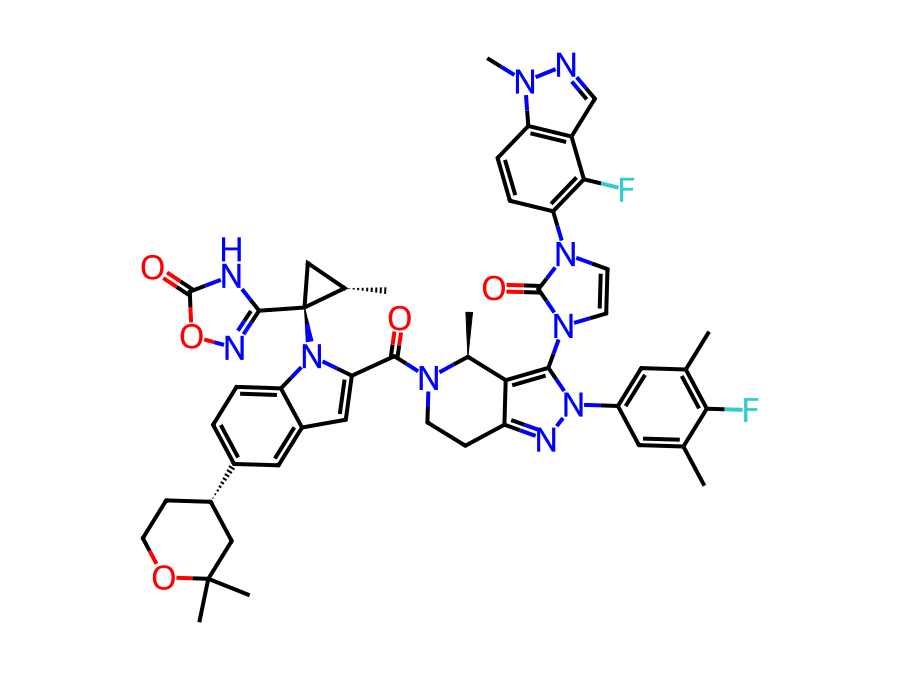
It is structurally nothing like them. Semaglutide is a modified peptide, a chain of amino acids. Orforglipron is a designed organic molecule with four defined stereocentres, developed from a compound originally coded OWL833 and licensed from another company.⁠1011 The difference in construction is what allows the drug to be a tablet.

Compound data

ClassNon-peptide small molecule; GLP-1 receptor agonist⁠10
FormulaC48H48F2N10O5, 883.0⁠11
InChIKeyUSUWIEBBBWHKNI-KHIFEHGGSA-N⁠11
StereochemistryFour stereocentres, all defined⁠11
CAS2212020-52-3⁠11
UNII7ZW40D021M⁠11
TargetHuman GLP-1 receptor, Ki about 1 nM⁠11
SignallingPartial agonist, biased to G protein over arrestin⁠10
Oral bioavailability77% at a low dose, against about 1% for the oral peptide⁠34
Food restrictionNone3
Half-life29 to 49 hours⁠3
Protein binding99.9%⁠3
Cleared byCYP3A4; 87% in faeces, under 1% in urine⁠3
Rodent activityNone. Inactive at the rat and mouse receptor⁠610
The residueA primate-specific tryptophan at position 33⁠10
US approval1 Apr 2026, new molecular entity⁠1
US boxed warningThyroid C-cell tumours, from the class⁠6
EU statusPositive opinion 15 Oct 2026⁠7
Weight, 72 weeks, with diabetes−9.6% vs −2.5% placebo, n=1,613⁠5
Stopped for adverse events6.1 to 9.9% vs 4.1%⁠5
Liver screen, 11,220 people6 on drug, 6 on comparator⁠13
Post-approval requirement5 years of enhanced liver surveillance⁠1
WADA 2026Not prohibited, not named⁠9

Evidence

About ten percent at seventy-two weeks, below the injectables and above placebo.

The trial this page quotes in full is the one in people with type 2 diabetes, because it was read directly: 72 weeks, 136 sites in ten countries, 1,613 participants randomised across three doses and placebo, with 89.5% completing.⁠5

For researchers
Weight change at week 72, intention-to-treatResultDifference vs placebo
Lowest dose−5.1% (95% CI −6.0 to −4.2)⁠5−2.7%
Middle dose−7.0% (−7.8 to −6.2)⁠5−4.5%
Highest dose−9.6% (−10.5 to −8.7)⁠5−7.1%, p<0.0001
Placebo−2.5% (−3.0 to −1.9)⁠5
Stopped for adverse events6.1 to 9.9%vs 4.1% on placebo⁠5

Baseline in that trial was a weight of 101.4 kg and a body mass index of 35.6, so the participants had substantial obesity and diabetes. Every prespecified weight and cardiometabolic measure including glycated haemoglobin improved significantly.⁠5

The companion trial in people without diabetes reported a larger effect, about 11.2% against 2.1% on placebo at the same 72 weeks on the top dose. Those figures come from secondary research and from the product information rather than from the paper read in full, as noted in the gaps section.⁠3

A phase 3 trial in Japanese adults with obesity disease, ATTAIN-J, was published in The Lancet Diabetes & Endocrinology on 30 October 2026. It randomised 238 people to three doses or placebo for 72 weeks. Mean weight change was −5.9%, −8.7% and −7.9% on the three doses against −0.6% on placebo, and 45.6%, 60.8% and 58.8% lost at least 5% of body weight against 15.2% on placebo. Adverse events were mostly mild to moderate gastrointestinal symptoms.⁠14

Comparison with the injectables. This library’s tirzepatide page records the largest effect of any licensed medicine, and semaglutide the best outcome evidence. About ten to eleven percent is smaller than the effect reported for the best injectable. No head-to-head against injected semaglutide or tirzepatide in obesity has been run. A head-to-head against the oral peptide in type 2 diabetes exists and favoured orforglipron on blood sugar while showing more gastrointestinal events and discontinuations: that comparison is reported in the research behind this page and was not read in full here, so no figure from it appears on the page.⁠5

Two drugs of this kind were abandoned over liver signals. This one has pooled data on 11,220 people.

An oral small-molecule GLP-1 agonist is not a new idea, and the two previous serious attempts both stopped. One was discontinued in 2023 and the other in 2025, with liver findings among the stated reasons in each case.⁠12

For researchers

The question is whether the liver signals are specific to the molecule or shared by the class. The answer available is a pooled analysis across seven phase 3 trials and 11,220 participants. In that dataset, six participants on orforglipron and six on comparators met the laboratory screen for serious drug-induced liver injury, and the reported conclusion is that alternative causes accounted for all the orforglipron cases.⁠13

After approving it, the FDA asked for five years of enhanced liver pharmacovigilance and a liver-injury assessment from a further trial.⁠1 The MHRA’s own announcement says it “will keep the safety and effectiveness of orforglipron under close review”.⁠2

Two findings stand together. A balanced six-against-six across more than eleven thousand people is a substantial piece of evidence and the strongest answer any drug in this class has given to this question. A five-year surveillance requirement indicates that the regulator regards the question as not closed.⁠131

It is inactive in rats and mice, so the test behind its own boxed warning cannot be run.

A related problem, a test in a species that cannot show the hazard, is described on the thalidomide and TGN1412 pages.

For researchers

Orforglipron is pharmacologically inactive at the rat and mouse GLP-1 receptor. The reason is a single residue: the structural work describes an “interaction between LY3502970 and the primate-specific Trp33 of the ECD” that “informs species selective activity”.⁠10 To test it in animals at all, its developers had to use mice carrying a humanised receptor and a rat in which the receptor had been gene-edited to make it sensitive.⁠1011

The consequence is unusual. The whole GLP-1 class carries a warning about thyroid C-cell tumours, and that warning comes from rodent studies. The label states that the drug “is not pharmacologically active in rats or mice and did not produce tumors in rodents”, and that the human relevance of the class finding “has not been determined”. The two-year rat study and a transgenic mouse study were non-carcinogenic at exposures many times the human level.⁠63

The boxed warning is kept despite a negative rodent result. A clean rodent study in an animal whose receptor the drug cannot activate is not evidence of safety. It is the same logic as the TGN1412 page, with the sign reversed: there a clean primate study could not have shown the hazard, and here a clean rodent study cannot show the absence of one. The regulator kept a class warning rather than accepting a negative result from a test that could not have been positive.6

Mechanism

Seventy-seven percent against about one percent.

Peptides are digested in the gut, so getting a peptide into the bloodstream by mouth is difficult. The one product that does so uses an absorption enhancer and a strict administration routine. The two labels compare as follows:

For researchers
Orforglipron, a small moleculeOral semaglutide, a peptide
Absorbed77% of a low dose⁠3About 1%4
Food ruleNone. "At any time of day, without food or water restriction"⁠3Empty stomach after at least 8 hours fasting⁠4
VariabilityNo clinically relevant food effect⁠3"Highly variable and may be minimal (2-4% of patients will not have any exposure)"⁠4
Half-life29 to 49 hours⁠3About a week⁠4

The variability row. The oral peptide’s own label states that between two and four percent of patients get no exposure at all. A drug absorbed at 77% with no food effect gives a different exposure profile from one absorbed at 1% with a fasting rule, not because the receptor pharmacology is better but because what reaches the blood is predictable.⁠34

Enlicitide is an oral peptide of which roughly one percent is absorbed. Orforglipron addresses the same problem from the other direction, by not being a peptide.

A different binding pocket and a partial signal.

A small molecule cannot bind a receptor the way a 31-residue peptide does, and it does not try to. The structural work describes “a unique binding pocket in the upper helical bundle where the compound is bound by the extracellular domain (ECD), extracellular loop 2, and transmembrane helices 1, 2, 3, and 7”.⁠10

For researchers
Binds
A high-affinity, selective ligand of the human GLP-1 receptor, with an inhibition constant around 1 nanomolar and selectivity against the other class B receptors⁠1011
Partial, and biased
A partial agonist "biased toward G protein activation over beta-arrestin recruitment", with "low intrinsic efficacy for effector activation and negligible beta-arrestin recruitment"⁠1011
Low occupancy is enough
"Low GLP-1R occupancy by orforglipron is sufficient to yield a full biological response"⁠11
Appetite falls
In animals it "distributed to and activated neurons in brain regions that regulate appetite and decreased food intake"; the label attributes the human weight effect to decreased appetite, with greater fat than lean mass loss⁠3

⚠ The clinical consequence of the bias is not established. Biased agonism is often invoked to explain better tolerability. No source retrieved shows that this molecule’s arrestin bias produces any clinical difference, and its gastrointestinal event rates are recognisably those of the class. The bias is established pharmacology; the clinical consequence of it is not established.⁠1011

Regulatory status

Approved in the United States and the United Kingdom, positive opinion in the European Union.

JurisdictionStatus
United KingdomAuthorised by the MHRA on 10 August 2026, prescription only, for weight management and for type 2 diabetes⁠23
United StatesApproved 1 April 2026 as a new molecular entity, for weight reduction and maintenance in obesity, or overweight with a weight-related comorbidity. Boxed warning for thyroid C-cell tumours⁠16
European UnionCommittee positive opinion 15 October 2026; no Commission decision found as of 6 November 2026⁠7
Anti-dopingNot prohibited and not named in the 2026 list. Note it would have been caught by the non-approved-substances class before April 2026⁠9
For researchers

The indication in the MHRA product information is specific, and it is the reason this page can give no score for a general reader: weight management in adults with a body mass index of 30 or more, or 27 to under 30 with at least one weight-related comorbidity, as an adjunct to a reduced-calorie diet and increased physical activity.⁠3

Status by country

Where regulators list this compound, country by country. Each line names who listed it, the date it was read and the source. A country with no line has not been checked yet.

Europe 1 of 10 checked

CountryStatusDetail
United KingdomListed as authorised by the MHRA, as of 9 Nov 2026. Source: MHRA (GOV.UK) source dated 10 Aug 2026The Medicines and Healthcare products Regulatory Agency (MHRA) has today (10, August, 2026) authorised orforglipron (Foundayo)

Not yet checked. North America: Canada, Mexico, United States. South America: Argentina, Brazil. Europe: European Union (central authorisation), Belgium, France, Germany, Italy, Netherlands, Russia, Spain, Switzerland. Africa: Egypt, Nigeria, South Africa. Asia: China, India, Japan, South Korea, Thailand, United Arab Emirates. Oceania: Australia, New Zealand.

Sport (WADA) applies worldwide, not a country

WADA Prohibited List 2026Not yet checked

Information only, not legal advice. Not verified for any individual situation. Status changes; check the date and the source.

The same records as data: JSON and CSV, with a version and a change log.

Checked and missing

What this page does not carry, and why.

Signature score, not set

This page carries no Signature score. It lists what the studies found, how sure the findings are, and what is still missing.

What was not read, including one trial this page quotes.

The trial in people without diabetes was not read in full. Its headline figures, about 11.2% against 2.1% at 72 weeks and adverse-event discontinuation of 5.3 to 10.3% against 2.7%, come from the research behind this page and the product information rather than from the paper itself. The trial quoted in full on this page is the one in people with type 2 diabetes. The trial paper is the source for those figures.35

For researchers

The head-to-head against the oral peptide is described and not quoted. It exists, in type 2 diabetes, and the research behind this page reports that orforglipron won on blood sugar with more gastrointestinal events and discontinuations. No number from it appears on this page because the paper was not read here.⁠5

Two sets of errata were not read, on a further trial and on the earlier phase 2 in type 2 diabetes. No figure on this page comes from either of those reports.⁠13

The pooled liver analysis was read as a report rather than in full. The six-against-six figure and the statement about alternative causes are quoted as reported; the underlying case narratives were not examined.⁠13

Corporate and review-pathway claims are deliberately absent. Secondary reporting describes a priority-voucher pathway and an adjusted decision date; the regulator’s own record lists the review as standard, so neither claim is stated here. 18

Not checked in this pass: post-authorisation adverse-event databases, the body-composition paper behind the label’s fat-versus-lean statement, and whether a European Commission decision has issued since 6 November 2026. Recorded as unchecked rather than as clear.⁠7

Sources14

This page cites 14 sources, numbered to match the small numbers in the text above. Each one links to the paper or record. Where a source states its design, a tag says so (a human trial, an animal study, a cell study, a review); the tag names the design and is not a grade. Each source also links back to where it is cited above.

  1. 01
    US Food and Drug Administration. Approval of new drug application 220934, orforglipron, 1 April 2026, as a Type 1 new molecular entity, with the approval letter signed 1 April 2026 and the application received 20 January 2026; a labelling…no read date recorded
    Full text
    US Food and Drug Administration. Approval of new drug application 220934, orforglipron, 1 April 2026, as a Type 1 new molecular entity, with the approval letter signed 1 April 2026 and the application received 20 January 2026; a labelling supplement was approved 4 August 2026. Indication: to reduce excess body weight and maintain weight reduction long term in adults with obesity, or overweight with at least one weight-related comorbidity. Supports the United States approval date and indication, and the post-approval requirements referred to on this page, namely five years of enhanced liver pharmacovigilance and a drug-induced liver injury assessment from a further trial.
    Cited 6 times, back to the text123456
  2. 02
    Medicines and Healthcare products Regulatory Agency. Announcement of the authorisation of orforglipron (Foundayo), 10 August 2026. Quoted on this page: "As with all GLP-1 receptor agonists, this is a prescription-only medication"; "Whilst…no read date recorded
    Full text
    Medicines and Healthcare products Regulatory Agency. Announcement of the authorisation of orforglipron (Foundayo), 10 August 2026. Quoted on this page: "As with all GLP-1 receptor agonists, this is a prescription-only medication"; "Whilst this tablet is approved for use in the UK, it is not available currently via the NHS"; and that the agency "will keep the safety and effectiveness of orforglipron under close review". The release describes the agency as the first regulator in Europe to authorise it.
    Cited 2 times, back to the text12
  3. 03
    Electronic medicines compendium. Foundayo (orforglipron) tablets, summary of product characteristics, marketing authorisation holder Eli Lilly Nederland B.V., marketing authorisation PL 14895/0369, legal category prescription-only…read 6 Nov 2026
    Full text
    Electronic medicines compendium. Foundayo (orforglipron) tablets, summary of product characteristics, marketing authorisation holder Eli Lilly Nederland B.V., marketing authorisation PL 14895/0369, legal category prescription-only medicine, date of first authorisation 10 August 2026. Read on 6 November 2026. Supports: the United Kingdom indications, namely weight management in adults with a body mass index of 30 or more or 27 to under 30 with at least one weight-related comorbidity as an adjunct to a reduced-calorie diet and increased physical activity, and type 2 diabetes as an adjunct to diet and exercise; the mechanism statement that it "binds to and activates the human GLP-1 receptor"; that in animal studies it "distributed to and activated neurons in brain regions that regulate appetite and decreased food intake", that it "reduces body weight, with greater fat mass loss than lean mass loss" and "decreases food intake", an effect "likely mediated by decreased appetite"; the pharmacokinetics, namely a "geometric mean absolute bioavailability of orforglipron was 77% after a 1 mg oral capsule dose and decreased with increasing capsule dose", time to peak of 4 to 8 hours, an "elimination half-life of approximately 29 to 49 hours" with steady state in about a week and roughly 1.6-fold accumulation, no clinically relevant food effect, 99.9 per cent plasma protein binding, metabolism principally by CYP3A4 with 87 per cent of a dose recovered in faeces and under 1 per cent in urine; the dosing instruction to take it "once-daily at any time of day, without food or water restriction" and to swallow the tablet whole, with a 9 mg cap alongside strong CYP3A4 inhibitors, avoidance of strong inducers, and the gastric-emptying interaction affecting other oral medicines; the preclinical statement that the drug is not pharmacologically active in rats or mice with non-carcinogenic two-year rat and 26-week transgenic mouse studies at 24 to 49 times human exposure. The weight figures from the trial in participants without diabetes, about 11.2 per cent against 2.1 per cent at 72 weeks, are taken from the product information and the research behind this page rather than from that trial read in full.
    Cited 17 times, back to the text12345678and 9 more
  4. 04
    Electronic medicines compendium. Oral semaglutide, summary of product characteristics, read on 6 November 2026 for the comparison drawn on this page. Quoted: "estimated bioavailability of semaglutide is approximately 1% following oral…read 6 Nov 2026
    Full text
    Electronic medicines compendium. Oral semaglutide, summary of product characteristics, read on 6 November 2026 for the comparison drawn on this page. Quoted: "estimated bioavailability of semaglutide is approximately 1% following oral administration"; the administration requirement to take it on an "empty stomach after a recommended fasting period of at least 8 hours" with a "sip of water (up to half a glass ... 120 mL)" and to "wait at least 30 minutes before eating, drinking or taking other oral medicinal products"; a half-life of about one week; and the statement that absorption "is highly variable and may be minimal (2-4% of patients will not have any exposure)". The absorption enhancer that makes the peptide absorbable at all is salcaprozate sodium. This library has its own fuller page for semaglutide.
    Cited 6 times, back to the text123456
  5. 05
    Orforglipron, an oral small-molecule GLP-1 receptor agonist, for the treatment of obesity in people with type 2 diabetes (ATTAIN-2): a phase 3, double-blind, randomised, multicentre, placebo-controlled trial. The Lancet 2026. PMID 41275875.Human RCTPMID 41275875no read date recorded
    Full text
    Orforglipron, an oral small-molecule GLP-1 receptor agonist, for the treatment of obesity in people with type 2 diabetes (ATTAIN-2): a phase 3, double-blind, randomised, multicentre, placebo-controlled trial. The Lancet 2026. PMID 41275875. ClinicalTrials.gov NCT05872620. Correction check, both methods, 6 November 2026: no update relation in Crossref and no corrections in the Europe PMC record.
    Cited 12 times, back to the text12345678and 4 more
  6. 06
    US Food and Drug Administration. Orforglipron prescribing information, as approved April 2026. Supports: the boxed warning for risk of thyroid C-cell tumours; the statement that the drug "is not pharmacologically active in rats or mice and…no read date recorded
    Full text
    US Food and Drug Administration. Orforglipron prescribing information, as approved April 2026. Supports: the boxed warning for risk of thyroid C-cell tumours; the statement that the drug "is not pharmacologically active in rats or mice and did not produce tumors in rodents" and that the human relevance of the rodent class finding "has not been determined"; the absolute bioavailability figure of 77 per cent after a 0.8 mg dose; dosing with or without food; and the advice that females using oral contraceptives switch to a non-oral method or add a barrier method for 30 days after starting and after each dose escalation.
    Cited 5 times, back to the text12345
  7. 07
    European Medicines Agency. Committee for Medicinal Products for Human Use positive opinion of 15 October 2026, from the meeting of 12 to 15 October, for weight management and type 2 diabetes, applicant Eli Lilly Nederland B.V., procedure…no read date recorded
    Full text
    European Medicines Agency. Committee for Medicinal Products for Human Use positive opinion of 15 October 2026, from the meeting of 12 to 15 October, for weight management and type 2 diabetes, applicant Eli Lilly Nederland B.V., procedure EMEA/H/C/006632. The agency page records the opinion status as positive and notes that product information follows after the European Commission grants the marketing authorisation.
    Cited 3 times, back to the text123
  8. 08
    Eli Lilly and Company. Quarterly report on Form 10-Q for the period ended 30 September 2026. Cited for two corporate facts only: that the company has "submitted or launched orforglipron for the treatment of obesity and/or type 2 diabetes…no read date recorded
    Full text
    Eli Lilly and Company. Quarterly report on Form 10-Q for the period ended 30 September 2026. Cited for two corporate facts only: that the company has "submitted or launched orforglipron for the treatment of obesity and/or type 2 diabetes in all major markets", and that it holds worldwide development and commercialisation rights under a licence agreement with Chugai Pharmaceutical Co., Ltd., which is the origin of the molecule described on this page as having been coded OWL833. A private United Kingdom launch was reported in secondary sources attributed to a company spokesperson in late August 2026; no primary source for a launch date was found and this page does not state one.
    Back to the text1
  9. 09
    Anti-doping. The 2026 World Anti-Doping Code International Standard Prohibited List, as reproduced in full in the Austrian Federal Law Gazette BGBl. III Nr. 219/2025 of 30 December 2025, valid from 1 January 2026, read and searched on 6…read 6 Nov 2026
    Full text
    Anti-doping. The 2026 World Anti-Doping Code International Standard Prohibited List, as reproduced in full in the Austrian Federal Law Gazette BGBl. III Nr. 219/2025 of 30 December 2025, valid from 1 January 2026, read and searched on 6 November 2026 for glucagon, GLP, incretin, GIP and the names of the licensed GLP-1 medicines: NO HITS. Class S0 reaches only substances not currently approved by a governmental health authority for human therapeutic use, and orforglipron is now approved, so it is not caught; class S2 lists named peptide-hormone classes which do not include GLP-1 agonists, and class S4.4 names AMPK activators, PPAR-delta agonists, Rev-Erb agonists, insulins and their mimetics, meldonium and trimetazidine, none of which it is. So it is neither named nor caught. Secondary reporting describes markers for two injectable GLP-1 medicines as sitting on the monitoring programme rather than the prohibited list; the gazette text does not contain the monitoring programme, so that is not stated here as primary.
    Cited 2 times, back to the text12
  10. 10
    Discovery and characterisation of the molecule, in the Proceedings of the National Academy of Sciences, 2020, where it appears under the code OWL833. Quoted from the abstract: "LY3502970 is a partial agonist, biased toward G protein…no read date recorded
    Full text
    Discovery and characterisation of the molecule, in the Proceedings of the National Academy of Sciences, 2020, where it appears under the code OWL833. Quoted from the abstract: "LY3502970 is a partial agonist, biased toward G protein activation over beta-arrestin recruitment at the GLP-1R. Abstract only.
    Cited 11 times, back to the text12345678and 3 more
  11. 11
    Further pharmacological characterisation in Science Translational Medicine, 2024. Quoted from the abstract: "orforglipron is a high-affinity (inhibition constant (Ki) = 1 nM), selective ligand of the human GLP-1R", that it "has low…read 6 Nov 2026
    Full text
    Further pharmacological characterisation in Science Translational Medicine, 2024. Quoted from the abstract: "orforglipron is a high-affinity (inhibition constant (Ki) = 1 nM), selective ligand of the human GLP-1R", that it "has low intrinsic efficacy for effector activation and negligible beta-arrestin recruitment", and that "low GLP-1R occupancy by orforglipron is sufficient to yield a full biological response". The animal work required a rat in which "CRISPR-Cas9 gene editing was used to sensitize the rat GLP-1R (Glp1r S33W)", which is the second half of the species story. Identity data in the infobox are from PubChem compound record CID 137319706, read through the PUG-REST property endpoint on 6 November 2026 (molecular formula C48H48F2N10O5, molecular weight 883.0, InChIKey USUWIEBBBWHKNI-KHIFEHGGSA-N with a stereo-defined second block and four of four stereocentres defined), and from the US FDA Global Substance Registration System (CAS registry number 2212020-52-3, unique ingredient identifier 7ZW40D021M for the free form and VI5M9OZV2X for the calcium salt). The mass was reconciled independently from the formula, giving 882.97 against the registry’s 882.96, which agrees; the US product is the calcium salt and its strengths are quoted as free-base equivalents. The structure drawing on this page was generated locally from the stereo-defined isomeric SMILES and its formula asserted against C48H48F2N10O5 before it was written. Abstract only for the pharmacology.
    Cited 12 times, back to the text12345678and 4 more
  12. 12
    The class liver history. Two other oral small-molecule GLP-1 receptor agonist programmes were discontinued, one in 2023 and one in 2025, with liver findings among the stated reasons in each case.no read date recordedBack to the text1
  13. 13
    Pooled hepatic safety analysis across the phase 3 programme, as reported for this build: among 11,220 participants across seven phase 3 trials, six on orforglipron and six on comparators met the aminotransferase and bilirubin screening…no read date recorded
    Full text
    Pooled hepatic safety analysis across the phase 3 programme, as reported for this build: among 11,220 participants across seven phase 3 trials, six on orforglipron and six on comparators met the aminotransferase and bilirubin screening criteria for serious drug-induced liver injury, and alternative causes accounted for all of the orforglipron cases. This figure should be read together with reference 1, the five-year enhanced liver pharmacovigilance requirement imposed after approval, which is why this page presents both halves.
    Cited 5 times, back to the text12345
  14. 14
    Yokote K et al. Efficacy and safety of oral orforglipron in Japanese participants with obesity disease (ATTAIN-J): a double-blind, randomised, placebo-controlled, parallel-group, phase 3 trial. The Lancet Diabetes & Endocrinology 2026, online 30 October.Human RCTPMID 42962687DOI 10.1016/S2213-8587(26)00232-9read 10 Nov 2026
    Full text
    Yokote K et al. Efficacy and safety of oral orforglipron in Japanese participants with obesity disease (ATTAIN-J): a double-blind, randomised, placebo-controlled, parallel-group, phase 3 trial. The Lancet Diabetes & Endocrinology 2026, online 30 October. DOI 10.1016/S2213-8587(26)00232-9. PMID 42962687. ClinicalTrials.gov NCT05931380. Abstract read on PubMed, 10 Nov 2026: 238 adults randomised to orforglipron 6, 12 or 36 mg or placebo for 72 weeks; mean change in body weight −5.9%, −8.7% and −7.9% against −0.6% (treatment regimen estimand); at least 5% weight reduction in 45.6%, 60.8% and 58.8% against 15.2%; adverse events mostly mild to moderate gastrointestinal. Funded by Eli Lilly. Abstract only.
    Back to the text1

Where it sits

Related pages

SemaglutideA peptide in the same class, whose oral version has about 1% absorption and a fasting rule
TirzepatideThe largest effect of any licensed medicine in this category
EnlicitideThe library’s other oral-peptide page, illustrating the delivery problem this drug avoids by not being a peptide
RetatrutideAn unapproved injectable with a larger reported weight effect
TGN1412A page on why a clean animal study can show nothing; relevant to the boxed warning that this drug's rodent studies did not support

Primary studies

Don’t take our word for it. Read the study.

Read first: 05, 14.