Coredex
Contents
Where to buyOverviewEvidenceMechanismStatusSourcesWhere it sitsStudies

Retatrutide

LY3437943, LY-3437943, triple agonist, "reta"

Retatrutide is an investigational agonist of the GLP-1, GIP and glucagon receptors, developed by Eli Lilly, with phase 3 results on the molecule itself reporting up to 28.3% mean weight loss at 80 weeks. All published trials have a single sponsor, and the compound is not authorised anywhere.

  • Triple hormone receptor agonist
  • Subcutaneous injection
  • Investigational (phase 3)

Where to buy, code BENTheDhust, ships to the United States

  1. Compounds
  2. Incretin and metabolic peptides
  3. Triple GIP/GLP-1/glucagon receptor agonists
  4. Retatrutide

13 sources 4 registered trials named in the sources last source read 10 Nov 2026 page reviewed 22 Nov 2026

Where to buy

TheDhust

  • US shipping
  • Affiliate link
Use codeenter it at checkout

Affiliate link. Coredex earns a commission if you buy through it. It does not change what you pay or what this page reports, and listing a vendor is not a recommendation. Each vendor’s own listing says what an item is sold as (a supplement, a medicine or research material); read it before you order. Read the full disclosure. Full vendor table.

Overview

In its favour

The evidence is about the molecule itself: 28.3% mean weight loss in a 2,339-patient phase 3

Recorded harm

Gastrointestinal effects are the main adverse effects and are dose-dependent

Not settled

It is not authorised anywhere yet, and there is no independent replication of the sponsor's trials

A synthetic peptide acting on three receptors.

Retatrutide is a synthetic peptide of 39 amino acids carrying a C20 fatty diacid chain on lysine 17. It activates three receptors at once: GLP-1, GIP and glucagon. Semaglutide acts on the first. Tirzepatide acts on the first two. Retatrutide adds the third.⁠1

For researchers

The fatty acid chain is the structural feature that explains the pharmacology. It binds the peptide to albumin in the blood, which slows clearance by the kidneys. The modification gives a half-life of days rather than hours.⁠2

It is developed by Eli Lilly and is not approved anywhere. It is in Phase 3.

Compound data

YTyr
AibAib
QGln
GGly
TThr
FPhe
TThr
SSer
DAsp
YTyr
SSer
IIle
mLMeLeu
LLeu
DAsp
KLys
KLys
AAla
QGln
AibAib
AAla
FPhe
IIle
EGlu
YTyr
LLeu
LLeu
EGlu
GGly
GGly
PPro
SSer
SSer
GGly
AAla
PPro
PPro
PPro
SSer
NonpolarAcidicBasic Teal dashed = not a standard amino acid
Positions 2 and 20 are aminoisobutyric acid and 13 is alpha-methyl-leucine. None of the three is a coded amino acid, and they are there to stop DPP-4 and the ordinary peptidases cutting the chain. The highlighted lysine at 17 is where the entire C20 lipid arm attaches.⁠7
ClassTriple agonist: GLP-1, GIP and glucagon receptors⁠1
DeveloperEli Lilly
Code nameLY3437943
CAS2381089-83-2⁠7
UNIINOP2Y096GV⁠7
PubChemCID 171934787⁠7
ChEMBLCHEMBL5095485⁠8
FormulaC221H342N46O68⁠7
Mass4731.4 g/mol
InChIKeyMLOLQJNKXBNWFW-JMUPIODPSA-N
Length39 amino acids, C-terminal amide⁠1
ModificationC20 fatty diacid on Lys17, through a gamma-glutamate and an AEEA spacer. Binds albumin, which is what produces the long half-life⁠38
Receptor potencyGIP 8.9×, GLP-1 0.4×, glucagon 0.3×, against the body's own ligands⁠2
Half-lifeApprox. 6 days, estimates to 8⁠3
Time to peak12 to 72 hours⁠3
RouteSubcutaneous
AppearanceWhite lyophilised powder

Evidence at a glance

Trial stage reachedPhase 3, ongoing⁠4
Largest reported trial2,339 patients, 80 weeks⁠4
Best reported effect28.3% mean weight loss⁠4
Peer-reviewed publicationYes. Phase 2 in the NEJM1
Independent replicationNone. Single sponsor throughout
Approved anywhereNo

Related

SemaxA contrasting evidence position: the weakest checkable human evidence
ComparePut this next to the others on all five axes
MOTS-cAlso metabolic, and the opposite evidence position
BPC-157Where half-life and duration of effect disagree
CJC-1295Abandoned as a development candidate two decades ago
GHK-CuWhere the same formula arithmetic caught four disagreeing database records
PT-141Approved by a regulator, with modest trial results
SS-31What a negative trial looks like, twice, on the endpoints people care about
TesamorelinMoves visceral fat and not body weight, and the label says so
AdipotideA different fat-loss route
Cardarine (GW-501516)The PPAR-delta compound sold for fat loss on rodent data, with a carcinogenicity finding
DNP (2,4-Dinitrophenol)The opposite end of the Get lean shelf: a fat-loss effect from an industrial chemical with lethal toxicity
CagrilintideAn amylin analogue with a different mechanism, and one half of the CagriSema combination
ClenbuterolA stimulant used for the same goal, with a mild effect and a cardiac cost

Evidence

The published structure and how it was checked.

Searching PubChem for "retatrutide" returns a reference substance record, SID 528343961, which states that its compound entry is not available and might not be a discrete structure. Some peptide reference sites list retatrutide with no structure on file.⁠7

For researchers

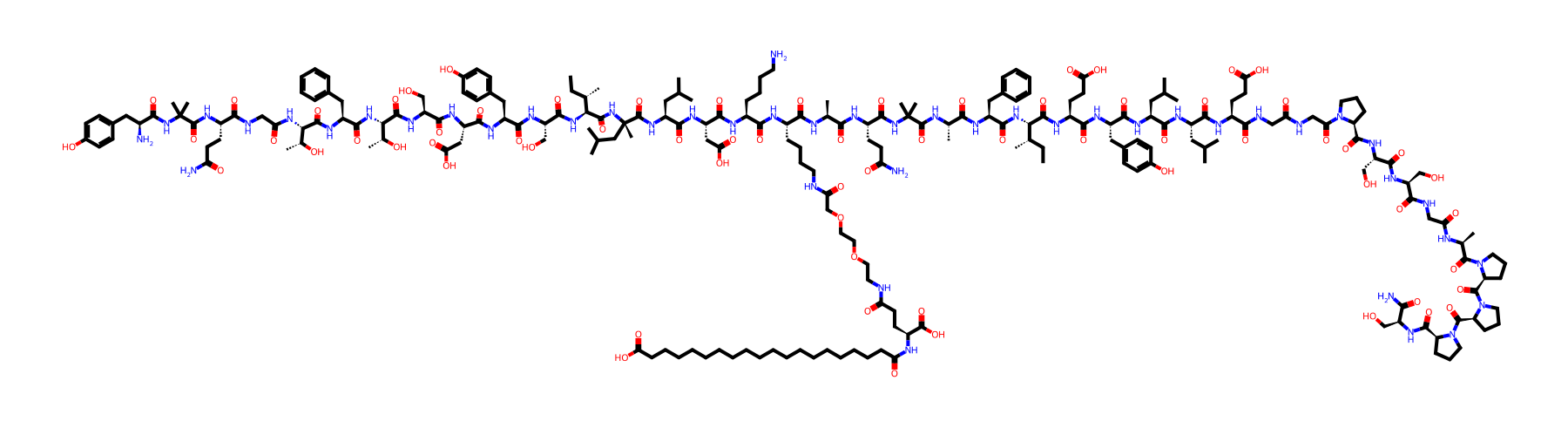
The structure is published but filed under a different record. PubChem holds it at CID 171934787, and the sequence sits in the ChEMBL entry that Eli Lilly's discovery paper points at.⁠78 Below is that structure, drawn from the published connection table rather than copied from anywhere.

Two-dimensional skeletal structure of retatrutide, showing the 39-residue backbone running left to right and the C20 fatty diacid arm descending from lysine 17
Retatrutide, C221H342N46O68, 4731.4 g/mol. Backbone runs N-terminus at left to the amidated serine at right. The long arm below the middle is the C20 diacid, attached to lysine 17 through a gamma-glutamate and an AEEA spacer. Drawn from the published structure, not traced.⁠78

How the structure was checked

Three sources were made to agree before the structure was drawn:⁠9

SequenceThe 39 residues, with aminoisobutyric acid at 2 and 20, alpha-methyl-leucine at 13, the lipid arm on lysine 17 and a C-terminal amide, taken from the ChEMBL record⁠8
RebuiltThat sequence rebuilt from residue masses, independently of any published formula, gives C221H342N46O68 at 4731.4 g/mol
MatchedPubChem's record returns the same formula, and parsing the published structure returns the same InChIKey, MLOLQJNKXBNWFW-JMUPIODPSA-N7

One circulating formula does not reconcile. Several commercial product pages give retatrutide as C228H350N48O66 at 4894.6 g/mol, and describe the lipid as a C18 chain attached at position 30. The formula does not reconcile with any 39-residue sequence, the chain is C20, and position 30 is a glycine. A mass of 4894 therefore comes from those product pages rather than from the molecule.

Trials of the molecule itself.

LabAnimalHuman, controlledPhase 3 completeApproved

Evidence found: lab; animal; human, controlled.

For many compounds in this library the human evidence does not quite apply. MOTS-c borrows a trial of a different molecule. Tesamorelin is approved for a different population. CJC-1295 was abandoned two decades ago. Retatrutide is the exception: the human trials studied the molecule itself.

For researchers
Phase 2338 adults, 48 weeks, published in the New England Journal of Medicine. Four dose arms against placebo. 24.2% mean weight reduction in the highest dose arm1
Phase 3, TRIUMPH-12,339 patients, 28.3% mean weight loss at 80 weeks, reported May 2026⁠4. Published in the New England Journal of Medicine on 5 November 2026: the treatment-regimen estimand gave −23.7% and −25.0% in the two dose arms against −3.9% on placebo⁠10
Phase 3, TRIUMPH-21,152 adults with type 2 diabetes, 80 weeks, published in The Lancet on 10 October 2026: −16.8% and −18.8% in the two dose arms against −5.1% on placebo⁠11
Phase 3, TRIUMPH-428.7% at 68 weeks, reported December 2025⁠4
Knee osteoarthritis and sleep apnoeaTwo New England Journal of Medicine papers report phase 3 results: knee osteoarthritis pain in TRIUMPH-4 and TRIUMPH-1-OA (445 and 574 participants)⁠12, and obstructive sleep apnoea in TRIUMPH-1-OSA and TRIUMPH-2-OSA (243 and 448 participants)⁠13. Each reported a larger fall in its primary measure than placebo, and gastrointestinal events were the most common adverse events
Other programmesA Phase 2a randomised trial in metabolic dysfunction-associated steatotic liver disease⁠5, and the TRANSCEND programme in type 2 diabetes⁠6
IndependenceSingle sponsor. Every trial above is Lilly's. That is the one real weakness in the evidence base

24.2% at 48 weeks is higher than any figure published for a licensed medicine in this class.

Basis for the Evidence score of 4. A 5 in this library requires approval, and retatrutide does not have it. There is no regulatory dossier, no independent replication outside the sponsor, and no long-term safety record. The effect size scores 5 and the evidence scores 4.

For comparison, see AOD-9604. It is the last growth-hormone-derived fat-loss compound to get a proper confirmatory trial: 502 people, 24 weeks, powered for 1.8 kg, and it did not find it. The sponsor terminated the programme a month later.
Adverse effects

Effects are dose-dependent. Figures below are from the Phase 2 trial in the highest dose arm.

For researchers
Nausea47% in the highest dose arm. Mostly mild to moderate, concentrated in escalation⁠1
Vomiting21% in the highest dose arm⁠1
Heart rateDose-dependent increase, peaking at 24 weeks, declining thereafter⁠1
Skin sensitivityIncreased skin sensitivity in about 7% against 1% on placebo.⁠1
Serious events0% to 6% across retatrutide groups, against 4% on placebo⁠1

Limitations of the evidence

  • Every trial has one sponsor. No independent replication exists.
  • No approval anywhere, so no regulator has audited the dossier.
  • No long-term safety data. The longest reported follow-up is 104 weeks, in a 532-person extension of TRIUMPH-1 (company-reported, not peer-reviewed). The peer-reviewed TRIUMPH-1 paper covers 80 weeks.
  • Cardiovascular outcome data is still reporting.
  • None of it describes unlicensed material from outside the licensed supply chain.

What we looked for and did not find

A structure under the obvious name. Searching PubChem for retatrutide, LY3437943, LY-3437943 and CAS 2381089-83-2 through the compound endpoint returns no CID for any of them. What comes back is a Reference Collection substance entry, SID 528343961, stating that its compound entry is "not available and might not be a discrete structure".⁠7

For researchers

The structure exists anyway. It is filed at CID 171934787, reachable through the ChEMBL record rather than by name.⁠78 The structure was initially missed for this reason: a name search returning nothing is a failed search, not an absent molecule.

Independent replication. Every trial on this page has one sponsor. Searches for retatrutide trials run by any group other than Eli Lilly return nothing, which is the single largest gap in an otherwise strong evidence base.

Mechanism

Receptor potency is below the native hormone at two of the three receptors.

"Triple agonist" does not mean three times the strength. Measured against the body's own ligands at each receptor, retatrutide is less potent at two of the three.⁠2

For researchers
GIP 8.9×
Nearly nine times more potent than natural GIP. This is the receptor where the molecule is most potent, and the receptor tirzepatide added to GLP-1 agonism.⁠2
GLP-1 0.4×
Roughly 40% as potent as natural GLP-1. Appetite suppression, slowed gastric emptying, glucose-dependent insulin release. This is the familiar part of the class.⁠2
Glucagon 0.3×
About 30% as potent as natural glucagon. Activity here is restrained, because glucagon raises blood sugar as well as energy expenditure. Excess activity at this arm would offset the other two.2
Net effect
Appetite falls through GLP-1 and GIP while energy expenditure rises through glucagon. Most of the class only does the first half.⁠1

The glucagon arm

Every drug in this class reduces how much is eaten. Retatrutide also increases energy expenditure, through the glucagon receptor. That is the proposed mechanistic reason its trial numbers sit above those of tirzepatide and semaglutide.

Glucagon activity is also what limits the design. Glucagon opposes insulin. An agonist that pushed that arm hard would raise blood glucose and hand back the metabolic benefit the other two receptors deliver. The restraint at 0.3× is a design feature.

Half-life and time to peak.

Half-life is roughly six days, with estimates running to eight. Peak concentration arrives 12 to 72 hours after administration. Those two figures are consistent with a long interval between administrations.⁠3

For researchers
Time to peak concentration12 to 72 h
Half-lifeapprox. 6 days
03 d7 d

For comparison, on BPC-157 the half-life and the duration of effect disagree so completely that no schedule can be derived from them, and on MOTS-c the pharmacokinetics of an injected dose have not been measured in a person. For retatrutide the pharmacokinetic figures come from the development programme.

Timing of adverse events

Adverse events in the Phase 2 trial clustered almost entirely in the dose-escalation period.⁠1

Regulatory status

Status by country

Where regulators list this compound, country by country. A country with no line has not been checked yet.

No country or sport list has been checked yet

Not yet checked. North America: Canada, Mexico, United States. South America: Argentina, Brazil. Europe: European Union (central authorisation), Belgium, France, Germany, Italy, Netherlands, Russia, Spain, Switzerland, United Kingdom. Africa: Egypt, Nigeria, South Africa. Asia: China, India, Japan, South Korea, Thailand, United Arab Emirates. Oceania: Australia, New Zealand.

Sport (WADA) applies worldwide, not a country

WADA Prohibited List 2026Not yet checked

Information only, not legal advice. Not verified for any individual situation. Status changes; check the date and the source.

The same records as data: JSON and CSV, with a version and a change log.

Sources13

This page cites 13 sources, numbered to match the small numbers in the text above. Each one links to the paper or record. Where a source states its design, a tag says so (a human trial, an animal study, a cell study, a review); the tag names the design and is not a grade. Each source also links back to where it is cited above.

  1. 01
    Jastreboff AM, Kaplan LM, Frías JP, et al. Triple-hormone-receptor agonist retatrutide for obesity, a phase 2 trial. N Engl J Med 2023;389:514-526.nejm.orgno read date recorded
    Full text
    Jastreboff AM, Kaplan LM, Frías JP, et al. Triple-hormone-receptor agonist retatrutide for obesity, a phase 2 trial. N Engl J Med 2023;389:514-526. Source for the 338-participant design, the 1, 4, 8 and 12 mg dose arms, the 12-week escalation, 24.2% weight reduction at 48 weeks, and the adverse event figures including nausea, vomiting, heart rate and cutaneous hyperesthesia.
    Cited 12 times, back to the text12345678and 4 more
  2. 02
    Eli Lilly, Medical Information. Mechanism of action of retatrutide. Source for the receptor potency ratios against endogenous ligands: 8.9× at GIP, 0.4× at GLP-1, 0.3× at glucagon.medical.lilly.comno read date recordedCited 6 times, back to the text123456
  3. 03
    Retatrutide, a game changer in obesity pharmacotherapy. Review. Source for the C20 fatty diacid and albumin binding, the approximately six-day half-life, and the 12 to 72 hour time to peak concentration.ncbi.nlm.nih.govno read date recordedCited 4 times, back to the text1234
  4. 04
    Eli Lilly TRIUMPH Phase 3 programme readouts. TRIUMPH-1, 2,339 patients, 28.3% mean weight loss at 80 weeks, reported May 2026. TRIUMPH-4, 28.7% at 68 weeks, reported December 2025. No regulatory approval in any jurisdiction as at 31 July 2026.no read date recordedCited 5 times, back to the text12345
  5. 05
  6. 06
    ClinicalTrials.gov NCT06354660, TRANSCEND-T2D-1, retatrutide in adults with type 2 diabetes.NCT06354660no read date recordedBack to the text1
  7. 07
    PubChem CID 171934787, C221H342N46O68, 4731.4 g/mol.pubchem.ncbi.nlm.nih.govno read date recorded
    Full text
    PubChem CID 171934787, C221H342N46O68, 4731.4 g/mol. Source for the formula, the mass and the InChIKey. The separate reference-substance record, SID 528343961, states that its compound entry is "not available and might not be a discrete structure", which is why a name search alone returns nothing. Source also for CAS 2381089-83-2 and UNII NOP2Y096GV. Checked 31 July 2026.
    Cited 11 times, back to the text12345678and 3 more
  8. 08
    ChEMBL CHEMBL5095485, retatrutide. Source for the 39-residue sequence, the aminoisobutyric acid substitutions at positions 2 and 20, the alpha-methyl-leucine at 13, the C-terminal serinamide, and the (AEEA)-(gamma-Glu)-(C20 diacid) arm on lysine 17.ebi.ac.ukno read date recordedCited 6 times, back to the text123456
  9. 09
    Independent reconstruction performed for this page, 31 July 2026. The sequence at reference 10 was rebuilt from standard residue masses without reference to any published formula, and the published structure was parsed independently. Both…no read date recorded
    Full text
    Independent reconstruction performed for this page, 31 July 2026. The sequence at reference 10 was rebuilt from standard residue masses without reference to any published formula, and the published structure was parsed independently. Both return C221H342N46O68 and 4731.4 g/mol, and the parsed structure returns InChIKey MLOLQJNKXBNWFW-JMUPIODPSA-N. Working retained in the vault.
    Back to the text1
  10. 10
    Jastreboff AM et al. Retatrutide, a Triple Hormone Receptor Agonist, for Treatment of Obesity (TRIUMPH-1). New England Journal of Medicine 2026;395(18):1781–1793.PMID 42814954DOI 10.1056/NEJMoa2604169read 10 Nov 2026
    Full text
    Jastreboff AM et al. Retatrutide, a Triple Hormone Receptor Agonist, for Treatment of Obesity (TRIUMPH-1). New England Journal of Medicine 2026;395(18):1781–1793. DOI 10.1056/NEJMoa2604169. PMID 42814954. ClinicalTrials.gov NCT05929066. Abstract read on PubMed, 10 Nov 2026: 2,339 adults with obesity without diabetes randomised to retatrutide 4, 9 or 12 mg or placebo for 80 weeks; mean change in body weight −17.6%, −23.7% and −25.0% against −3.9% (treatment-regimen estimand, intention to treat). Funded by Eli Lilly. Abstract only.
    Back to the text1
  11. 11
    Bellido V et al. Retatrutide in adults with obesity and type 2 diabetes (TRIUMPH-2). The Lancet 2026;408(10563):1455–1472.PMID 42810372DOI 10.1016/S0140-6736(26)01861-1read 10 Nov 2026
    Full text
    Bellido V et al. Retatrutide in adults with obesity and type 2 diabetes (TRIUMPH-2). The Lancet 2026;408(10563):1455–1472. DOI 10.1016/S0140-6736(26)01861-1. PMID 42810372. ClinicalTrials.gov NCT05929079. Abstract read on PubMed, 10 Nov 2026: 1,152 adults with obesity and type 2 diabetes randomised to retatrutide 4, 9 or 12 mg or placebo; at week 80 the treatment-regimen estimand gave −11.9%, −16.8% and −18.8% against −5.1%. Funded by Eli Lilly. Abstract only.
    Back to the text1
  12. 12
    Schnitzer TJ et al. Retatrutide Once Weekly in Adults with Knee Osteoarthritis Pain and Obesity (TRIUMPH-4 and TRIUMPH-1-OA). New England Journal of Medicine 2026, online 8 November.PMID 43001755DOI 10.1056/NEJMoa2610676read 10 Nov 2026
    Full text
    Schnitzer TJ et al. Retatrutide Once Weekly in Adults with Knee Osteoarthritis Pain and Obesity (TRIUMPH-4 and TRIUMPH-1-OA). New England Journal of Medicine 2026, online 8 November. DOI 10.1056/NEJMoa2610676. PMID 43001755. ClinicalTrials.gov NCT05931367 and NCT05929066. Abstract read on PubMed, 10 Nov 2026: 445 participants in TRIUMPH-4 (68 weeks) and 574 in TRIUMPH-1-OA (80 weeks); significantly greater reductions in WOMAC pain score and body weight than placebo; serious adverse events more common with retatrutide, most common adverse events gastrointestinal. Funded by Eli Lilly. Abstract only.
    Back to the text1
  13. 13
    Grunstein RR et al. Retatrutide Once Weekly for Treatment of Obstructive Sleep Apnea (TRIUMPH-1-OSA and TRIUMPH-2-OSA). New England Journal of Medicine 2026, online 21 October.PMID 42904878DOI 10.1056/NEJMoa2611477read 10 Nov 2026
    Full text
    Grunstein RR et al. Retatrutide Once Weekly for Treatment of Obstructive Sleep Apnea (TRIUMPH-1-OSA and TRIUMPH-2-OSA). New England Journal of Medicine 2026, online 21 October. DOI 10.1056/NEJMoa2611477. PMID 42904878. Abstract read on PubMed, 10 Nov 2026: 243 and 448 participants with moderate-to-severe obstructive sleep apnoea and a body-mass index of at least 27, without and with type 2 diabetes; significantly greater decreases in the apnoea-hypopnoea index than placebo at 80 weeks; most common adverse events gastrointestinal. Funded by Eli Lilly. Abstract only.
    Back to the text1

Where it sits

Primary studies

Don’t take our word for it. Read the study.

Read first: 05, 01, 10.

Where this compound is sold

Affiliate links. Coredex earns a commission if a reader buys through the links in this table. The commission has no influence on what the page above reports. The publisher also has a partner relationship with TheDhust. Read the full disclosure.

One vendor, TheDhust, is listed.

VendorProduct and sizePublic lab report
TheDhustTHED-RT, 5 mg, 10 mg, 20 mg, 30 mgNot published