Coredex
Contents
OverviewEvidenceMechanismStatusCheckedSourcesWhere it sitsStudies

Adipotide

FTPP, Prohibitin-TP01, CKGGRAKDC-GG-D(KLAKLAK)2

Adipotide is a chimeric peptide designed to bind prohibitin on the blood vessels of white fat and trigger apoptosis in them. In obese monkeys the animals lost up to 14.7% of body weight in four weeks, three primate species developed kidney tubule changes at the effective exposure, and the one human trial enrolled four of a planned fifteen patients and published nothing.

  • Peptide, 25 residues
  • Two-part chimeric design
  • Phase I terminated
  1. Compounds
  2. Other investigational and specialist drugs
  3. Pro-apoptotic targeting peptides
  4. Adipotide

13 sources 1 registered trial named in the sources last source read 16 Aug 2026 page reviewed 22 Nov 2026

Overview

Three findings shape this page. Organ toxicity at the effective dose, a total absence of human safety data, and what is actually in the vials. They are set out in the Signature.
In its favour

Two animal papers of good quality, and in obese monkeys it produced weight loss

Recorded harm

Kidney injury at the doses that worked, in three primate species, and it is structural rather than incidental

Not settled

No human results have been published, so every effect size on the page comes from animals

Two peptides joined by a linker.

Most fat-loss compounds act on appetite or metabolism. Adipotide does neither by design. It is a chimera, built from two peptides that had already been characterised separately, joined by a two-glycine hinge.

For researchers
CKGGRAKDC
The homing half. Found by screening a random peptide library in live mice, and it binds prohibitin on the blood vessels of white fat⁠2
GG
A two-glycine linker. Flexible, so the two halves do not interfere with each other
D(KLAKLAK)2
The killing half. A 14-residue sequence designed in 1999 to be "nontoxic outside cells, but toxic when internalized into targeted cells by the disruption of mitochondrial membranes"3
Result
The homing half delivers the killing half into the vessel wall. The vessels die, and the fat they were feeding dies with them1

⭐ The design is deliberate. Every part of the molecule was designed, and the design does what it was designed to do. The rest of this page concerns what happened next.

Compound data

ClassChimeric peptidomimetic, vascular-targeted pro-apoptotic1
SequenceCKGGRAKDC-GG-D(KLAKLAK)21
Residues25, one disulfide, 14 of them D-form⁠1
FormulaC111H204N36O28S29
Mass2555.219
CASNone found
Registry recordNone. FDA substance registry returns zero⁠9
TargetProhibitin, on white adipose vasculature⁠2
OriginIn vivo phage display, mice, 2004⁠2
Net chargeAbout +8, nine basic residues against one acidic⁠9
Route in studiesSubcutaneous, daily⁠1
Target organ of toxicityKidney, proximal tubule⁠1
Human results publishedNone

Evidence at a glance

ApprovedNo, nowhere, ever
Highest phase reachedPhase I, terminated⁠6
Humans dosed4, results never posted⁠5
Primate efficacyYes, 3 species⁠1
Body fat reduction38.7% vs 14.8% control⁠1
Effect in lean animalsNone, which supports the mechanism⁠1
Mechanism challenged in printYes, 2012, unresolved⁠4
Papers in the literature7, none with it in the title⁠13
RetractionsNone found13

Regulatory status

AuthorisationBy country, with sources
ScheduledNo
Regulator actionNone found naming adipotide⁠9
SportProhibited at all times. Not named, but WADA S0 covers any substance with no approval for human therapeutic use and names "drugs under pre-clinical or clinical development or discontinued"12
AgeNothing in this library is intended for anyone under 18

Related

RetatrutideFat-loss compound with completed trials
ZiconotideAnother compound with a defined mechanism and no approval for this use
AP503Another preclinical-only entry
TB-500Another compound where product composition differs from the studied material
ComparePut it beside the fat-loss compounds on the same five axes
ACE-031Another compound where the concern is the product rather than the pharmacology
Cardarine (GW-501516)The other Get lean entry with an affirmative toxicology finding
DNP (2,4-Dinitrophenol)The lethal extreme of the Get lean shelf

No registry holds this molecule, and a commercial catalogue formula differs from the published structure.

The ziconotide page notes how clean its identifiers are, because a regulator holds a dossier on it. Adipotide is at the other end of that scale.

For researchers
  • No CAS number could be found from any source.
  • The FDA substance registry returns zero records for it.⁠9
  • No molecular formula or mass appears in either founding paper, or in any registry.⁠19
  • No paper anywhere carries "adipotide" in its title.13

The molecule was rebuilt from its published sequence, in both of its plausible forms.

FormFormulaAverage mass
Disulfide-closed
the paper's cyclic motif
C111H204N36O28S22555.21
Open chain, no disulfideC111H206N36O28S22557.23
Open chain, plus one acetateC113H210N36O30S22617.28
Comparison with a commercial catalogue formula

A commercial chemical catalogue lists the product as C113H210N36O30S2, molecular weight 2617.23.⁠10

That is the bottom row of the table, to within 0.05 daltons. It is the open-chain peptide as an acetate salt. The paper's molecule is closed: the founding paper calls CKGGRAKDC "a cyclic motif", and the ring is what gives the homing half its shape.⁠1

Two hydrogen atoms is the entire difference between a disulfide bridge and no disulfide bridge. The published formula has both of them.

⚠️ Limits of this comparison. A catalogue entry is not an assay, and the discrepancy may be data-entry error. It is, however, the chemical description published for the product, and it describes an open-chain peptide. The same listing writes the sequence without a stereodescriptor, so it cannot convey the D-configuration either.⁠10

Both design features that make adipotide work, the ring and the D-configuration, are absent from the catalogue description.

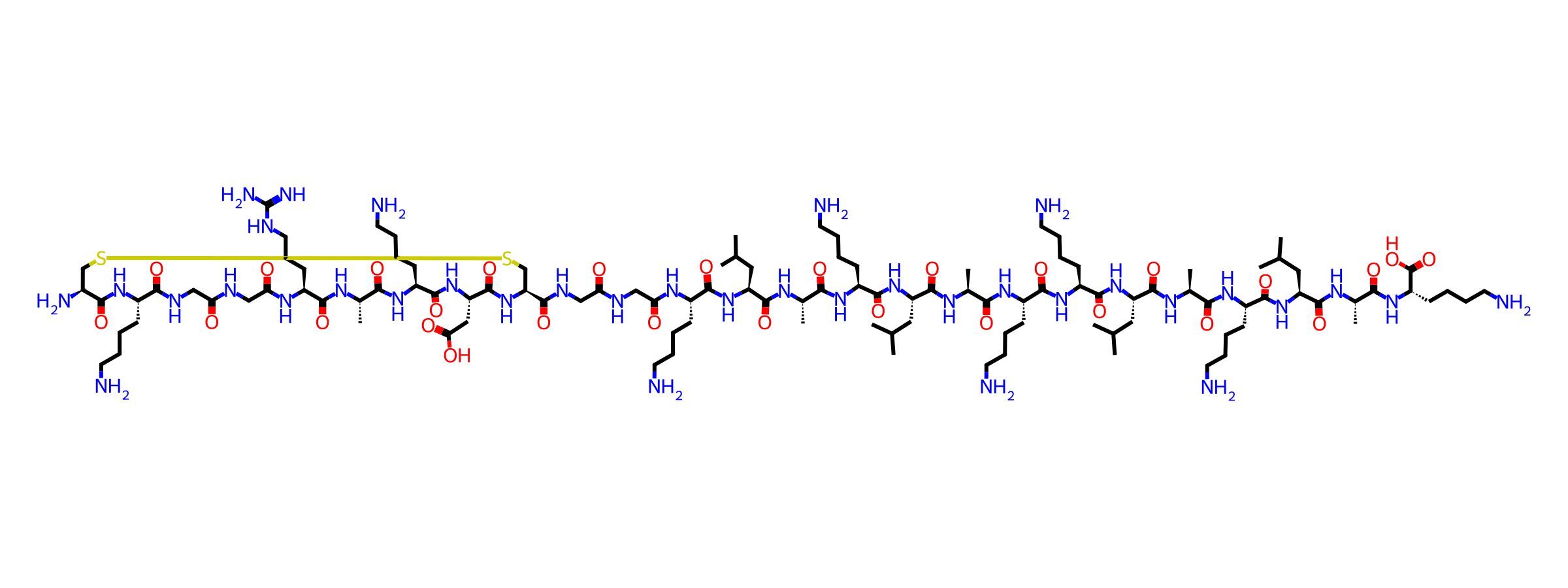
Two-dimensional skeletal structure of adipotide, showing the cyclic nine-residue homing loop closed by a disulfide bridge at the left, a two-glycine linker, and the fourteen-residue KLAKLAK repeat extending to the right
Adipotide as the paper describes it, C111H204N36O28S2, 2555.21 g/mol. The ring at the left is the homing half, closed by the disulfide drawn in yellow. The long chain running right is the pro-apoptotic half. The two-glycine hinge sits between them. Drawn from the verified structure, not retrieved.⁠9

Nine of the 25 residues carry a positive charge, four lysines and one arginine in the homing loop and eight lysines in the tail, against a single aspartate.⁠9 That is a strongly cationic peptide, which is what lets the killing half sit on and disrupt a mitochondrial membrane once it is inside a cell.

Evidence

Two animal papers, then no further primary work.

LabAnimalHuman, anyControlled efficacyApproved

Evidence found: lab; animal.

⚠️ The third rung is deliberately unlit even though four humans were dosed. A trial that enrols people and publishes nothing produces no evidence. It produces a gap. See The trial.

For researchers
What was shownWhereIn what
CKGGRAKDC homes to white fat vasculature; prohibitin identified as its binding partner; targeted apoptosis ablated white fat and reversed obesityNature Medicine, 2004⁠2Mice
Weight loss ranging from −7.4% to −14.7% over four weeks of daily dosingSci Transl Med, 2011⁠1Obese rhesus macaques
Total body fat down 38.7% in treated animals against 14.8% in controlsSame paper⁠1Rhesus, n=15
Insulin AUC down 36.2%; insulinogenic index down 48.5%Same paper⁠1Rhesus
Lean monkeys given a therapeutic dose did not lose weightSame paper⁠1Rhesus
Human efficacy or safety results of any kindNone publishedNobody

⭐ The lean-monkey result is consistent with a targeted mechanism: a drug that only removes fat from animals that have fat to lose behaves as a targeted therapy would, and an appetite suppressant would not.

The primate work was substantial. Three species of Old World monkey, rhesus macaques, baboons and cynomolgus monkeys were studied, with the efficacy cohort being 15 obese rhesus, 10 treated and 5 controls, treated daily for four weeks after a dose-finding phase.⁠1 It is far more extensive than the rodent-only evidence behind most of this library.

And then the literature simply stops

Seven records mention adipotide in the indexed biomedical literature. Zero carry it in the title.13 Two of the seven are automatic-indexing false positives. The founding primate paper has been cited 77 times by one count and 94 by another, which is respectable attention for a target paper and nowhere near the volume a working anti-obesity drug would have generated in fifteen years.⁠1

The work that has continued is on successor molecules, not on this one. The most recent is a 2025 paper on a redesigned mixed-chirality peptide built around improved stability.⁠13

Authorship concentration, and one thing checked and cleared

The literature is dominated by a single laboratory. Arap, Pasqualini and Kolonin appear on the 2004 mouse paper, the 1999 pro-apoptotic peptide paper, the 2011 primate paper and the successor work.⁠13 With seven papers in total, it is a research programme more than a field.

⭐ A retraction check was run on that group and came back clean. No retraction and no misconduct finding was located for any of these authors or any of the adipotide papers.⁠13 The scientific dispute in this programme's history is a published exchange of letters, not a retraction.

The monkeys ate less, and the paper says so.

The mechanism is vascular. The claim is that fat disappears because its blood supply is destroyed. If the animals simply ate less, the entire mechanistic story is unnecessary.

For researchers
The paper's own words

"the number of monkey chow biscuits consumed by treated monkeys decreased in an inversely proportional manner with the dose of adipotide administered"1

"we observed that weight loss in obese rhesus monkeys occurred concurrently with a reduction in food intake"1

The authors address it directly and argue the pattern points to satiety rather than nausea, because the animals kept eating their enrichment foods and cut back only on biscuits. They also concede that "the possibility of mild nausea as a contributor to overall weight loss cannot be completely ruled out".⁠1

In April 2012 a formal Comment was published in the same journal, arguing that the results may reflect a direct effect on food consumption rather than apoptosis of the adipose vasculature. The authors published a Response. Both remain in the literature and neither paper has been retracted or corrected.4

⚠️ This page does not adjudicate that. The lean-monkey result is evidence for the targeted mechanism, and a dose-proportional fall in food intake is evidence for the simpler explanation. The central mechanistic claim was challenged in print fourteen years ago and has not been settled, because the experiment that would settle it, in people, was not completed.

It happened at the doses that worked, not above them.

The abstract's sentence is precise and it is usually quoted carelessly:

For researchers
Verbatim, from the abstract

"At experimentally determined optimal doses, monkeys from three different species displayed predictable and reversible changes in renal proximal tubule function."1

🚨 At the optimal doses, not above them. The renal signal appeared at the exposure the researchers had determined was the right one.

The full text is more specific than the abstract, and less comfortable:

  • "Slight-to-moderate dose-dependent elevations in serum creatinine" were reported at higher exposures.⁠1
  • "mild-to-marked glucosuria, mild-to-moderate proteinuria", and increased renal epithelial cells in urine.⁠1
  • Kidney histology showed degenerative and necrotic changes, including single-cell necrosis, graded up to "minimal to moderate in the high-dose group".⁠1
  • Most serum and urine changes "were reversed within 28 days upon discontinuation".⁠1

The authors' own summary: "the primary side effect of adipotide is relatively mild, predictable, and reversible renal injury and altered tubular function."1

Reading the renal findings

"Reversible renal injury" is the researchers' reading of their own data, and the changes did resolve.

"Injury" is the word they chose, in an animal study, under controlled dosing, with veterinary monitoring, over 28 days. What happens in a person, at any exposure or duration, without monitoring, has not been established.

A human trial exists under a different name.

Most writing about adipotide says there was no human trial, because the trial does not use the word "adipotide". Searching the US trial registry for the name returns nothing.⁠5

For researchers
Registry record 
IdentifierNCT01262664
Compound named asProhibitin Targeting Peptide 1, not adipotide
Title"A First-in-Man, Phase I Evaluation of A Single Cycle of Prohibitin Targeting Peptide 1 in Patients With Metastatic Prostate Cancer and Obesity"
SponsorM.D. Anderson Cancer Center
Started24 May 2012
Primary completion2 January 2019
Planned enrolmentUp to 15, three at each of five dose levels⁠6
Actual enrolment4
StatusTerminated
Stated reason"Terminated per PI's request"
Results postedNone

All fields from the trial registry record.⁠5

What that record actually says

Six and a half years open, four patients enrolled out of fifteen, and nothing published. The development record independently confirms the ending: the programme was discontinued for obesity in January 2019, terminated "as per principal investigators request".⁠6

⚠️ No source states why. Not the registry, not the sponsor, not any paper. What is on the record is that the trial that would have answered the safety question was open for six and a half years and published nothing.

⭐ The trial was a dose-escalation study in men with metastatic prostate cancer who were also obese, with weight loss as a biological-activity endpoint.⁠5 That is a first-in-human oncology safety design, not an obesity trial, and a standard way to give a first dose of a compound with a known toxicity signal to people who have run out of other options.

No independent identity or purity dataset was found.

Independent testing, absent because none exists

No independent testing platform holds records for adipotide, and no third-party purity or identity dataset for this compound could be found.⁠11

For researchers
Why identity is harder to confirm for this molecule

For a simple linear peptide, identity and purity are one question that a mass spectrometer answers. Adipotide is not a simple linear peptide. Confirming it requires three things at once:

  • The sequence, 25 residues in the correct order.
  • The disulfide, closed, forming the ring that the homing half needs to have a shape.
  • The stereochemistry, with fourteen residues in the D configuration and eleven in the L.

A mass check alone cannot distinguish an L-form impostor from the real thing, because mirror images weigh exactly the same. And the disulfide question is a two-hydrogen difference, which is precisely the discrepancy sitting in the catalogue data at the top of this page.

Summary: a molecule with a known organ toxicity, no human safety data, no independent testing, and a catalogue description that differs from the published structure. Each of those is survivable on its own. Together they are why the page reads as it does.

Mechanism

Prohibitin is the target and is widely distributed.

The 2004 mouse paper found the homing peptide by in vivo phage display, then worked out what it was binding. The answer was prohibitin, described in that paper as "a multifunctional membrane protein", and the authors established it as "a vascular marker of adipose tissue".⁠2

For researchers

They also reported that "prohibitin is also expressed in blood vessels of human white fat", which is the sentence the whole translational case rests on.⁠2

⚠️ What prohibitin is not

It is not an adipose-specific protein. Prohibitins are highly conserved and broadly distributed, found "in the nucleus, cytoplasm, and mitochondria" and across "prokaryotes and eukaryotes".⁠7

The targeting claim is not that prohibitin only exists in fat. It is that prohibitin is presented on the cell surface of white fat vasculature in a way it is not elsewhere. That is a much narrower claim, and it is the one doing all the work.

One tissue has been checked, and the answer was reassuring. The same laboratory later reported that this homing motif does not bind brown fat, and had to find a separate peptide to target it.⁠8 ⚠️ That is evidence the targeting is selective between fat depots. It is not a safety finding about brown fat, which was never dosed.

No published study was found that quantifies off-target apoptosis in the other tissues that express prohibitin.⁠9 That is not a claim that harm occurs there; it is a statement that it has not been examined.

The killing half predates adipotide by five years. (KLAKLAK)2 came out of a 1999 paper on targeted pro-apoptotic peptides for cancer, whose whole design principle was a sequence that is harmless in the bloodstream and lethal once it is taken inside a cell.⁠3

⭐ Why the D-amino acids matter, and why they are also the problem

The killing half is built from D-amino acids, the mirror images of those in human proteins. The reason is proteolytic resistance: enzymes that degrade ordinary peptides do not recognise them, so the molecule survives long enough to reach the target.⁠3

The founding primate paper names the consequence itself. It identifies renal D-amino acid oxidase as the only known mammalian enzyme that can use the D(KLAKLAK)2 moiety of adipotide as a substrate.⁠1

🚨 Implication. The one organ equipped to process the killing half is the kidney. The renal toxicity described below follows from the design decision that makes the molecule work.

Regulatory status

Status by country

Where regulators list this compound, country by country. A country with no line has not been checked yet.

No country or sport list has been checked yet

Not yet checked. North America: Canada, Mexico, United States. South America: Argentina, Brazil. Europe: European Union (central authorisation), Belgium, France, Germany, Italy, Netherlands, Russia, Spain, Switzerland, United Kingdom. Africa: Egypt, Nigeria, South Africa. Asia: China, India, Japan, South Korea, Thailand, United Arab Emirates. Oceania: Australia, New Zealand.

Sport (WADA) applies worldwide, not a country

WADA Prohibited List 2026Not yet checked

Information only, not legal advice. Not verified for any individual situation. Status changes; check the date and the source.

The same records as data: JSON and CSV, with a version and a change log.

Checked and missing

Three claims against the published record.

  • Smaller exposure does not avoid the renal signal. The renal signal appeared at the experimentally determined optimal doses in three species, and dose-dependent creatinine rises were reported at higher exposures in that work.⁠1
  • Fat loss independent of food intake is not shown. Weight loss in the primate study happened alongside a dose-proportional fall in food intake, and no study has separated the two.⁠14
  • A product label does not establish the molecule in the paper. There is no registry entry, no CAS number, no independent testing, and the catalogue chemical data describes an open-chain peptide.⁠91011

The findings that cut against the page are included.

  • The primate work is strong and nothing on this page is a criticism of it.⁠1
  • "Reversible renal injury" is the researchers' own characterisation, made on their own data, and this page quotes it in full rather than only the alarming half.⁠1
  • No human safety data exists in either direction. The absence of reported human harm is the absence of any report, not a clean record.⁠5
  • No reason for the trial's termination is on record, and the inference that it was a safety decision is not made here.⁠56
  • The catalogue formula discrepancy is a discrepancy in published data, not an assay result. It may be data-entry error.⁠10
  • The food-intake confound is unresolved in both directions, and the lean-monkey result cuts against it.⁠14
  • Seven papers in total, one laboratory. A retraction check on that group came back clean.⁠13
  • No published study quantifies off-target apoptosis in the other tissues that express prohibitin.⁠7

Sources13

This page cites 13 sources, numbered to match the small numbers in the text above. Each one links to the paper or record. Where a source states its design, a tag says so (a human trial, an animal study, a cell study, a review); the tag names the design and is not a grade. Each source also links back to where it is cited above.

  1. 01
    Barnhart KF, Christianson DR, Hanley PW et al., "A peptidomimetic targeting white fat causes weight loss and improved insulin resistance in obese monkeys", Science Translational Medicine, 2011;3(108):108ra112.AnimalPMID 22072637DOI 10.1126/scitranslmed.3002621read 16 Aug 2026
    Full text
    Barnhart KF, Christianson DR, Hanley PW et al., "A peptidomimetic targeting white fat causes weight loss and improved insulin resistance in obese monkeys", Science Translational Medicine, 2011;3(108):108ra112. PMID 22072637, DOI 10.1126/scitranslmed.3002621. The founding primate paper. Source for the sequence CKGGRAKDC-GG-(D)(KLAKLAK)2 and its description as a cyclic motif chemically fused to the D-enantiomer; three species of Old World monkey; the efficacy cohort of 15 obese rhesus macaques, 10 treated and 5 control, dosed daily for four weeks at a fixed 0.43 mg/kg; weight loss "ranged from −7.4 to −14.7%"; total body fat down 38.7% against 14.8% in controls; insulin AUC down 36.2% and insulinogenic index down 48.5%; "lean rhesus monkeys receiving a therapeutic dose of adipotide did not lose weight"; the abstract sentence "At experimentally determined optimal doses, monkeys from three different species displayed predictable and reversible changes in renal proximal tubule function"; the full-text renal findings, "Slight-to-moderate dose-dependent elevations in serum creatinine ... at doses greater than 0.25 mg/kg", "mild-to-marked glucosuria, mild-to-moderate proteinuria", histological single-cell necrosis graded "minimal to moderate in the high-dose group", and reversal of most changes "within 28 days upon discontinuation"; the authors' summary that "the primary side effect of adipotide is relatively mild, predictable, and reversible renal injury and altered tubular function"; the food-intake observations quoted in the Confound section; and the identification of renal D-amino acid oxidase as the only known mammalian enzyme that can use the D(KLAKLAK)2 moiety as a substrate. Citation count 77 by one index and 94 by another; both retrieved 16 August 2026 and both reported rather than picking one. ⚠️ Two contemporaneous press releases gave insulin figures of "about 50 percent" and "about 60 percent" that match neither each other nor the paper. This page uses the paper's own numbers.
    Cited 32 times, back to the text12345678and 24 more
  2. 02
    Kolonin MG, Saha PK, Chan L, Pasqualini R, Arap W, "Reversal of obesity by targeted ablation of adipose tissue", Nature Medicine, 2004;10(6):625-632.AnimalPMID 15133506DOI 10.1038/nm1048no read date recorded
    Full text
    Kolonin MG, Saha PK, Chan L, Pasqualini R, Arap W, "Reversal of obesity by targeted ablation of adipose tissue", Nature Medicine, 2004;10(6):625-632. PMID 15133506, DOI 10.1038/nm1048. The original mouse work. Source for isolation of CKGGRAKDC by in vivo phage display; prohibitin as its binding partner, described as "a multifunctional membrane protein" and established as "a vascular marker of adipose tissue"; ablation of white fat and reversal of obesity in mice; and "prohibitin is also expressed in blood vessels of human white fat". ⚠️ Note that this paper reports obesity reversal in mice "without detectable adverse effects", which the later primate work did not reproduce.
    Cited 6 times, back to the text123456
  3. 03
    Ellerby HM, Arap W, Ellerby LM et al., "Anti-cancer activity of targeted pro-apoptotic peptides", Nature Medicine, 1999;5(9):1032-1038.DOI 10.1038/12469no read date recorded
    Full text
    Ellerby HM, Arap W, Ellerby LM et al., "Anti-cancer activity of targeted pro-apoptotic peptides", Nature Medicine, 1999;5(9):1032-1038. DOI 10.1038/12469. The origin of the (KLAKLAK)2 warhead, five years before adipotide. Source for the two-domain design principle and for the pro-apoptotic domain being "nontoxic outside cells, but toxic when internalized into targeted cells by the disruption of mitochondrial membranes", and for D-amino acids being used for proteolytic resistance.
    Cited 3 times, back to the text123
  4. 04
    Criscione L, "Comment on 'A peptidomimetic targeting white fat causes weight loss and improved insulin resistance in obese monkeys'", Science Translational Medicine, 2012;4(131):131le2.AnimalPMID 22539771DOI 10.1126/scitranslmed.3003760no read date recorded
    Full text
    Criscione L, "Comment on 'A peptidomimetic targeting white fat causes weight loss and improved insulin resistance in obese monkeys'", Science Translational Medicine, 2012;4(131):131le2. PMID 22539771, DOI 10.1126/scitranslmed.3003760, published 25 April 2012. Argues the results may reflect a direct effect on food consumption rather than apoptosis of adipose vasculature. The authors published a Response, DOI 10.1126/scitranslmed.3004103. ⚠️ The full texts of both letters were behind publisher blocks and were not read directly; this page describes the Comment's core criticism from the abstract record and does not characterise the Response's content. 🚨 Neither paper has been retracted or corrected. This is a published scientific disagreement, not a misconduct finding, and this page states the difference deliberately.
    Cited 4 times, back to the text1234
  5. 05
    United States clinical trial registry record NCT01262664, retrieved via the registry API 16 August 2026.NCT01262664read 16 Aug 2026
    Full text
    United States clinical trial registry record NCT01262664, retrieved via the registry API 16 August 2026. Title: "A First-in-Man, Phase I Evaluation of A Single Cycle of Prohibitin Targeting Peptide 1 in Patients With Metastatic Prostate Cancer and Obesity". Sponsor M.D. Anderson Cancer Center. Start date 24 May 2012, primary completion 2 January 2019. Status TERMINATED, reason recorded verbatim as "Terminated per PI's request". Actual enrolment 4 participants. Results posted: none. ⭐ The word "adipotide" does not appear in the record. A registry search for "adipotide" returns an empty result set, which is why the trial is widely believed not to exist.
    Cited 6 times, back to the text123456
  6. 06
    Pharmaceutical development database record for adipotide / Prohibitin-TP01, retrieved 16 August 2026. Originator University of Texas M.D. Anderson Cancer Center; developer Ablaris Therapeutics. Highest phase reached: Phase I for obesity.…read 16 Aug 2026
    Full text
    Pharmaceutical development database record for adipotide / Prohibitin-TP01, retrieved 16 August 2026. Originator University of Texas M.D. Anderson Cancer Center; developer Ablaris Therapeutics. Highest phase reached: Phase I for obesity. Records "02 Jan 2019" as the termination of the phase I trial "as per principal investigators request" and "18 Jan 2019" as "Discontinued - Phase-I for Obesity in USA (SC)". Also the source for the planned enrolment of up to 15 participants across five dose levels, taken from the sponsor's own announcement rather than the registry, which now exposes only the actual figure.
    Cited 4 times, back to the text1234
  7. 07
    Zhou Y, Oyang L, Li J et al., "The function of prohibitins in mitochondria and the clinical potentials", Cancer Cell International, 2022;22:343.DOI 10.1186/s12935-022-02765-xno read date recorded
    Full text
    Zhou Y, Oyang L, Li J et al., "The function of prohibitins in mitochondria and the clinical potentials", Cancer Cell International, 2022;22:343. DOI 10.1186/s12935-022-02765-x. Source for prohibitins being "highly evolutionarily conserved proteins that widely distribute in prokaryotes and eukaryotes" and located "in the nucleus, cytoplasm, and mitochondria". Cited on this page to establish that prohibitin is not an adipose-specific protein, which narrows what the targeting claim can mean.
    Cited 2 times, back to the text12
  8. 08
    Azhdarinia A et al., "A peptide probe for targeted brown adipose tissue imaging", Nature Communications, 2013;4:2472.DOI 10.1038/ncomms3472no read date recorded
    Full text
    Azhdarinia A et al., "A peptide probe for targeted brown adipose tissue imaging", Nature Communications, 2013;4:2472. DOI 10.1038/ncomms3472. From the same research group. Reports a separate peptide, CPATAERPC, that "selectively binds to the vascular endothelium of brown adipose tissue, but not of intraperitoneal white adipose tissue", with CKGGRAKDC used as the white-fat comparison. ⚠️ Cited here only as evidence that the white-fat homing motif does not target brown fat. It is not evidence that adipotide is safe for brown fat, which was not tested.
    Back to the text1
  9. 09
    Identity, structure and registry verification performed for this page, 16 August 2026. The molecule was built from the published sequence CKGGRAKDC + GG + (KLAKLAK) 2 in both forms. Disulfide-closed: C111H204N36O28S2, average mass 2555.21…no read date recorded
    Full text
    Identity, structure and registry verification performed for this page, 16 August 2026. The molecule was built from the published sequence CKGGRAKDC + GG + (KLAKLAK)2 in both forms. Disulfide-closed: C111H204N36O28S2, average mass 2555.21, monoisotopic 2553.51. Open chain: C111H206N36O28S2, average mass 2557.23. Residue composition, the count of nine basic against one acidic side chain, and the resulting net charge of about +8 were derived from the sequence. The skeletal structure displayed was generated from the disulfide-closed form and checked at the size this page displays it. ⚠️ No molecular formula or mass is stated in either founding paper, no CAS number could be found from any source, and the FDA substance registry returns zero records for adipotide. Searches for regulator action naming adipotide returned nothing. Working and search terms retained in the vault.
    Cited 11 times, back to the text12345678and 3 more
  10. 10
    Chemical supplier catalogue listing for adipotide acetate, retrieved 16 August 2026, cited as a Tier 3 source and only to establish what sellers publish about the product. States molecular formula C113H210N36O30S2 and molecular weight…read 16 Aug 2026
    Full text
    Chemical supplier catalogue listing for adipotide acetate, retrieved 16 August 2026, cited as a Tier 3 source and only to establish what sellers publish about the product. States molecular formula C113H210N36O30S2 and molecular weight 2617.23, with the sequence written as CKGGRAKDCGGKLAKLAKKLAKLAK and no CAS number. 🚨 That formula and mass correspond to the open-chain peptide plus one acetate, computed at 2617.28 in reference 9, a difference of 0.05. The disulfide-closed form as an acetate would carry two fewer hydrogens. The listed sequence carries no stereodescriptors and so cannot express the D-configuration. Consumer-facing peptide retailers were also found offering the compound at around 77 US dollars for a 10 mg vial under a research-use-only disclaimer. No vendor is named on this page and none of this is a purchasing recommendation.
    Cited 4 times, back to the text1234
  11. 11
    Independent testing coverage check, 16 August 2026. The third-party peptide testing platforms this library draws on hold no results for adipotide. One publishes a tracked list of 76 peptides and adipotide is not among them. No…no read date recorded
    Full text
    Independent testing coverage check, 16 August 2026. The third-party peptide testing platforms this library draws on hold no results for adipotide. One publishes a tracked list of 76 peptides and adipotide is not among them. No independently published purity or identity dataset for this compound could be located from any source. The only purity claims in existence are vendor self-assertions. Search terms retained in the vault.
    Cited 2 times, back to the text12
  12. 12
    World Anti-Doping Agency, Prohibited List 2026, section S0, Non-Approved Substances, in effect from 1 January 2026, read 16 August 2026. Adipotide is not named anywhere in the document. S0 verbatim: "Any pharmacological substance which is…read 16 Aug 2026
    Full text
    World Anti-Doping Agency, Prohibited List 2026, section S0, Non-Approved Substances, in effect from 1 January 2026, read 16 August 2026. Adipotide is not named anywhere in the document. S0 verbatim: "Any pharmacological substance which is not addressed by any of the subsequent sections of the List and with no current approval by any governmental regulatory health authority for human therapeutic use (e.g. drugs under pre-clinical or clinical development or discontinued, designer drugs, substances approved only for veterinary use) is prohibited at all times." ⚠️ The statement on this page is the application of those published criteria to adipotide's verified regulatory position, not a WADA ruling naming the compound.
    Back to the text1
  13. 13
    Literature volume, concentration and retraction check, 16 August 2026. The indexed biomedical literature returns seven records mentioning adipotide and zero carrying it in the title; two of the seven are automatic-indexing false positives.…no read date recorded
    Full text
    Literature volume, concentration and retraction check, 16 August 2026. The indexed biomedical literature returns seven records mentioning adipotide and zero carrying it in the title; two of the seven are automatic-indexing false positives. The foundational papers share authors across 1999, 2004, 2011 and the successor work, making this a single research programme rather than a field. The most recent related publication is a 2025 paper on a redesigned mixed-chirality successor peptide. 🚨 A deliberate retraction check was run on the principal authors and on the adipotide papers and returned nothing: publication-type queries for retracted publications under both senior authors returned zero results, and no misconduct finding or retraction was located from any source. ⚠️ The check is strong but not exhaustive: post-publication comment platforms could not be searched, and retraction indexing covers indexed journals only. The scientific dispute in this programme's history is the 2012 Comment at reference 4, which is a published disagreement and not a retraction.
    Cited 8 times, back to the text12345678

Where it sits

Primary studies

Don’t take our word for it. Read the study.

Read first: 05.