Coredex
Contents
OverviewEvidenceMechanismStatusSourcesWhere it sitsStudies

TB-500

Ac-LKKTETQ, thymosin beta-4 fragment 17-23, fequesetide (free form), often sold simply as "thymosin beta-4"

TB-500 is a seven-amino-acid fragment of thymosin beta-4, a 43-residue protein that is five and a half times heavier. Of eighteen registered human trials of thymosin beta-4, seventeen tested the full protein and one tests this fragment, and that one is still recruiting. None of the eighteen studied a tendon.

  • Heptapeptide fragment
  • Fragment of thymosin beta-4
  • Injected
  • Prohibited in sport by name
  1. Compounds
  2. Repair and tissue peptides
  3. Thymosin peptides
  4. TB-500

15 sources 1 registered trial named in the sources last source read 5 Aug 2026 page reviewed 22 Nov 2026

Overview

In its favour

The binding motif is a real actin-binding domain, and the parent protein has well-characterised biology

Recorded harm

Nothing recorded in humans

Not settled

Three different molecules answer to this name, and seventeen of eighteen registered trials are a different molecule

A seven-residue fragment of thymosin beta-4.

Thymosin beta-4 is a real and well-studied protein. Forty-three amino acids, present in essentially every cell and body fluid, and the main actin-sequestering molecule in the cell. It was isolated from bovine thymus in 1981.⁠15

For researchers

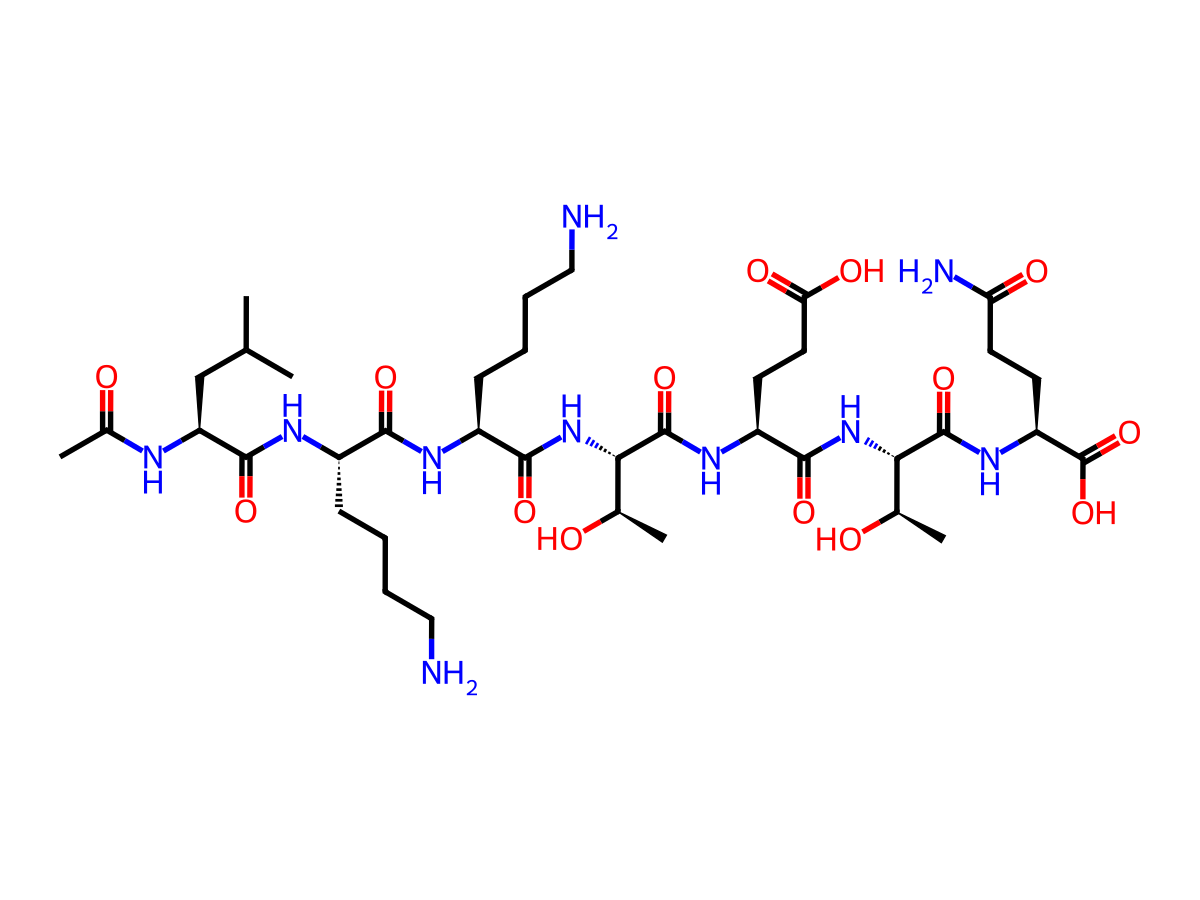
TB-500 is not that protein. It is a synthetic seven-residue peptide, leucine-lysine-lysine-threonine-glutamate-threonine-glutamine, which corresponds to residues 17 to 23 of the protein: the central actin-binding domain plus one extra glutamine.⁠5 The US Food and Drug Administration lists it under exactly that description, "Thymosin beta-4, fragment (LKKTETQ), also known as TB-500".⁠1

Almost all of the human evidence, the trial data and the regulatory-grade safety work belongs to the 43-residue protein. The fragment is about 18% of that molecule by mass.

Compound data

LLeu
KLys
KLys
TThr
EGlu
TThr
QGln
BasicAcidicHydroxylNeutral
Seven residues, positions 17 to 23 of the 43-residue protein. The two lysines are what make the sequence bind actin, and the terminal glutamine is the one residue that is not part of the binding domain proper⁠5
ClassSynthetic peptide fragment of an endogenous protein⁠1
SequenceAc-Leu-Lys-Lys-Thr-Glu-Thr-Gln
Parent proteinThymosin beta-4, 43 residues, 4963 Da⁠4
Position in parentResidues 17-23⁠5
FormulaC38H68N10O14, 889.02⁠2
Free formC36H66N10O13, 847.0⁠3
PubChemCID 62707662 (acetyl), CID 10169788 (free)⁠23
InChIKeyADKDNDYYIZUVCZ-ZQNQAVPYSA-N⁠2
CAS476014-70-7 (free fragment)⁠3
INNFequesetide, for the free form⁠3
Mass ratio5.6× lighter than the protein it is named after
Basic residuesTwo lysines, plus the terminal amine when unacetylated
Half-lifeNot published for this fragment in humans⁠1
BioavailabilityNot published1
AppearanceWhite lyophilised powder

Evidence at a glance

Parent isolated1981, from bovine thymus⁠15
Registered trials, parent17, including three of 300 to 700 participants⁠6
Registered trials, fragmentOne, recruiting, safety endpoints⁠7
Completed human trials, fragmentNone6
Musculoskeletal trialsNone, either molecule⁠6
Human exposure data, per FDANone identified1
Independent replicationLimited. The defining review is co-authored by the discoverer, who founded the developer⁠514
Approved anywhereNo

Regulatory status

USNot FDA approved. Placed in Category 2 of the 503A bulk substances list on safety grounds, the agency noting no identified human exposure data and risks of immunogenicity and peptide-related impurities⁠1
April 2026Removed from Category 2 because the nomination was withdrawn, not because a question was answered. Removal from a list is not authorisation⁠112
July 2026The Pharmacy Compounding Advisory Committee recommended it for the 503A list on 23 July, by 8 votes to 6 with one abstention, against the FDA's own scientific reviewers, who had advised against all seven peptides on the agenda. Six of the seven were recommended⁠11
What that meansNo regulatory status has changed. The committee only advises. The FDA must still decide and then complete notice-and-comment rulemaking⁠1112
SportProhibited at all times. Unlike most compounds in this library it is named explicitly: thymosin-beta-4 and its derivatives, with TB-500 given as the example, under the growth factors section⁠10

Related

BPC-157 + TB-500The two-peptide blend, tested together in one rat tendon study
BPC-157 + TB-500 + GHK-CuThe three-peptide blend; no study of the three together was found
BPC-157 + TB-500 + KPV + GHK-CuThe four-peptide blend; no study of the four together was found
AP503The other compound with almost nothing established, for a very different reason
SemaxAnother variant with unpublished pharmacokinetics
ComparePut this next to the others on all five axes
BPC-157A compound often used alongside this one, with more published evidence
CJC-1295The other page where one name covers two molecules
MOTS-cA similar analogue-naming problem, in the other direction
GHK-CuThe same discoverer-owns-the-company pattern
PT-141Two molecules a single functional group apart, and how the identity is settled
SS-31The opposite case: one molecule, and every name agrees
NAD+ / NMNFour molecules in one conversation, and a library entry that conflated two
AdipotideWhere the chemical data in circulation also do not match the studies

Three different molecules answer to this name.

Chemical databases, the sequence record and the FDA describe TB-500 in three different ways. They are three distinct chemical entities separated by up to a factor of six in mass.

For researchers
What it isFormulaMassHow it shows up
Ac-LKKTETQ
CID 62707662
C38H68N10O14889.02The N-acetylated heptapeptide. This is what PubChem returns for the name "TB-500", and it is the form most commonly described in commercial literature⁠2
LKKTETQ, free
CID 10169788
C36H66N10O13847.0The same seven residues with a free N-terminus. It has its own international non-proprietary name, fequesetide, and its own CAS number, 476014-70-7. Differs from the row above by a single acetyl group, 42 Da3
Thymosin beta-4
CID 45382195
C212H350N56O78S4963The whole 43-residue protein. 5.6 times the mass of TB-500. This is the molecule in essentially every human trial⁠4

The arithmetic checks out in both directions, so the records are internally consistent. Building the free heptapeptide from its sequence returns C36H66N10O13 at 846.98 and the InChIKey LVLWJWXFRFTMLK-JMWNXRNDSA-N, matching CID 10169788 exactly. Acetylating it adds C2H2O, 42.04 Da, giving 889.02 and the InChIKey ADKDNDYYIZUVCZ-ZQNQAVPYSA-N, which is CID 62707662 exactly.⁠13

The same check on the protein resolves a discrepancy rather than creating one. Building the 43-residue sequence gives 4921.5, which is 42 Da short of PubChem's 4963. That gap is also an acetyl group: the mature protein is acetylated at its own N-terminus. Two records, two independent routes, one explanation.⁠13

The 42-dalton difference

The difference is one acetyl group. Registry entries for this compound disagree about whether it is acetylated, and its common name is shared with a molecule six times its size, so a purity figure alone does not identify which of three molecules is meant.

A similar naming problem appears on CJC-1295, where one name covers two molecules with very different half-lives, and on MOTS-c, where an analogue is used under the parent’s name.

Evidence

Eighteen registered trials. Seventeen are a different molecule.

The public trial registry shows what has actually been tested. A search of registered interventional studies of thymosin beta-4 and TB-500 returns eighteen studies.⁠6

For researchers
LabAnimalHuman, this moleculeControlled efficacyMeta-analysis

Evidence found: lab; animal.

Full protein, eyesThe bulk of the human data, and it is substantial. Thymosin beta-4 as an eye drop has completed trials of 700, 601 and 317 participants for dry eye, plus phase 3 work in neurotrophic keratopathy⁠68
Full protein, skinPhase 2 studies in pressure ulcers and venous stasis ulcers, 72 participants each. A trial in epidermolysis bullosa was terminated6
Full protein, heartSeveral phase 2 studies in acute myocardial infarction, 62 and 90 participants, with a further 189-participant study not yet recruiting. One earlier cardiac study was withdrawn6
Full protein, safetyPhase 1 studies in healthy volunteers, 54 and 30 participants6
TB-500, the fragmentOne study. NCT07487363. Phase 1/2, 80 participants, in China, in patients with stable atherosclerotic cardiovascular disease. Its primary endpoints are treatment-emergent and serious adverse events, so it is a safety study, not an efficacy one. It began 5 February 2026 and is still recruiting, with primary completion scheduled for 14 February 2027⁠7
Muscle, tendon, ligamentNone. Not one of the eighteen studies, in either molecule, is a musculoskeletal trial6

Indications studied

TB-500 is promoted for soft-tissue injury: tendons, ligaments, muscle tears and joint recovery. The registry contains no trial of either molecule for any of those things. The human evidence base is eyes, chronic skin ulcers and heart attacks.

Of the three large dry-eye trials the published record is mixed, and the third phase 3 study in neurotrophic keratopathy did not meet its primary endpoint.⁠9 This is the molecule with the most data, from the sponsor with the most experience.

Discoverer and developer

Thymosin beta-4 was isolated in 1981 by Teresa Low and Allan Goldstein.⁠15 Goldstein went on to found the company that has run essentially all of the clinical development of the molecule, where he remains chief scientific adviser, and he is a co-author on the review that defines the active sites and underpins the fragment's rationale.⁠514

A similar pattern appears elsewhere in the library. BPC-157 has one research group behind most of its mechanistic literature; GHK-Cu has a discoverer who also owned the company selling it. None of that makes the findings wrong. It does mean independent replication carries more weight than volume of publication, and on the fragment specifically there is very little of either.

TB-500 was one of three compounds in the grouped 8 to 6 advisory committee vote of 23 July 2026, alongside BPC-157 and KPV. The vote was a recommendation made against the written assessment of the agency’s own reviewers, and KPV’s page quotes that assessment in full.
Limitations of the evidence

  • No completed human trial of this molecule exists, at any dose, for any indication.
  • No human pharmacokinetic data. No measured half-life, bioavailability or distribution for the fragment.
  • No musculoskeletal trial of either molecule, which is the entire use case.
  • The mechanistic rationale rests substantially on one review, co-authored by the protein's discoverer, who founded the company developing it.⁠514
  • The full protein's own record is mixed, including a terminated trial, a withdrawn trial and a phase 3 that missed its primary endpoint.⁠69
  • No long-term safety data, and specifically nothing on repeated stimulation of angiogenesis in people.

What we looked for and did not find

A completed human trial of the fragment. Registry searches on TB-500 and thymosin beta 4 return eighteen interventional studies, of which exactly one tests the fragment and it is still recruiting.⁠67 The FDA independently states it has identified no human exposure data for this substance.⁠1

For researchers

Any trial in tendon, ligament or muscle injury. None exists for either molecule, despite that being the use for which it is most often promoted.⁠6

A published head-to-head of the fragment against the full protein. Searches for a study comparing LKKTETQ with intact thymosin beta-4 on the same endpoint, in the same model, returned nothing. The claim that the fragment reproduces the protein's effects is asserted from the active-site mapping, not demonstrated by comparison.⁠5

Mechanism

The binding motif, without most of the protein around it.

Thymosin beta-4 is the cell's principal actin-sequestering protein. It binds monomeric actin and holds it in reserve, which regulates how quickly the cytoskeleton can be built and dismantled. That is what lets a cell change shape and migrate, and it is the foundation of every repair claim made for this family.⁠5

For researchers
aa 17-23
LKKTETQ is the central actin-binding domain of the protein, plus one additional glutamine. It is the part that contacts actin⁠5
Migration
In preclinical models the short sequence promotes cell migration, angiogenesis and wound healing when tested on its own⁠5
Not the rest
The protein has other active sites the fragment does not contain, including the N-terminal Ac-SDKP tetrapeptide that blocks inflammation and reduces fibrosis, and a 15-residue N-terminal region that blocks apoptosis⁠5
Consequence
The fragment is a subset of the protein’s activity. Evidence generated with the whole protein cannot be assumed to transfer, because the whole protein was doing more than one thing

The fragment is not inert: the review that mapped these active sites concluded the LKKTETQ sequence does promote angiogenesis, wound healing and cell migration in its own right.⁠5 That is a real finding.

The evidence for the fragment is entirely preclinical. Cardiac-repair, corneal-healing and anti-fibrotic results came from the whole protein, and in the anti-fibrotic case from a specific four-residue site at the opposite end of the molecule that is not present in TB-500 at all.⁠5

No human pharmacokinetic data

There is no human pharmacokinetic data for this fragment. No published half-life, no bioavailability figure, no distribution study. Short unstructured peptides in this size range are generally cleared quickly by plasma peptidases, but that is inference from the class, not measurement of this molecule. The FDA states that it has identified no human exposure data for the fragment by any route.⁠1

Regulatory status

Status by country

Where regulators list this compound, country by country. A country with no line has not been checked yet.

No country or sport list has been checked yet

Not yet checked. North America: Canada, Mexico, United States. South America: Argentina, Brazil. Europe: European Union (central authorisation), Belgium, France, Germany, Italy, Netherlands, Russia, Spain, Switzerland, United Kingdom. Africa: Egypt, Nigeria, South Africa. Asia: China, India, Japan, South Korea, Thailand, United Arab Emirates. Oceania: Australia, New Zealand.

Sport (WADA) applies worldwide, not a country

WADA Prohibited List 2026Not yet checked

Information only, not legal advice. Not verified for any individual situation. Status changes; check the date and the source.

The same records as data: JSON and CSV, with a version and a change log.

Sources15

This page cites 15 sources, numbered to match the small numbers in the text above. Each one links to the paper or record. Where a source states its design, a tag says so (a human trial, an animal study, a cell study, a review); the tag names the design and is not a grade. Each source also links back to where it is cited above.

  1. 01
    US Food and Drug Administration. Certain Bulk Drug Substances for Use in Compounding that May Present Significant Safety Risks, content current as of 22 April 2026, read 5 August 2026. The substance is listed as "Thymosin beta-4, fragment…fda.govread 5 Aug 2026
    Full text
    US Food and Drug Administration. Certain Bulk Drug Substances for Use in Compounding that May Present Significant Safety Risks, content current as of 22 April 2026, read 5 August 2026. The substance is listed as "Thymosin beta-4, fragment (LKKTETQ), also known as TB-500", which is the regulator's own identification of TB-500 as the seven-residue fragment. The entry states that compounded drugs containing it may pose a risk for immunogenicity due to aggregation and peptide-related impurities, and that FDA has not identified any human exposure data for drug products containing it. It appears in the table of substances previously in Category 2 whose nominations were withdrawn.
    Cited 9 times, back to the text12345678and 1 more
  2. 02
    PubChem compound record CID 62707662, retrieved 5 August 2026 via the PUG-REST property endpoint.pubchem.ncbi.nlm.nih.govread 5 Aug 2026
    Full text
    PubChem compound record CID 62707662, retrieved 5 August 2026 via the PUG-REST property endpoint. Returned for the search term "TB-500". C38H68N10O14, molecular weight 889.0, InChIKey ADKDNDYYIZUVCZ-ZQNQAVPYSA-N. This is the N-acetylated heptapeptide.
    Cited 4 times, back to the text1234
  3. 03
    PubChem compound record CID 10169788, retrieved 5 August 2026.pubchem.ncbi.nlm.nih.govread 5 Aug 2026
    Full text
    PubChem compound record CID 10169788, retrieved 5 August 2026. Title fequesetide, synonyms including LKKTETQ, CAS 476014-70-7. C36H66N10O13, molecular weight 847.0, InChIKey LVLWJWXFRFTMLK-JMWNXRNDSA-N. The recorded IUPAC name shows a free N-terminal leucine, confirming this record is the unacetylated fragment.
    Cited 5 times, back to the text12345
  4. 04
    PubChem compound record CID 45382195, thymosin beta-4, retrieved 5 August 2026.pubchem.ncbi.nlm.nih.govread 5 Aug 2026
    Full text
    PubChem compound record CID 45382195, thymosin beta-4, retrieved 5 August 2026. C212H350N56O78S, molecular weight 4963. The InChIKey ends UHFFFAOYSA, indicating stereochemistry is undefined in this record.
    Cited 2 times, back to the text12
  5. 05
    Sosne G, Qiu P, Goldstein AL, Wheater M. Biological activities of thymosin beta4 defined by active sites in short peptide sequences. FASEB J 2010;24:2144-2151.Review or meta-analysispubmed.ncbi.nlm.nih.govno read date recorded
    Full text
    Sosne G, Qiu P, Goldstein AL, Wheater M. Biological activities of thymosin beta4 defined by active sites in short peptide sequences. FASEB J 2010;24:2144-2151. Review. Source for the identification of LKKTETQ as the central actin-binding domain at residues 17 to 23 plus one additional glutamine, for the finding that this short sequence promotes angiogenesis, wound healing and cell migration, and for the separate active sites the fragment does not contain, including the N-terminal Ac-SDKP tetrapeptide that blocks inflammation and reduces fibrosis and the 15-residue N-terminal region that blocks apoptosis. Note the publication type is a review, and co-author Allan Goldstein is the discoverer of the parent protein and founder of its developer, see reference 16.
    Cited 13 times, back to the text12345678and 5 more
  6. 06
    ClinicalTrials.gov registry, queried 5 August 2026 via the version 2 API for interventional studies of thymosin beta 4 and of TB-500. The intervention query returned 18 studies. Seventeen test the full-length protein, across ophthalmic…no read date recorded
    Full text
    ClinicalTrials.gov registry, queried 5 August 2026 via the version 2 API for interventional studies of thymosin beta 4 and of TB-500. The intervention query returned 18 studies. Seventeen test the full-length protein, across ophthalmic indications including studies enrolling 700, 601 and 317 participants, dermal ulcer studies of 72 participants each, cardiac studies of 62, 90 and 189 participants, and phase 1 healthy-volunteer studies of 54 and 30 participants. One study is terminated, two are withdrawn. A separate query on the term TB-500 returned one study, NCT07487363. No study in the returned set has a musculoskeletal, tendon, ligament or muscle-injury indication.
    Cited 12 times, back to the text12345678and 4 more
  7. 07
    ClinicalTrials.gov, NCT07487363, "TB-500 (Thymosin Beta 4 17-23 Fragment) for Cardiovascular Biomarkers in Stable ASCVD", retrieved 5 August 2026. Lead sponsor Hudson Biotech.NCT07487363read 5 Aug 2026
    Full text
    ClinicalTrials.gov, NCT07487363, "TB-500 (Thymosin Beta 4 17-23 Fragment) for Cardiovascular Biomarkers in Stable ASCVD", retrieved 5 August 2026. Lead sponsor Hudson Biotech. Interventional, phase 1/phase 2, 80 participants, located in China. Start date 5 February 2026, primary completion 14 February 2027, status recruiting. Primary outcome measures are the incidence of treatment-emergent adverse events and the incidence of serious adverse events. The intervention is described as thymosin beta 4 17-23 fragment against a matching vehicle.
    Cited 3 times, back to the text123
  8. 08
    Sosne G, et al. 0.1% RGN-259 (thymosin beta-4) ophthalmic solution promotes healing and improves comfort in neurotrophic keratopathy patients in a randomized, placebo-controlled, double-masked phase III clinical trial. Published 2022. The…Human RCTPMC9820614no read date recorded
    Full text
    Sosne G, et al. 0.1% RGN-259 (thymosin beta-4) ophthalmic solution promotes healing and improves comfort in neurotrophic keratopathy patients in a randomized, placebo-controlled, double-masked phase III clinical trial. Published 2022, PMC9820614. The first phase 3 study in this indication recruited, treated and analysed 18 patients. Source for the ophthalmic programme being conducted with the full-length protein as the active ingredient, not the fragment.
    Back to the text1
  9. 09
    RegeneRx Biopharmaceuticals, RGN-259 programme, and the associated registry entries at reference 6. The dry-eye programme comprises ARISE-1, ARISE-2 and ARISE-3, and the neurotrophic keratopathy programme comprises SEER-1, SEER-2 and…regenerx.comno read date recorded
    Full text
    RegeneRx Biopharmaceuticals, RGN-259 programme, and the associated registry entries at reference 6. The dry-eye programme comprises ARISE-1, ARISE-2 and ARISE-3, and the neurotrophic keratopathy programme comprises SEER-1, SEER-2 and SEER-3. The SEER-3 phase 3 trial did not meet its primary endpoint. Cited here only to characterise the maturity and consistency of the full-length protein's clinical record, which is the most favourable evidence base available to this compound family.
    Cited 2 times, back to the text12
  10. 10
    World Anti-Doping Agency, The Prohibited List, current edition. Thymosin-beta-4 and its derivatives, with TB-500 given as a named example, appear under section S2, growth factors and growth factor modulators, covering substances affecting…wada-ama.orgno read date recorded
    Full text
    World Anti-Doping Agency, The Prohibited List, current edition. Thymosin-beta-4 and its derivatives, with TB-500 given as a named example, appear under section S2, growth factors and growth factor modulators, covering substances affecting muscle, tendon or ligament protein synthesis or degradation, vascularisation, energy utilisation, regenerative capacity or fibre type switching. Prohibited at all times, non-specified. Corroborated by the Banned Substances Control Group and by USADA's published summary of the year the entry was added. WADA has separately funded research into TB-500 metabolism and detection limits in urine and plasma.
    Back to the text1
  11. 11
    Steinzor P. FDA Panel Backs 6 Peptides for Compounding. American Journal of Managed Care, 31 July 2026. Source for the Pharmacy Compounding Advisory Committee's 23 and 24 July 2026 votes. On 23 July the committee voted 8 to 6 with one…ajmc.comno read date recorded
    Full text
    Steinzor P. FDA Panel Backs 6 Peptides for Compounding. American Journal of Managed Care, 31 July 2026. Source for the Pharmacy Compounding Advisory Committee's 23 and 24 July 2026 votes. On 23 July the committee voted 8 to 6 with one abstention to recommend BPC-157, KPV and TB-500; MOTS-c passed 7 to 5 with two abstentions. Six of the seven peptides considered were recommended, the single rejection being emideltide, voted down 7 to 6 with one abstention. FDA scientists had recommended against all seven, finding available studies short in duration, small in sample size and insufficient to establish safety or effectiveness. The article states none of the peptides has been added to the 503A list and none is an FDA-approved drug.
    Cited 2 times, back to the text12
  12. 12
    US Food and Drug Administration, Bulk Drug Substances Used in Compounding Under Section 503A of the FD&C Act, content current as of 14 May 2026. Source for the three-category interim policy and for the requirement that a substance appear…fda.govno read date recorded
    Full text
    US Food and Drug Administration, Bulk Drug Substances Used in Compounding Under Section 503A of the FD&C Act, content current as of 14 May 2026. Source for the three-category interim policy and for the requirement that a substance appear on the 503A list, comply with a USP or NF monograph, or be a component of an approved drug before it may be compounded. Removal from Category 2 does not place a substance on the 503A list and is not authorisation. See also the regulatory section of the BPC-157 page.
    Cited 2 times, back to the text12
  13. 13
    Independent reconstruction performed for this page, 5 August 2026. The heptapeptide was built from the sequence LKKTETQ, returning C36H66N10O13 at 846.98 and InChIKey LVLWJWXFRFTMLK-JMWNXRNDSA-N, matching CID 10169788 on all three.no read date recorded
    Full text
    Independent reconstruction performed for this page, 5 August 2026. The heptapeptide was built from the sequence LKKTETQ, returning C36H66N10O13 at 846.98 and InChIKey LVLWJWXFRFTMLK-JMWNXRNDSA-N, matching CID 10169788 on all three. Acetylating the N-terminus returned C38H68N10O14 at 889.02 and InChIKey ADKDNDYYIZUVCZ-ZQNQAVPYSA-N, matching CID 62707662, confirmed independently by an exact-structure search against PubChem which resolved to the same CID. The 43-residue parent sequence was built and returned 4921.5, which is 42.04 lower than PubChem's 4963 for CID 45382195; the difference is one acetyl group, consistent with the mature protein being N-terminally acetylated. The skeletal structure displayed on this page was drawn locally from the verified structure rather than hotlinked. Catalogue supplier codes for the fragment appear in the PubChem synonym list, but no catalogue list price was obtainable without an account, so no reference ceiling is published here. Working retained in the vault.
    Cited 2 times, back to the text12
  14. 14
    RegeneRx Biopharmaceuticals, company disclosures for Allan L. Goldstein, and associated biographical sources, checked 5 August 2026. Goldstein co-discovered thymosin beta-4, founded RegeneRx Biopharmaceuticals, and serves as its chief…regenerx.comread 5 Aug 2026
    Full text
    RegeneRx Biopharmaceuticals, company disclosures for Allan L. Goldstein, and associated biographical sources, checked 5 August 2026. Goldstein co-discovered thymosin beta-4, founded RegeneRx Biopharmaceuticals, and serves as its chief scientific adviser. He is a co-author of the review at reference 5 that defines the active sites underpinning the fragment's rationale. Recorded here as a disclosure relevant to weighing independence of evidence, not as an allegation of misconduct.
    Cited 3 times, back to the text123
  15. 15
    Low TLK, Goldstein AL. The chemistry and biology of thymosin. Thymosin beta-4 was isolated from bovine thymus in 1981 as part of NIH-funded work on thymosin peptide fractions. Source for the discovery date and origin of the parent protein.Animalno read date recordedCited 3 times, back to the text123

Where it sits

Primary studies

Don’t take our word for it. Read the study.

Read first: 08, 07.