Ziconotide
ω-Conotoxin MVIIA, SNX-111, sold as Prialt
Ziconotide is a synthetic peptide based on a cone snail venom component that blocks N-type calcium channels. It is a licensed medicine given only by intrathecal infusion through an implanted pump, with a boxed warning for psychiatric harm, and the one pivotal trial matching the later licensed administration found no significant responder difference from placebo.
Ziconotide is a medicine administered only into the spinal fluid. It is an approved medicine, licensed in the EU, the US and Great Britain, delivered into the fluid around the spinal cord through a surgically implanted pump by a specialist pain service. The limiting factor is the route of administration.
- Peptide, 25 residues
- N-type calcium channel blocker
- Authorised by the FDA and EMA, as of 10 Nov 2026
- Intrathecal administration only
- Compounds
- Other investigational and specialist drugs
- Calcium channel blockers
- N-type
- Ziconotide
Overview
It reduced pain scores in the pivotal trials, through a mechanism that stops the pain message being sent rather than dulling it
The main limiting adverse effects are neurological and psychiatric, and the drug must reach the spinal cord directly
The three pivotal trials are not a comparable series, and the one using administration like the later licence did not separate from placebo on its responder analysis, 16.1% against 12.0%, p=0.39
A peptide from the venom of a fish-hunting cone snail.
Conus magus is a cone snail. The FDA label describes it as piscivorous: it hunts fish by harpooning them with venom.1 Ziconotide is the synthetic version of one peptide out of that venom, ω-conotoxin MVIIA.
For researchers
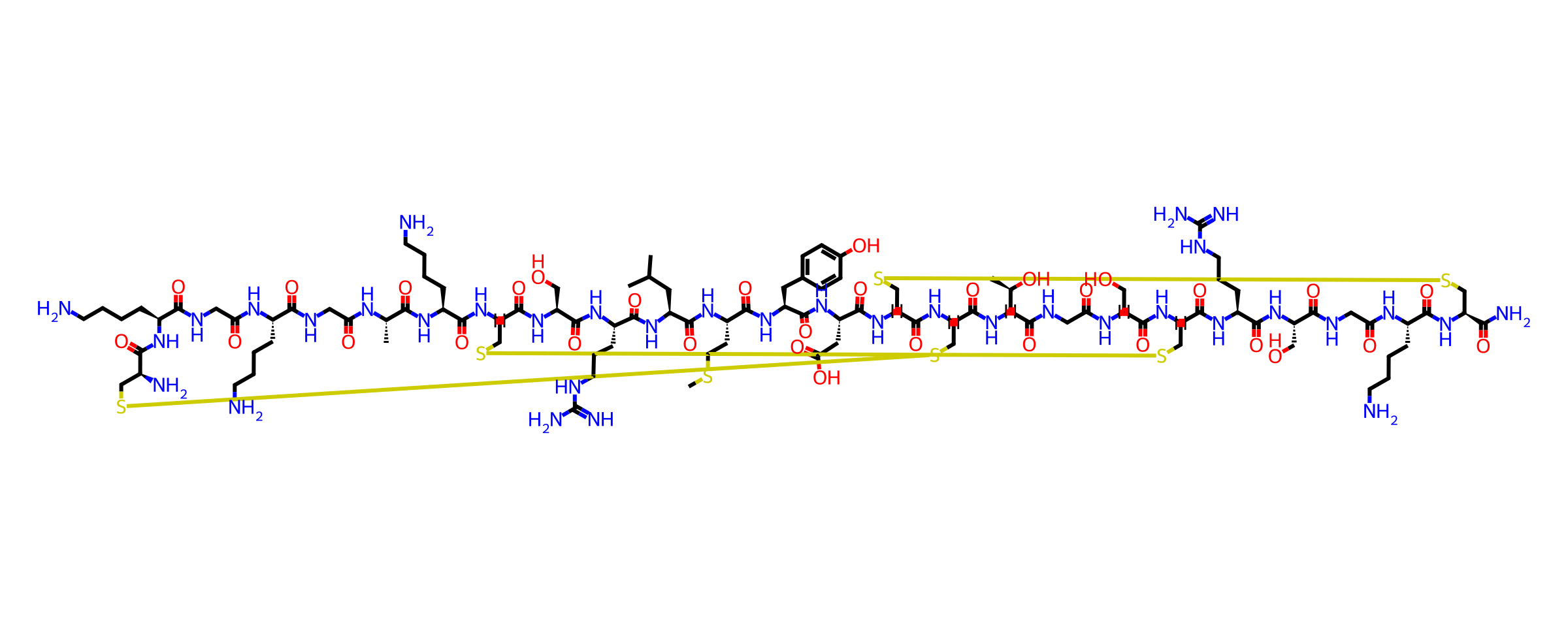
The molecule is 25 amino acids held in shape by three disulfide bridges, at 2,639 daltons.1 Two structural features follow from its composition.
Count the charges. Four lysines and two arginines carry a positive charge at body pH, the free N-terminus carries another, and exactly one residue, a single aspartate, carries a negative one. The C-terminus is amidated, so it contributes nothing. Net charge roughly +6.10
The FDA label calls it a "polybasic peptide".1 A small, rigid, strongly cationic molecule binds well at the mouth of an ion channel and crosses lipid membranes poorly. The same property that makes it bind means it cannot reach the target on its own.
The three disulfides do the other half. Six cysteines, paired 1 to 16, 8 to 20 and 15 to 25, lock the backbone into a rigid knot rather than a floppy chain.10 A rigid molecule pays a much smaller entropy penalty when it binds, which is a large part of why the affinity is what it is. It is also why this peptide survives in cerebrospinal fluid rather than falling apart in minutes.
Compound data
| Class | Synthetic conopeptide, N-type calcium channel blocker1 |
| Origin | Venom of Conus magus, a piscivorous marine snail1 |
| Residues | 25, with three disulfide bridges1 |
| Sequence | CKGKGAKCSRLMYDCCTGSCRSGKC10 |
| Formula | C102H172N36O32S71 |
| Mass | 2639.131 |
| InChIKey | BPKIMPVREBSLAJ-QTBYCLKRSA-N12 |
| Stereochemistry | Fully defined, 22 of 22 centres12 |
| Net charge | About +6 at body pH, six basic residues against one acidic10 |
| Target | Cav2.2, on A-δ and C afferents, Rexed laminae I and II1 |
| Opioid receptor activity | None. Not reversed by opioid antagonists1 |
| Route | Intrathecal infusion only, via an implanted pump2 |
| Half-life, CSF | 4.6 h2 |
| Half-life, plasma | 1.3 h2 |
| Tolerance | None reported2 |
Evidence at a glance
| Approved, US | Yes, December 20041 |
| Approved, EU | Yes, 21 February 20053 |
| Randomised trials | Three pivotal, placebo controlled3 |
| Meta-analysis | Pooled OR 2.77 (1.37 to 5.59)5 |
| Number needed to treat | 5.564 |
| Total safety exposure | 1,254 patients, 662 patient years1 |
| Real-world completion | 28 of 93 at 18 months6 |
| Head to head vs IT morphine | Never run3 |
Regulatory status
| Great Britain | Prescription only medicine. Authorisation PLGB42336/00062. ⚠️ A PLGB number covers Great Britain only. Northern Ireland ran under the EU authorisation, and the MHRA has been reissuing these as UK-wide licences, so the current number may have moved on from the one printed here2 |
| United States | Approved for severe chronic pain where intrathecal therapy is warranted, with a boxed warning1 |
| Controlled drug | No. No abuse liability signal, and animals did not self-administer3 |
| Sport | Not on the 2026 Prohibited List. Neither ziconotide nor conotoxin appears anywhere in it, and the S7 narcotics list is opioids only11 |
Related
| AP503 | The other compound in this group. Out of reach for the opposite reason: nothing has been tested |
| Tesamorelin | An approved medicine whose label does not cover the use it is sold for |
| SS-31 | Approved on a secondary endpoint after missing both primary endpoints |
| Semax | Decades of clinical use behind a literature that is difficult to verify |
| Adipotide | Another compound with preclinical research and no approval |
| Library index | Index of library compounds |
| Chlorotoxin | Another venom peptide used in surgery; the pivotal trial found fluorescence guidance no better than the surgeon |
For once, every register agrees.
Registry identifiers for ziconotide agree with one another. As a licensed medicine, it has a regulator-held dossier, and the identifiers were fixed before sale was permitted.
For researchers
Identifiers for compounds without an approval are often inconsistent across registries; ziconotide is an example of a compound where they are not.
| Field | Value |
|---|---|
| Sequence | CKGKGAKCSRLMYDCCTGSCRSGKC, C-terminal amide10 |
| Formula | C102H172N36O32S71 |
| Average mass | 2639.131 |
| Monoisotopic mass | 2637.098410 |
| CAS | 107452-89-112 |
| PubChem CID | 1613541512 |
| InChIKey | BPKIMPVREBSLAJ-QTBYCLKRSA-N12 |
| UNII | 7I64C51O1612 (ziconotide acetate, the salt, is T2I226K69M)12 |
| Disulfides | Three. Cys1 to Cys16, Cys8 to Cys20, Cys15 to Cys2510 |
The molecule was rebuilt from its published sequence, the C-terminus amidated and the three disulfides closed, then checked against the label. The formula came out as C102H172N36O32S7 exactly. Average mass reconciled to 2639.19 against the published 2639.13, a difference of 0.06, inside a 0.1 tolerance. Monoisotopic mass agreed to four decimal places with the independent registry value.10
The sequence also predicts the formula's seven sulfur atoms, from six cysteines and one methionine, which is the kind of cross-check that catches a transcription error before it reaches a page.
The registry record has all 22 stereocentres defined.12
Limit of the InChIKey check. The InChIKey's second block here is QTBYCLKRSA rather than the UHFFFAOYSA seen on a flat record. That block encodes stereochemistry and isotopes, and its last two characters are version flags, so a non-UHFFFAOYSA block indicates that a stereo layer exists. It does not by itself prove the stereochemistry is complete. The 22-of-22 count above is the evidence for that, and the InChIKey is corroboration.
Teal marks the six cysteines that form the three bridges. Amber marks the six basic residues that carry the positive charge. One acidic residue, the aspartate at position 14, is the only negative charge in the whole molecule.
Evidence
Three pivotal trials with different endpoint windows and populations.
Evidence found: lab; animal; human, any; controlled efficacy; approved.
Ziconotide has randomised placebo-controlled trials, a regulatory dossier and authorisations in the US and EU, so every rung of the evidence ladder applies. The detail of the trials differs from the headline results.
For researchers
| Pivotal trial | n | Endpoint timing | Population analysed | Mean VASPI improvement | p |
|---|---|---|---|---|---|
| 95-001 malignant pain Staats 2004 | 112 | 5 to 6 days | Evaluable | 53.1% vs 18.1% | <0.001 |
| 96-002 non-malignant Wallace 2006 | 257 | 5 to 6 days | Evaluable | 30.7% vs 6.2% | <0.001 |
| 301 slower schedule Rauck 2006 | 220 | 3 weeks | Randomised, LOCF | 14.7% vs 7.2% | 0.036 |
The sequence 53%, 31%, 15% resembles a dose-response curve collapsing, but all three trials label their endpoint "end of initial titration" while measuring three different things.
- The windows differ by a factor of three and a half. The first two measured after 5 or 6 days. Study 301 measured at 3 weeks.3
- The populations differ. The 53.1% and 30.7% figures are the evaluable populations. Study 301's 14.7% is the full randomised set carried forward.3
- The administration schedules differ, deliberately. Study 301 was designed to test a slower schedule.3
An identical endpoint name covers three different measurements, which is visible only in the regulatory assessment and not in the summary table.
Study 301: two results that disagree.
Study 301 is the only pivotal trial whose administration matches the licence that followed.4 Its published result is two numbers, and they disagree.
| Study 301, Rauck 2006 | Ziconotide | Placebo | p |
|---|---|---|---|
| Mean % VASPI improvement at week 3 the stated primary endpoint | 14.7% | 7.2% | 0.036 |
| Responders, at least 30% VASPI improvement the definition all three trials used | 16.1% | 12.0% | 0.39 |
On the continuous measure, ziconotide separated from placebo. On the responder analysis, four percentage points apart at p=0.39, it did not.13
All three pivotal trials defined a responder the same way, at a 30% reduction.4 The version of the drug with administration like the later licence did not show a significant responder rate against placebo.13
The independent review reaches the same place: in study 301, "the proportion of responders was not significantly different between groups".4
The same review writes that in two of the studies, "(Rauck et al., 2006; Staats et al., 2004), dosages were much higher than those described in the subsequent SPC".4 Rauck 2006 is study 301, the lower-intensity trial, and the same paper describes it a few lines later as corresponding to the licence.
The two higher-intensity studies are Staats 2004 and Wallace 2006. The sentence is quoted because its substance is checkable; the study attribution is inconsistent.
A 2017 systematic review pooled all three and reported an odds ratio of 2.77 (95% CI 1.37 to 5.59) favouring ziconotide, concluding that it "is beneficial for pain reduction in chronic neuropathic pain. However, there remain some methodological issues that may call into question the validity of the results."5 From those figures the number needed to treat works out at 5.56.4
The FDA label describes the same three studies as covering "a total of 457 patients (268 PRIALT, 189 placebo)".1 The European assessment's per-study randomised numbers add up to 589.3 Study 301 matches exactly across both, at 112 and 108.
The gap is most likely analysis populations rather than a contradiction, the same factor that makes the first table unreadable as a series. Both figures are reported and attributed.
A small group of interventional pain physicians recurs across this field: the same names appear as authors of the registration trials, as authors of the review and consensus literature that interprets them, and on the manufacturer-run registry described below.6 That is common in a small speciality and it is not an allegation of anything.
The independent voice on this drug is limited, and some reviews read more favourably than study 301. The most critical published assessment declares no conflicts and was funded by a Swedish regional health authority and a Lions research fund.4
A manufacturer-run registry: 93 patients started and 28 finished.
The manufacturer ran a prospective registry, PRIZM, to record outcomes outside a trial.6
For researchers
| Point | Still on therapy |
|---|---|
| Baseline | 93 (100%) |
| Week 12 | 74 (80%) |
| Month 18, end of study | 28 (30%) |
- 32% discontinued because of adverse events.6
- 13% discontinued for lack of efficacy.6
- Serious adverse events in 29% of patients. Nausea 25.8%, confusional state 22.6%, dizziness 20.4%, auditory hallucination 18.3%.6
The registry reports that at month 18, 38.5% of patients had at least a 30% reduction in pain.6
It is 38.5% of the twenty-eight patients still taking it, which is 38.5% of the 30% who did not stop. Patients for whom it did not work, or who could not tolerate it, had already left the denominator. A response rate measured only among patients who stayed on a drug reflects who stayed as well as what the drug does.
The critical review makes the same observation about the interim analysis: "only 23 out of 93 enrolled patients reported data at 12 months".4
The same review notes that high discontinuation has been found repeatedly by other investigators in open-label studies, and that in many European countries, the Nordic countries and the UK among them, ziconotide is available in only a few centres.4
Mechanism
The signal is blocked at the nerve terminal, before it is sent onward.
Opioids work downstream, by reducing how the signal is received and perceived. Ziconotide acts upstream of that, on the nerve that carries the signal.
For researchers
The prescribing information states that ziconotide does not bind opioid receptors and that its effects are not blocked by opioid antagonists.1 That second half is the stronger claim: naloxone reverses an opioid, and it does nothing here.
Ziconotide is not an opioid. It is a different mechanism for the same clinical problem, and the only one of its kind that has reached a licence.
Delivery to the spinal fluid determines the route of administration.
The molecule binds ion channels well and crosses membranes poorly. The pharmacokinetics reflect that.
For researchers
| Measure | In cerebrospinal fluid | In plasma |
|---|---|---|
| Half-life | 4.6 ± 0.9 h2 | 1.3 ± 0.3 h2 |
| Clearance | Slow2 | Fast2 |
Clearance from the spinal fluid is about seven hundred times slower than clearance from blood. The peptide cannot pass between the two compartments in the useful direction, so it is not given orally, intramuscularly or intravenously. It is infused continuously into the fluid around the spinal cord through an implanted pump.2
A pump is implanted, with a catheter threaded into the intrathecal space, and then refilled. That is a surgical procedure with its own infection and mechanical failure risks, separate from the drug. The licensed use is the implanted pump system.
Scale. The whole licensed daily amount is measured in micrograms, and the maximum amounts differ between the EU/UK summary of product characteristics2 and the US label.1
Origin of the "thousand times stronger than morphine" figure.
The figure is the most repeated statement about ziconotide. It comes from one paper, which reports something narrower.
For researchers
Bowersox and colleagues, 1996, in the Journal of Pharmacology and Experimental Therapeutics: "SNX-111 was approximately 1000-fold more potent than morphine in blocking phase 2 responses when the compounds were administered by intrathecal bolus injection."8
- The species is rat.
- The route is intrathecal for both drugs. It is not a comparison with morphine as used clinically.
- The endpoint is phase 2 of the formalin test, a chemical model of tonic inflammatory pain in rodents. It is one assay, not a clinical outcome.8
- Potency is not efficacy. Potency describes how much is required, not how much relief results. Clinical relief is addressed by the trial table above.
Neither the FDA prescribing information nor the European assessment contains any potency comparison with morphine.13 Both had the 1996 paper available.
The European document notes the absence of comparative data: "While there are no safety or efficacy data available from randomised, controlled clinical trials of IT morphine".3 The head-to-head comparison the claim implies has not been run in people. The label states that ziconotide is for patients who are intolerant of or refractory to other treatment "such as systemic analgesics, adjunctive therapies, or intrathecal morphine", which describes where it sits in a sequence, not how strong it is.1
The label positions ziconotide for patients in whom intrathecal morphine has not worked. That is sourced and does not rely on a rat formalin-test potency ratio.
Items outside the scope of this page.
The Signature axes were designed to compare supplements and peptides sold outside medicine. A licensed intrathecal medicine does not fit them, and a score would imply a comparison the axes cannot support.
For researchers
Ziconotide is manufactured to a regulatory dossier under an authorisation.
No published account of ziconotide being diverted or offered outside clinical supply was found.10 That is consistent with the pharmacology: it is inactive when taken orally, injected under the skin or given intravenously, and acts only when delivered into the spinal fluid.
Other ω-conotoxins were taken toward the clinic. Leconotide, also called AM336, from Conus catus, reached a phase I/IIa assessment in Australia and was pursued partly because it looked as though it might be given intravenously rather than intrathecally.9 It never reached approval, and the published work on it since is preclinical.
The critical review states: "For the time being, there is but one animal toxin based analgesic on the market."4
Safety and standards
Boxed warning and adverse reactions.
The FDA label opens with a boxed warning: "PRIALT is contraindicated in patients with a preexisting history of psychosis."1 The UK summary of product characteristics adds a contraindication for any history of suicide attempt or suicidal ideation on the drug.2
For researchers
| Effect | Rate |
|---|---|
| Confusion | 33%1 |
| Memory impairment | 22%1 |
| Speech disorder | 14%1 |
| Hallucinations | 12%1 |
| Paranoid reactions | 3%1 |
| Psychosis | 1%1 |
| Suicide, attempts and ideation | 0.27 per patient year, against 0.10 on placebo1 |
A 2024 scoping review gathered the published cases, 21 of them across 13 papers, and found the presentations were mostly auditory hallucinations and paranoid delusions.7 Its proposed explanation is that blocking N-type channels on glutamatergic and GABAergic neurons has knock-on effects in dopaminergic pathways.7 ⚠️ Its incidence figures are the label's figures, not an independent count, and are cited here as the label.
Creatine kinase rose above the upper limit of normal in 40% of treated patients, and above three times that limit in 11%.1 Usually without symptoms, and the UK summary asks prescribers to watch for progressive rises alongside signs of myopathy.2 The very common adverse reactions are dizziness, nystagmus, memory impairment, headache, somnolence, nausea, vomiting, confusion, abnormal gait and weakness.2
There is no reported tolerance and no addiction. The UK summary of product characteristics states: "There is no evidence of the development of pharmacological tolerance to ziconotide in patients." The next sentence qualifies it: "However, in view of limited data, the development of tolerance cannot be excluded."2 The European assessment adds that continuous infusion "did not lead to tolerance nor did it alter opioid-induced analgesia", and that in dependence testing "monkeys did not maintain IV self-administration".3
Ziconotide is used in a population in which opioid tolerance and dependence are central problems. On the registry figures, the absence of reported tolerance did not prevent most patients discontinuing.
Regulatory status
Status by country
Where regulators list this compound, country by country. Each line names who listed it, the date it was read and the source. A country with no line has not been checked yet.
North America 1 of 3 checked
| Country | Status | Detail |
|---|---|---|
| United States | Listed as authorised by the FDA, as of 10 Nov 2026. Source: Drugs@FDA (openFDA) source dated 28 Dec 2004 | Drugs@FDA lists ziconotide as the single active ingredient of Prialt (1 application with a single-ingredient prescription or over-the-counter product) |
Europe 1 of 10 checked
| Country | Status | Detail |
|---|---|---|
| European Union (central authorisation) | Listed as authorised by the EMA, as of 10 Nov 2026. Source: EMA medicines table source dated 21 Feb 2005 | Products on the EMA table: Prialt |
Not yet checked. North America: Canada, Mexico. South America: Argentina, Brazil. Europe: Belgium, France, Germany, Italy, Netherlands, Russia, Spain, Switzerland, United Kingdom. Africa: Egypt, Nigeria, South Africa. Asia: China, India, Japan, South Korea, Thailand, United Arab Emirates. Oceania: Australia, New Zealand.
Sport (WADA) applies worldwide, not a country
| WADA Prohibited List 2026 | Not yet checked |
|---|
Information only, not legal advice. Not verified for any individual situation. Status changes; check the date and the source.
The same records as data: JSON and CSV, with a version and a change log.
Checked and missing
Three limits on use.
- It is not licensed for ordinary pain. The licence is for severe chronic pain in patients for whom intrathecal therapy is already warranted and who are intolerant of or refractory to other treatment.1
- It is not active by other routes. Not oral, not subcutaneous, not intravenous. The molecule cannot reach its target from the bloodstream and the licensed route is intrathecal infusion.2
- It does not deliver a thousand times morphine's pain relief. That figure is a potency ratio from a rodent assay, not a measure of clinical relief.8
Limits of the published evidence.
- The three pivotal trials are not directly comparable. Same endpoint name, three different endpoint windows, two different analysis populations and different administration schedules.3
- The only trial with administration matching the later licence did not separate from placebo on its responder analysis, 16.1% against 12.0% at p=0.39.13
- The critical review attributes the higher-intensity trials inconsistently, naming Rauck 2006 where Wallace 2006 is meant.4
- Patient numbers differ between the two regulators' accounts of the same three studies, 457 against 589, most likely from analysis-population definitions.13
- The real-world registry was manufacturer-run and 70% of enrolled patients did not reach its endpoint.6
- The clinical literature is written largely by one small group, overlapping the trials, the reviews and the registry.6
- There is no randomised controlled trial of intrathecal morphine to compare it against, which the European assessment states directly.3
- The scoping review's adverse-effect rates are the label's rates, not an independently derived incidence.7
- No published cost per patient per year was found.
Sources13
This page cites 13 sources, numbered to match the small numbers in the text above. Each one links to the paper or record. Where a source states its design, a tag says so (a human trial, an animal study, a cell study, a review); the tag names the design and is not a grade. Each source also links back to where it is cited above.
- 01United States Food and Drug Administration, PRIALT (ziconotide) solution, intrathecal infusion, prescribing information, reference label 021060s012, revised 2023, retrieved 16 August 2026. Source for: the boxed warning and the…read 16 Aug 2026Cited 34 times, back to the text12345678and 26 moreUnited States Food and Drug Administration, PRIALT (ziconotide) solution, intrathecal infusion, prescribing information, reference label 021060s012, revised 2023, retrieved 16 August 2026. Source for: the boxed warning and the contraindication in patients with a preexisting history of psychosis; the indication for severe chronic pain in adults for whom intrathecal therapy is warranted and who are "intolerant of or refractory to other treatment, such as systemic analgesics, adjunctive therapies, or intrathecal morphine"; the mechanism, ziconotide binding N-type calcium channels on primary nociceptive A-δ and C afferents in the superficial layers of the dorsal horn; the description of the source organism as the piscivorous marine snail Conus magus; the 25 amino acid, three disulfide, polybasic peptide description with formula C102H172N36O32S7 at 2,639 daltons; the UNII T2I226K69M; the adverse reaction rates for confusion 33%, memory impairment 22%, speech disorder 14%, hallucinations 12%, paranoid reactions 3% and psychosis 1%; the suicidality rate of 0.27 per patient year against 0.10 on placebo; the total safety exposure of 1,254 patients and 662 patient years; and the statement that the three double-blind placebo-controlled studies covered "a total of 457 patients (268 PRIALT, 189 placebo)". This label contains no potency comparison with morphine.
- 02Electronic Medicines Compendium, Prialt 100 micrograms/mL solution for infusion, Summary of Product Characteristics, marketing authorisation holder Esteve Pharmaceuticals GmbH, authorisation number PLGB42336/0006, text last revised 07…read 16 Aug 2026Cited 17 times, back to the text12345678and 9 more
Full text
Electronic Medicines Compendium, Prialt 100 micrograms/mL solution for infusion, Summary of Product Characteristics, marketing authorisation holder Esteve Pharmaceuticals GmbH, authorisation number PLGB42336/0006, text last revised 07 February 2023, retrieved 16 August 2026. Source for: the legal category, "Prescription only medicine"; the intrathecal route by continuous infusion using an infusion pump and intrathecal catheter; cerebrospinal fluid half-life 4.6 ± 0.9 h, clearance 0.38 mL/min, volume of distribution 155 mL, and plasma half-life 1.3 ± 0.3 h with clearance 270 mL/min; the maximum licensed dose of 21.6 micrograms per day; the contraindications including combination with intrathecal chemotherapy, history of psychosis, and history of suicide attempt or suicidal ideation on ziconotide; the very common adverse reactions; the guidance on creatine kinase monitoring; and the statement "There is no evidence of the development of pharmacological tolerance to ziconotide in patients." - 03European Medicines Agency, Prialt, EPAR scientific discussion, and the associated authorisation record, retrieved 16 August 2026.Human RCTread 16 Aug 2026Cited 14 times, back to the text12345678and 6 more
Full text
European Medicines Agency, Prialt, EPAR scientific discussion, and the associated authorisation record, retrieved 16 August 2026. Source for: the marketing authorisation granted 21 February 2005; the three pivotal studies and their randomised numbers, 95-001 with 112 patients (72 ziconotide, 40 placebo), 96-002 with 257 patients (170 ziconotide, 87 placebo) and study 301 with 220 patients (112 ziconotide, 108 placebo); the mean percentage change from baseline in visual analogue scale pain intensity of 53.1% against 18.1% (p<0.001), 30.7% against 6.2% in the evaluable population (p<0.001), and 14.7% against 7.2% (p=0.0360); the statement that "while there are no safety or efficacy data available from randomised, controlled clinical trials of IT morphine"; and the statements that continuous intrathecal infusion "did not lead to tolerance nor did it alter opioid-induced analgesia" and that in dependence assessment "monkeys did not maintain IV self-administration". - 04Bäckryd E, "Do the potential benefits outweigh the risks? An update on the use of ziconotide in clinical practice", European Journal of Pain, 2018. PMID 29635804 Review or meta-analysisPMID 29635804DOI 10.1002/ejp.1229read 16 Aug 2026Cited 11 times, back to the text12345678and 3 more
Full text
Bäckryd E, "Do the potential benefits outweigh the risks? An update on the use of ziconotide in clinical practice", European Journal of Pain, 2018. PMID 29635804, DOI 10.1002/ejp.1229. Open-access full text read at the Linköping University repository, 16 August 2026. Source for: the observation that in two of the three pivotal studies "dosages were much higher than those described in the subsequent SPC" and that in the third, using doses corresponding to the licence, "the proportion of responders was not significantly different between groups"; the calculated number needed to treat of 5.56; the note that "only 23 out of 93 enrolled patients reported data at 12 months" in the registry interim analysis; the observation that high discontinuation has been found by other investigators in similar open-label studies; the statement that in many European countries including the Nordic countries and the UK the treatment is available in only a few centres if any; and "For the time being, there is but one animal toxin based analgesic on the market." ⭐ This review declares no conflicts of interest and was funded by Region Östergötland and a Lions postdoctoral research fund, which is why it is quoted throughout this page. - 05Brookes ME, Eldabe S, Batterham A, "Ziconotide Monotherapy: A Systematic Review of Randomised Controlled Trials", Current Neuropharmacology, 2017;15(2):217-231.Review or meta-analysisPMID 26861472DOI 10.2174/1570159x14666160210142056no read date recordedCited 2 times, back to the text12
Full text
Brookes ME, Eldabe S, Batterham A, "Ziconotide Monotherapy: A Systematic Review of Randomised Controlled Trials", Current Neuropharmacology, 2017;15(2):217-231. PMID 26861472, DOI 10.2174/1570159x14666160210142056. Source for: the inclusion of three randomised controlled trials in a random effects meta-analysis; the pooled odds ratio of responders on ziconotide against placebo of 2.77 (95% CI 1.37 to 5.59); the note that frequent serious adverse events resulted in two of the studies revising their protocol; and the conclusion that ziconotide "is beneficial for pain reduction in chronic neuropathic pain. However, there remain some methodological issues that may call into question the validity of the results." ⚠️ The review's total patient count across the three trials could not be read from an accessible copy and is not quoted on this page. - 06McDowell GC, Vanhove GF et al., "Effectiveness and Safety of Intrathecal Ziconotide: Final Results of the Patient Registry of Intrathecal Ziconotide Management (PRIZM)", Pain Medicine, 2020;21(11):2925-2938.Human observationalPMID 32472137no read date recordedCited 9 times, back to the text12345678and 1 more
Full text
McDowell GC, Vanhove GF et al., "Effectiveness and Safety of Intrathecal Ziconotide: Final Results of the Patient Registry of Intrathecal Ziconotide Management (PRIZM)", Pain Medicine, 2020;21(11):2925-2938. PMID 32472137. Source for: 93 patients enrolled, 74 (80%) at week 12 and 28 (30%) at month 18; treatment-emergent adverse events leading to discontinuation in 30 (32%) patients and lack of efficacy in 12 (13%); serious adverse events in 27 (29%); nausea 25.8%, confusional state 22.6%, dizziness 20.4%, auditory hallucination 18.3%, memory impairment 14.0%; and the month 18 figure of 38.5% of patients achieving at least 30% pain reduction. The registry was run to the clinical research standard operating procedures of Jazz Pharmaceuticals, the marketer of the product at the time, and a Jazz employee is among the authors. ⚠️ The explicit funding and conflicts statements sit behind a paywall and were not read directly. The recurrence of the same author names across the registration trials, the review literature and this registry was established from bibliographic listings and is described on this page as a pattern, not as a finding about any individual. - 07Peraire M, Gimeno-Vergara R, Pick-Martin J, Boscá M, Echeverria I, "Ziconotide and psychosis: from a case report to a scoping review", Frontiers in Molecular Neuroscience, 2024;17:1412855.Review or meta-analysisDOI 10.3389/fnmol.2024.1412855no read date recordedCited 3 times, back to the text123
Full text
Peraire M, Gimeno-Vergara R, Pick-Martin J, Boscá M, Echeverria I, "Ziconotide and psychosis: from a case report to a scoping review", Frontiers in Molecular Neuroscience, 2024;17:1412855. DOI 10.3389/fnmol.2024.1412855. Source for: the review of 21 cases across 13 papers, 9 case reports and 4 case series; the finding that presentations were mostly auditory hallucinations and paranoid delusions, generally classified as psychosis; and the proposed explanation that blockade of N-type voltage-gated calcium channels in glutamatergic and GABAergic neurons affects dopaminergic pathways. ⚠️ The incidence percentages this review quotes are the FDA label's figures rather than an independently derived incidence, and this page cites them to the label at reference 1. - 08Bowersox SS, Gadbois T, Singh T, Pettus M, Wang YX, Luther RR, "Selective N-type neuronal voltage-sensitive calcium channel blocker, SNX-111, produces spinal antinociception in rat models of acute, persistent and neuropathic pain", Journal…AnimalPMID 8968347no read date recordedCited 3 times, back to the text123
Full text
Bowersox SS, Gadbois T, Singh T, Pettus M, Wang YX, Luther RR, "Selective N-type neuronal voltage-sensitive calcium channel blocker, SNX-111, produces spinal antinociception in rat models of acute, persistent and neuropathic pain", Journal of Pharmacology and Experimental Therapeutics, 1996;279(3):1243-1249. PMID 8968347. The origin of the thousand-times-morphine claim. Verbatim: "SNX-111 was approximately 1000-fold more potent than morphine in blocking phase 2 responses when the compounds were administered by intrathecal bolus injection." The comparison is a potency ratio measured in rats, by intrathecal bolus for both compounds, on phase 2 of the formalin test only. Reported ED50 values in that assay were 14 ng/hr for phase 1 and 0.82 ng/hr for phase 2 by 72 hour infusion. Authors were associated with the developer of the compound. - 09Review of ω-conotoxins and their clinical development, covering ω-conotoxin MVIIA as the first to be approved for human use, and ω-conotoxin CVID from Conus catus, developed as leconotide or AM336, which "has undergone a Phase I/IIa…Review or meta-analysisno read date recordedBack to the text1
Full text
Review of ω-conotoxins and their clinical development, covering ω-conotoxin MVIIA as the first to be approved for human use, and ω-conotoxin CVID from Conus catus, developed as leconotide or AM336, which "has undergone a Phase I/IIa assessment for treatment of severe morphine-resistant pain after it was given approval for human trials by the Australian Therapeutic Goods Administration". Published in Marine Drugs, 2006. ⚠️ No document was found stating that leconotide development was formally terminated. The statement on this page is that it never reached approval and that subsequent published work on it is preclinical, which is what the record supports. - 10Identity, structure and availability verification performed for this page, 16 August 2026. The molecule was constructed from the published sequence CKGKGAKCSRLMYDCCTGSCRSGKC, amidated at the C-terminus, with the three disulfide bridges…no read date recordedCited 10 times, back to the text12345678and 2 more
Full text
Identity, structure and availability verification performed for this page, 16 August 2026. The molecule was constructed from the published sequence CKGKGAKCSRLMYDCCTGSCRSGKC, amidated at the C-terminus, with the three disulfide bridges closed at Cys1 to Cys16, Cys8 to Cys20 and Cys15 to Cys25. The molecular formula was asserted against the published C102H172N36O32S7 and matched exactly. Average mass computed at 2639.19 against the published 2639.13, a difference of 0.06 and inside this library's 0.1 tolerance; monoisotopic mass computed at 2637.0983 against an independent registry value of 2637.098389. Residue composition, basic and acidic side chain counts and the resulting net charge of approximately +6 were derived from the sequence, as was the reconciliation of the formula's seven sulfur atoms against six cysteines plus one methionine. The skeletal structure displayed was generated from that verified structure and checked at the size this page displays it. Searches for any published report of ziconotide being diverted, resold or supplied outside clinical channels returned no results; the search terms are retained in the vault. Working retained in the vault. - 11World Anti-Doping Agency, Prohibited List 2026, in effect from 1 January 2026, read 16 August 2026. Neither "ziconotide" nor "conotoxin" appears anywhere in the document. The S7 narcotics section is a closed list of opioids: buprenorphine…read 16 Aug 2026Back to the text1
Full text
World Anti-Doping Agency, Prohibited List 2026, in effect from 1 January 2026, read 16 August 2026. Neither "ziconotide" nor "conotoxin" appears anywhere in the document. The S7 narcotics section is a closed list of opioids: buprenorphine, dextromoramide, diamorphine, fentanyl and its derivatives, hydromorphone, methadone, morphine, nicomorphine, oxycodone, oxymorphone, pentazocine, pethidine and tramadol. Ziconotide is not among them and, being an approved medicine, does not fall under the S0 non-approved substances category either. - 12Chemical registry cross-check, performed 16 August 2026 across five independent registries. FDA GSRS gives ZICONOTIDE, UNII 7I64C51O16, CAS 107452-89-1, protein sequence CKGKGAKCSRLMYDCCTGSCRSGKC (25 amino acids), and disulfide bonds as…no read date recordedCited 8 times, back to the text12345678
Full text
Chemical registry cross-check, performed 16 August 2026 across five independent registries. FDA GSRS gives ZICONOTIDE, UNII 7I64C51O16, CAS 107452-89-1, protein sequence CKGKGAKCSRLMYDCCTGSCRSGKC (25 amino acids), and disulfide bonds as three linkages, 1→16, 8→20 and 15→25. ⚠️ GSRS lists T2I226K69M separately, as ziconotide acetate, CAS 914454-03-8, the salt form. This page previously carried the acetate UNII against the free-base CAS number, which was inconsistent, and it was corrected before publication. UniProt P05484, the Conus magus precursor, carries omega-conotoxin MVIIA at residues 46 to 70 with a C-terminal cysteine amide and disulfide bonds at 46-61, 53-65 and 60-70, which map to 1-16, 8-20 and 15-25 in the mature 25-mer and independently confirm both the sequence and the bridge pattern. ChEMBL record CHEMBL4594214 gives the same InChIKey and formula. ChemIDplus links CAS 107452-89-1 to InChIKey BPKIMPVREBSLAJ-QTBYCLKRSA-N under the name Ziconotide [USAN:INN]. ChemSpider record 17291932 gives formula C102H172N36O32S7, average mass 2639.134, monoisotopic mass 2637.098389, CAS 107452-89-1, and states 22 of 22 defined stereocentres. PubChem CID 16135415 carries the same formula. The InChIKey's second block, QTBYCLKRSA, indicates a record with stereochemistry fully specified, in contrast to the UHFFFAOYSA marker flagged on other pages in this library. - 13Rauck RL, Wallace MS, Leong MS et al., "A randomized, double-blind, placebo-controlled study of intrathecal ziconotide in adults with severe chronic pain", Journal of Pain and Symptom Management, 2006. This is study 301, the slow-titration…Human RCTno read date recordedCited 3 times, back to the text123
Full text
Rauck RL, Wallace MS, Leong MS et al., "A randomized, double-blind, placebo-controlled study of intrathecal ziconotide in adults with severe chronic pain", Journal of Pain and Symptom Management, 2006. This is study 301, the slow-titration trial, and the only pivotal study whose dosing corresponds to the licence that followed. Source for: 112 randomised to ziconotide and 108 to placebo; the primary endpoint of mean percentage change in VASPI from baseline to week 3; the primary result, "VASPI scores improved from baseline to Week 3 by a mean of 14.7% in the ziconotide-treated group and 7.2% in the placebo group (P=0.036)"; and the responder analysis, "The proportion of treatment responders (i.e., those with at least 30% VASPI score improvement) did not differ significantly between groups (16.1% for ziconotide, 12.0% for placebo, P=0.39)". Also the three-week titration period, the starting dose of 0.1 micrograms per hour, and the mean dose at study termination of 0.29 micrograms per hour, that is 6.96 micrograms per day, against a maximum allowable 0.9 micrograms per hour or 21.6 per day.