Coredex
Contents
Where to buyOverviewEvidenceMechanismSafetyStatusCheckedSourcesWhere it sitsStudies

Ipamorelin

NNC 26-0161, Aib-His-D-2-Nal-D-Phe-Lys-NH2, ipamorelin acetate, pentapeptide GHS

Ipamorelin is a five-residue growth hormone secretagogue that raises growth hormone in humans, a finding that is well established. Whether raising it that way changes body composition or any clinical outcome has not been tested: the only outcome trials were about recovery of bowel function after surgery, and the larger of the two has never reported.

  • Pentapeptide secretagogue
  • Growth hormone
  • Subcutaneous
  • WADA prohibited at all times

Where to buy, code BENTheDhust, ships to the United States

  1. Compounds
  2. Growth hormone secretagogues
  3. Ghrelin receptor agonists
  4. Peptide agonist (GHRP)
  5. Ipamorelin

11 sources 2 registered trials named in the sources last source read 22 Aug 2026 page reviewed 22 Nov 2026

Where to buy

TheDhust

  • US shipping
  • Affiliate link
Use codeenter it at checkout

Affiliate link. Coredex earns a commission if you buy through it. It does not change what you pay or what this page reports, and listing a vendor is not a recommendation. Each vendor’s own listing says what an item is sold as (a supplement, a medicine or research material); read it before you order. Read the full disclosure. Full vendor table.

Overview

In its favour

It reliably raises growth hormone in humans, with human pharmacokinetic data and two Phase 2 trials

Recorded harm

The FDA flagged an immunogenicity concern in its bulk drug substances review

Not settled

A 320-patient Phase 2 completed in 2014 and has never reported. No body-composition outcome has ever been demonstrated

Five residues, three of which are not ordinary L-amino acids.

Ipamorelin is a five-residue growth hormone secretagogue: it binds the ghrelin receptor and makes the pituitary release a pulse of growth hormone. It was developed at Novo Nordisk in the 1990s and described in 1998 as the first selective growth hormone secretagogue, meaning one that releases growth hormone without dragging the rest of the pituitary along with it.⁠1

For researchers

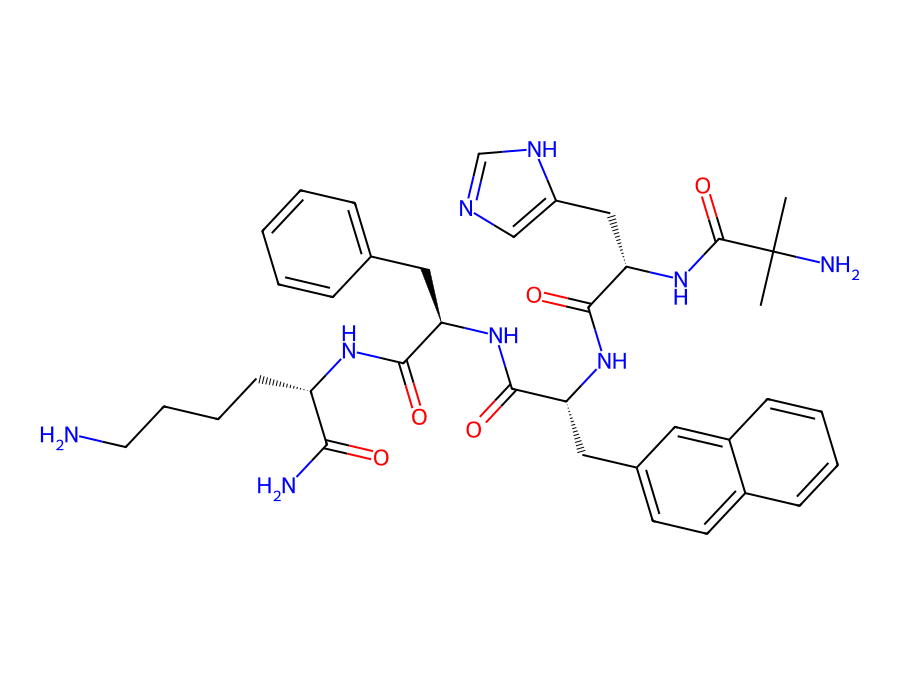
The structure is largely non-natural. Of its five residues, only two (histidine and lysine) are ordinary L-amino acids. The other three are deliberate:

Three engineered positions, each doing one job

Aib at the N-terminus is 2-aminoisobutyric acid, an amino acid with two methyl groups in place of the usual hydrogen. It is achiral, and aminopeptidases handle it badly.

D-2-Nal and D-Phe are mirror-image residues carrying bulky aromatic side chains. Proteases are stereospecific; most of them cannot cleave next to a D-residue.

The C-terminus is an amide rather than a free acid, which blocks carboxypeptidase from the other end.

Both termini and the middle are protected. The peptide is not a fragment of anything the body makes; it is engineered to survive in plasma and to act on one receptor.

It binds that receptor and the pituitary responds. The open questions are downstream of that. See the pharmacokinetics section.

Compound data

AibAib
HHis
NalD-2-Nal
FD-Phe
KLys
BasicNon-natural backboneD-amino acid
Three of five residues are not ordinary L-amino acids. Aib resists aminopeptidase, the two D-residues resist almost everything, and the C-terminus is an amide rather than a free acid⁠1

The molecule is engineered end to end for protease resistance. Nothing in it is a fragment of anything the body makes⁠5
ClassLinear pentapeptide amide, growth hormone secretagogue⁠1
SequenceAib-His-D-2-Nal-D-Phe-Lys-NH25
FormulaC38H49N9O5⁠5
Mass711.85 free base, 711.386 monoisotopic⁠56
CAS170851-70-45
UNIIY9M3S784Z6⁠5
InChIKeyNEHWBYHLYZGBNO-BVEPWEIPSA-N⁠6
StereocentresFour, S-R-R-S. Aib is achiral6
DisulfidesNone. No cysteine⁠5
Salt formAcetate. Roughly 76–92% peptide by mass⁠8
ReceptorGHS-R1a, the ghrelin receptor⁠1
Half-life2 h terminal, human, intravenous⁠2
Time to peak GH0.67 h2
Clearance0.078 L/h/kg, Vss 0.22 L/kg⁠2
SC observed?No human figure published
Route in humansIntravenous in every published study⁠23
AppearanceWhite lyophilised powder

Evidence at a glance

ApprovedNowhere. No marketing authorisation in any jurisdiction
Healthy humans dosed40, eight at each of five levels⁠2
Patients in trials114 analysed, plus 320 unreported⁠34
Randomised trials2. One published, one silent
Primary endpoints met0 of 1 reported3
Body composition dataNone in humans
Chronic dosing dataNone. Longest exposure 7 days⁠3
RetractionsNone

Regulatory status

Marketing authorisationNone anywhere. Development was discontinued; it was never approved
USCategory 2 of the FDA's bulk drug substances review since 29 September 2023, as “ipamorelin acetate”: substances that may present significant safety risks in compounding. The stated concern is immunogenicity8
WADAProhibited at all times. Named individually under S2.2.4, growth hormone secretagogues. Non-Specified⁠7
UKNot stated on this page. No UK instrument names it⁠11
AgeNothing in this library is intended for anyone under 18

Related

CJC-1295 (no DAC) + IpamorelinThe pair with the no-DAC releasing-hormone analogue; no study of the pair was found
CJC-1295A growth hormone secretagogue often combined with ipamorelin
TesamorelinThe GH-axis compound that did finish its trials and did get approved
BPC-157A contrasting evidence profile
SemaxAnother peptide with limited human pharmacokinetic data
MOTS-cAnother compound whose mechanism overlaps with exercise physiology
ComparePut it beside the others on the same five axes
MK-677 (Ibutamoren)The oral ghrelin-receptor agonist, with the same mechanism
GHRP-6An earlier compound with the same mechanism, with cortisol, prolactin and appetite effects
HexarelinA related compound whose prolactin and cortisol rises are measured in humans, while the selectivity evidence on this page is in pigs

Identity and salt form.

The identity is unambiguous: one registry record, one CAS number, and no competing molecule sharing the name, unlike CJC-1295 and Semax.

For researchers
Verified three ways

One. The FDA's substance registry holds it under UNII Y9M3S784Z6 as C38H49N9O5, average mass 711.8544, CAS 170851-70-4, with the sequence recorded both as Aib-His-D-2-Nal-D-Phe-Lys-NH2 and as a systematic name ending in lysinamide, which independently confirms the C-terminal amide.⁠5

Two. The formula and mass were rebuilt from the sequence for this page and reconciled by arithmetic: 711.86 derived against 711.85 published, inside this library's 0.1 tolerance. Monoisotopic mass 711.386.⁠6

Three. The structure drawn in the infobox was generated from that reconstructed molecule, and its InChIKey NEHWBYHLYZGBNO-BVEPWEIPSA-N matches the published key character for character. Four stereocentres, S-R-R-S; Aib contributes none because it is achiral.⁠6

The salt form

The free base is not the form in use. The FDA names the substance on its compounding list as “ipamorelin acetate”, and acetate is the salt form.⁠8 Peptide acetate salts typically run 76 to 92% peptide by mass, the remainder being counter-ion and residual water.

Labelled mass and peptide content

The peptide content of a salt is lower than its labelled mass, by roughly 15% here, and HPLC purity does not report peptide content. Purity and peptide content are different measurements.

This is a property of peptide salts generally and applies to most of this library. The gap it introduces (roughly 15%) is larger than the gap the next section is about.

Evidence

Mechanism shown in humans; clinical benefit not shown.

LabAnimalHumanMeta

Evidence found: lab; animal; human.

Ipamorelin has human pharmacokinetics, human pharmacodynamics, a completed randomised placebo-controlled Phase 2 trial, and a second Phase 2 trial nearly three times the size.

For researchers

None of that evidence measures body composition, recovery or injury healing.

QuestionAnswer
Does it raise GH in humans?Yes. Measured, dose-related, at every level tested⁠2
Does it raise IGF-1 in humans?Not established. No chronic human study located
Does it change body composition?Never tested in humans
Does it improve recovery, sleep or injury healing?Never tested in humans
Has it improved any clinical outcome?No. The one outcome trial that reported missed its primary endpoint3

The outcome trial that reported

The trial that took ipamorelin furthest was not about muscle. It tested whether the compound could get bowel function moving again after colorectal surgery: a real clinical problem, and a plausible use for a ghrelin mimetic, since ghrelin drives gut motility.⁠3

DesignPhase 2, multicentre, double-blind, placebo-controlled. Intravenous, for up to 7 days after bowel resection⁠3
Size117 enrolled, 114 analysed
EndpointTime to tolerating a first meal. Shorter is better
Result25.3 h on ipamorelin against 32.6 h on placebo, p = 0.15. Numerically faster, statistically indistinguishable. The endpoint was missed, and the paper reports no significant difference in the key or secondary efficacy analyses⁠3
TolerabilityAny treatment-emergent adverse event: 87.5% on ipamorelin, 94.8% on placebo3

A seven-hour difference that does not reach significance in 114 people leaves the question open. It is consistent with an underpowered trial of a small effect.

A 320-patient trial completed in 2014 with no reported results.

A larger trial followed. NCT01280344 was a Phase 2 dose-finding study run by Helsinn Therapeutics: three intravenous regimens against placebo after bowel resection, at 320 participants: nearly three times the published trial.⁠4

For researchers
RegisteredApril 2011
ArmsThree intravenous regimens and placebo⁠4
Enrolment320, actual: not estimated
Primary completionJune 2013
CompletedMay 2014
Results postedNone. The registry's own results flag is false, and the record was last updated in 2017⁠4
PublicationNone found. A Crossref sweep for a corresponding paper returned nothing⁠10
Non-reporting

A completed trial that does not report leaves the record with only the smaller, underpowered study.

Across medicine, completed trials that never report more often have negative results than published trials do. That is a general pattern, not a finding about this trial; what this trial found is not known.

Scope of this claim: no results are posted to ClinicalTrials.gov and no corresponding publication was found on Crossref. The EU Clinical Trials Register and the WHO ICTRP could not be reached from this environment, so this page says no public result was located rather than that none exists.⁠10

Mechanism

One receptor, one pulse, and a narrower selectivity claim than is often quoted.

GHS-R1a
Ipamorelin binds the growth hormone secretagogue receptor on pituitary somatotrophs: the same receptor ghrelin uses. It is a ghrelin mimetic in the literal sense⁠1
Somatotroph
Receptor activation triggers release of stored growth hormone. It does not increase synthesis; it empties a pool⁠1
GH pulse
A single episode of release. In humans, peak at 0.67 hours after a fifteen-minute infusion, then exponential decline to negligible⁠2
IGF-1?
This is where the chain stops being measured. Growth hormone drives hepatic IGF-1, and IGF-1 is what most of the physique claims actually depend on. No human study located here followed a chronic dosing schedule through to IGF-1, body composition, or anything a person would notice
For researchers

The selectivity claim, stated correctly

Ipamorelin's reputation rests on being clean: growth hormone up, nothing else moved. That claim is real, and it is routinely quoted wider than its source supports.

What is usually saidWhat the 1998 paper actually shows
No effect on ACTH, cortisol, prolactin, FSH, LH or TSH at over 200× the GH doseThe >200× figure attaches to ACTH and cortisol only. The other hormones carry no multiple⁠1
Compared against placeboThe ACTH and cortisol comparison is against GHRH, not placebo⁠1
Demonstrated in humansSwine. GH ED50 2.3 nmol/kg. The selectivity work is animal work⁠1

The narrower finding is still notable. A secretagogue that leaves the adrenal axis alone at two hundred times its effective dose is unusual, and it is the main reason this compound displaced older secretagogues that raised cortisol. It is not the six-hormone, human, placebo-controlled statement it is often repeated as.

Human pharmacokinetics come from intravenous dosing only.

There is one proper human pharmacokinetic study of this compound. Eight healthy men at each of five dose levels, given by intravenous infusion over fifteen minutes.⁠2

For researchers
ParameterValue
Time to peak GH0.67 h
Terminal half-life2 h
Clearance0.078 L/h/kg
Volume, steady state0.22 L/kg
SC50214 nmol/L
Max GH production rate694 mIU/L/h
PharmacokineticsDose-proportional
VariabilityBetween-person variability in the response was larger than in the pharmacokinetics. Same dose, different amount of growth hormone⁠2

The route is the real gap. Every number in that table came from a fifteen-minute intravenous infusion. No human subcutaneous bioavailability figure for ipamorelin could be found. No source reports what fraction of a subcutaneous dose arrives, or how the resulting pulse compares.

Safety and standards

Tolerability in the trials, and an FDA flag.

The tolerability record is favourable and large for this library. Forty healthy men across five dose levels in the pharmacokinetic study, and 114 post-surgical patients in the Phase 2 trial, where adverse events were less frequent on drug than on placebo.⁠23

For researchers
FDA bulk drug substances review

In September 2023 the FDA added ipamorelin acetate to Category 2 of its bulk drug substances review: substances that “may present significant safety risks” if used in compounding. The stated concern is immunogenicity: the possibility that a synthetic peptide provokes an antibody response.⁠8

That concern is about chronic use, and chronic use is precisely what has never been studied. Every human exposure on record is a single dose or seven days after surgery. No study has given this compound for months and looked for antibodies.

What the safety record does not cover

  • Chronic dosing. The longest human exposure located is seven days
  • Subcutaneous administration. Every human safety datapoint is intravenous
  • Healthy people using it for physique. The volunteers received one dose; the patients were recovering from bowel surgery
  • Immunogenicity. Flagged by a regulator, not measured
  • The blend. It is sold with CJC-1295 more often than alone, and no study has tested the combination in humans

Regulatory status

Status by country

Where regulators list this compound, country by country. A country with no line has not been checked yet.

No country or sport list has been checked yet

Not yet checked. North America: Canada, Mexico, United States. South America: Argentina, Brazil. Europe: European Union (central authorisation), Belgium, France, Germany, Italy, Netherlands, Russia, Spain, Switzerland, United Kingdom. Africa: Egypt, Nigeria, South Africa. Asia: China, India, Japan, South Korea, Thailand, United Arab Emirates. Oceania: Australia, New Zealand.

Sport (WADA) applies worldwide, not a country

WADA Prohibited List 2026Not yet checked

Information only, not legal advice. Not verified for any individual situation. Status changes; check the date and the source.

The same records as data: JSON and CSV, with a version and a change log.

Checked and missing

Three claims without human data.

  • Muscle gain. No human study has measured body composition on this compound
  • Equivalence to growth hormone therapy. It empties a pool of stored hormone in a pulse; it does not sustain a level. The pharmacology and physiology differ
  • Injury healing. The idea comes from the GH-IGF-1 axis in general, not from any study of this compound in an injured human

Where the evidence is thinner than it looks.

  • The human PK study is one study. Good design, clean numbers, never independently replicated
  • No human subcutaneous bioavailability figure exists. Every human number on this page came from intravenous dosing. The route people actually use is unmeasured
  • The selectivity data are from swine, at doses expressed as multiples of a swine ED50
  • The mechanism chain is unfinished in humans. Receptor to growth hormone is proven. Growth hormone to IGF-1 to anything a person would notice is not, on this compound
  • Four further human studies exist and are not fully characterised here: a 1998 iontophoretic and intravenous PK study, nasal administration work from 1998 and 2015, and a 2026 postoperative-ileus case series. None changes the outcome picture, but this page does not claim to have read them all⁠9
  • The 320-patient trial is a hole, not a finding. Everything above would read differently if it had reported

Sources11

This page cites 11 sources, numbered to match the small numbers in the text above. Each one links to the paper or record. Where a source states its design, a tag says so (a human trial, an animal study, a cell study, a review); the tag names the design and is not a grade. Each source also links back to where it is cited above.

  1. 01
    Raun K, Hansen BS, Johansen NL, Thøgersen H, Madsen K, Ankersen M, Andersen PH. Ipamorelin, the first selective growth hormone secretagogue. European Journal of Endocrinology 1998;139(5):552-561.AnimalPMID 9849822no read date recorded
    Full text
    Raun K, Hansen BS, Johansen NL, Thøgersen H, Madsen K, Ankersen M, Andersen PH. Ipamorelin, the first selective growth hormone secretagogue. European Journal of Endocrinology 1998;139(5):552-561. PMID 9849822. Source for the compound's origin, its identification as a GHS-R1a agonist, and the selectivity work. ⚠ Scope of the selectivity claim, verified 22 August 2026: the study is in swine, GH ED50 2.3 nmol/kg; the “more than 200-fold” figure attaches to ACTH and cortisol only, and the comparator for that pair is GHRH, not placebo. FSH, LH, prolactin and TSH are reported as unaffected but carry no stated multiple. This page states the narrowed version; the wider six-hormone form of the claim circulates widely and is not what the paper supports.
    Cited 9 times, back to the text12345678and 1 more
  2. 02
    Gobburu JV, Agersø H, Jusko WJ, Ynddal L. Pharmacokinetic-pharmacodynamic modeling of ipamorelin, a growth hormone releasing peptide, in human volunteers. Pharmaceutical Research 1999;16(9):1412-1416.Human RCTPMID 10496658read 22 Aug 2026
    Full text
    Gobburu JV, Agersø H, Jusko WJ, Ynddal L. Pharmacokinetic-pharmacodynamic modeling of ipamorelin, a growth hormone releasing peptide, in human volunteers. Pharmaceutical Research 1999;16(9):1412-1416. PMID 10496658. Dose escalation in healthy men, eight subjects at each of five dose levels (4.21, 14.02, 42.13, 84.27 and 140.45 nmol/kg), by infusion over fifteen minutes. Source for time to peak growth hormone 0.67 h, terminal half-life 2 h, clearance 0.078 L/h/kg, steady-state volume 0.22 L/kg, dose-proportional pharmacokinetics, SC50 214 nmol/L, maximum growth hormone production rate 694 mIU/L/h, and the finding that inter-individual variability in the pharmacodynamic parameters exceeded that in the pharmacokinetics. Read at source 22 August 2026. Note: the record does not state a total number of subjects, so the figure of forty used on this page is eight multiplied by five levels and assumes no subject appeared at more than one level.
    Cited 10 times, back to the text12345678and 2 more
  3. 03
    Beck DE, Sweeney WB, McCarter MD. Prospective, randomized, controlled, proof-of-concept study of the ghrelin mimetic ipamorelin for the management of postoperative ileus in bowel resection patients. International Journal of Colorectal…Human RCTPMID 25331030DOI 10.1007/s00384-014-2030-8no read date recorded
    Full text
    Beck DE, Sweeney WB, McCarter MD. Prospective, randomized, controlled, proof-of-concept study of the ghrelin mimetic ipamorelin for the management of postoperative ileus in bowel resection patients. International Journal of Colorectal Disease 2014;29(12):1527-1534. DOI 10.1007/s00384-014-2030-8, PMID 25331030, registered as NCT00672074. Phase 2, multicentre, double-blind, placebo-controlled; intravenous 0.03 mg/kg twice daily for up to seven days after bowel resection; 117 enrolled, 114 in the modified intention-to-treat analysis. Source for 25.3 hours on ipamorelin against 32.6 hours on placebo, p = 0.15 — the paper's own wording places 25.3 h in the ipamorelin arm, and shorter time to a tolerated meal is the favourable direction, so the drug arm was numerically faster and statistically indistinguishable. Also the source for the absence of significant differences in the key and secondary efficacy analyses, and for treatment-emergent adverse events in 87.5% of the ipamorelin arm against 94.8% of placebo. The registry states the primary outcome as recovery of gastrointestinal function; the publication describes it as time to tolerance of a first meal.
    Cited 10 times, back to the text12345678and 2 more
  4. 04
    ClinicalTrials.gov record NCT01280344, read at source 22 August 2026 via the single-record endpoint. Phase 2 dose-finding study of ipamorelin for the management of postoperative ileus following partial small or large bowel resection…NCT01280344read 22 Aug 2026
    Full text
    ClinicalTrials.gov record NCT01280344, read at source 22 August 2026 via the single-record endpoint. Phase 2 dose-finding study of ipamorelin for the management of postoperative ileus following partial small or large bowel resection, sponsored by Helsinn Therapeutics (U.S.), Inc. Four arms: 0.03 mg/kg twice daily, 0.06 mg/kg twice daily, 0.06 mg/kg three times daily, and placebo. Enrolment 320, recorded as actual rather than estimated. Study start April 2011, primary completion June 2013, overall completion May 2014, overall status Completed, hasResults false, record last updated 2017. No results have been posted.
    Cited 4 times, back to the text1234
  5. 05
    FDA Global Substance Registration System substance record for ipamorelin, UNII Y9M3S784Z6, read at source 22 August 2026. Source for molecular formula C38H49N9O5, average molecular weight 711.8544, CAS 170851-70-4, and the sequence…read 22 Aug 2026
    Full text
    FDA Global Substance Registration System substance record for ipamorelin, UNII Y9M3S784Z6, read at source 22 August 2026. Source for molecular formula C38H49N9O5, average molecular weight 711.8544, CAS 170851-70-4, and the sequence recorded both as Aib-His-D-2-Nal-D-Phe-Lys-NH2 and as a systematic name terminating in lysinamide, which independently confirms the C-terminal amide. A separate registry record exists for N-acetyl ipamorelin at 753.89, which is a different molecule and not a salt of this one; it is noted here because adjacent registry records are a known source of transcription error on peptide pages.
    Cited 8 times, back to the text12345678
  6. 06
    Structure and mass reconciliation performed for this page, 22 August 2026. The molecule was rebuilt from the sequence Aib-His-D-2-Nal-D-Phe-Lys-NH 2, giving molecular formula C38H49N9O5, average mass 711.87 against the registry's 711.85 —…no read date recorded
    Full text
    Structure and mass reconciliation performed for this page, 22 August 2026. The molecule was rebuilt from the sequence Aib-His-D-2-Nal-D-Phe-Lys-NH2, giving molecular formula C38H49N9O5, average mass 711.87 against the registry's 711.85 — a difference of 0.02, inside this library's 0.1 tolerance — monoisotopic mass 711.386, and InChIKey NEHWBYHLYZGBNO-BVEPWEIPSA-N, which matches the published key for this CAS number character for character. Four assigned stereocentres in the order S, R, R, S, consistent with L-His, D-2-Nal, D-Phe and L-Lys, with Aib contributing none because it is achiral. The skeletal structure displayed in the infobox was rendered from that reconstructed molecule rather than retrieved from a third party.
    Cited 5 times, back to the text12345
  7. 07
    World Anti-Doping Agency Prohibited List, section S2.2.4, growth hormone secretagogues. Ipamorelin is named individually, prohibited at all times, and classified non-Specified. Verified 22 August 2026 against two independent permitted…no read date recorded
    Full text
    World Anti-Doping Agency Prohibited List, section S2.2.4, growth hormone secretagogues. Ipamorelin is named individually, prohibited at all times, and classified non-Specified. Verified 22 August 2026 against two independent permitted mirrors of the current list, the WADA site itself being unreachable by automated retrieval. Non-Specified status is the stricter category for sanctioning purposes.
    Back to the text1
  8. 08
    US Food and Drug Administration, bulk drug substances nominated for use in compounding, Category 2 — substances that may present significant safety risks. “Ipamorelin acetate” was added on 29 September 2023, with the agency's stated…read 22 Aug 2026
    Full text
    US Food and Drug Administration, bulk drug substances nominated for use in compounding, Category 2 — substances that may present significant safety risks. “Ipamorelin acetate” was added on 29 September 2023, with the agency's stated concern being immunogenicity. Read at source 22 August 2026. Also the basis for this page's statement that the marketed material is the acetate salt rather than the free base; peptide acetate salts typically comprise 76 to 92% peptide by mass, with the balance counter-ion and residual water, which is a general property of peptide acetates rather than a measurement of any particular vial.
    Cited 4 times, back to the text1234
  9. 09
    Additional human literature identified but not fully characterised for this page: a 1998 study of iontophoretic and intravenous administration, nasal administration work published in 1998 and 2015, and a 2026 case series in postoperative…Human observationalno read date recorded
    Full text
    Additional human literature identified but not fully characterised for this page: a 1998 study of iontophoretic and intravenous administration, nasal administration work published in 1998 and 2015, and a 2026 case series in postoperative ileus. Identified via Crossref on 22 August 2026. None of these is an outcome study in healthy people and none changes the evidence position described on this page, but they are recorded here because the statement “one human pharmacokinetic study” would otherwise overstate the scarcity of human work. This page has not read them in full.
    Back to the text1
  10. 10
    Search for a published report of NCT01280344, conducted 22 August 2026.NCT01280344no read date recorded
    Full text
    Search for a published report of NCT01280344, conducted 22 August 2026. A Crossref bibliographic sweep on the sponsor, indication, compound and design returned no corresponding publication. The EU Clinical Trials Register and the WHO International Clinical Trials Registry Platform could not be reached from this environment. This page therefore states that no public result was located, not that none exists.
    Cited 2 times, back to the text12
  11. 11
    UK legal position, searched 22 August 2026. No United Kingdom statutory instrument on legislation.gov.uk names ipamorelin, and no MHRA marketing authorisation exists for it. This page draws no conclusion from that. Whether a given…read 22 Aug 2026
    Full text
    UK legal position, searched 22 August 2026. No United Kingdom statutory instrument on legislation.gov.uk names ipamorelin, and no MHRA marketing authorisation exists for it. This page draws no conclusion from that. Whether a given substance falls within the Human Medicines Regulations 2012 turns on presentation and function rather than on being named, and that is a legal determination this page is not in a position to make. Stated here as a documented gap rather than a status.
    Back to the text1

Where it sits

Primary studies

Don’t take our word for it. Read the study.

Read first: 03, 02.

Where this compound is sold

Affiliate links. Coredex earns a commission if a reader buys through the links in this table. The commission has no influence on what the page above reports. The publisher also has a partner relationship with TheDhust. Read the full disclosure.

One vendor, TheDhust, is listed.

VendorProduct and sizePublic lab report
TheDhustIpamorelin, 10 mgNot published