Semax
ACTH(4-7)PGP, Met-Glu-His-Phe-Pro-Gly-Pro, semax acetate, heptapeptide
Semax is a synthetic seven-residue analogue of an ACTH fragment, registered as a prescription medicine in Russia for about thirty years. Its mechanism is described mostly in rodents, and independent reviewers could not access the primary human data.
- 7-residue ACTH fragment
- Cognition, stroke
- Intranasal
Where to buy, code BENTheDhust, ships to the United States
- Compounds
- Cognition and neuroactive
- Neuropeptides
- ACTH-derived
- Semax
Where to buy
TheDhust
- Semax, 10 mgView at TheDhust
- Semax + Spray Kit, size per product labelView at TheDhust
Affiliate link. Coredex earns a commission if you buy through it. It does not change what you pay or what this page reports, and listing a vendor is not a recommendation. Each vendor’s own listing says what an item is sold as (a supplement, a medicine or research material); read it before you order. Read the full disclosure. Full vendor table.
Overview
About thirty years of clinical use in Russia, where it is a registered medicine on the essential-medicines list
No serious harm recorded; the seizure-threshold caution sometimes repeated has no valid mechanism
Two human papers out of twenty-seven are readable in English, and a high-affinity brain binding site exists whose protein has not been identified
An ACTH fragment without the adrenal-stimulating sequence.
Semax is a seven-residue peptide built from a fragment of adrenocorticotropic hormone, the pituitary hormone that tells the adrenal gland to make cortisol. It was developed in the late 1980s at the Institute of Molecular Genetics of the Russian Academy of Sciences, and it has been a registered prescription medicine in Russia for roughly thirty years.114
For researchers
The design premise is a dissociation: keep ACTH's effects on the brain, lose its effects on the adrenal gland. The sequence accounts for the dissociation.
Every melanocortin receptor, including the one ACTH uses to drive cortisol, requires the same four-residue pharmacophore to be activated: His-Phe-Arg-Trp.9
Semax carries His and Phe, and then stops. Where Arg and Trp should sit, it has Pro-Gly-Pro instead.
It is missing half the pharmacophore, and specifically the half that does most of the binding. The absence of hormonal activity follows from the sequence.
The Pro-Gly-Pro tail has a second role. Bare ACTH fragments survive minutes in plasma. The Pro-Gly-Pro was added specifically to resist carboxypeptidase, and prolines are poor substrates for it. Two of seven residues in this molecule exist for no reason other than to stop it being eaten.1
The tail is also the fragment that persists in tissue: see the pharmacology.
Compound data
His and Phe are two thirds of what a melanocortin receptor needs. The Arg and Trp that would complete the pharmacophore are exactly where the tail sits instead9
| Class | Linear heptapeptide, ACTH(4-7) analogue1 |
| Sequence | Met-Glu-His-Phe-Pro-Gly-Pro2 |
| Formula | C37H51N9O10S2 |
| Mass | 813.92 |
| PubChem | CID 98111022 |
| InChIKey | AFEHBIGDWIGTEH-AQRCPPRCSA-N2 |
| CAS | 80714-61-07 |
| Composition | Two prolines of seven, both in the C-terminal tail1 |
| Disulfides | None. No cysteine in the sequence2 |
| Basic residues | One histidine. A comparatively low counter-ion load |
| Salt form | Usually acetate |
| Binding | Kd 2.41 ± 1.02 nM, rat basal forebrain. Protein unidentified8 |
| Route | Intranasal, clinically and in most research4 |
| Effect duration | 20–24 h in animal models, single dose1 |
| Nose to brain | 0.093% per gram brain at 2 min, rat, ~80% intact6 |
| Main metabolite | Pro-Gly-Pro, and it is independently active613 |
| Appearance | White lyophilised powder, or a nasal solution |
Evidence at a glance
| Approved | Yes, in Russia. Not approved by the FDA or MHRA4 |
| In clinical use since | Approximately 30 years1 |
| Controlled trials, West | None |
| Healthy adults | 24, one imaging study4 |
| Stroke patients | 654 across a meta-analysis4 |
| Primary data accessible | Largely no. Russian language, abstracts only4 |
| Literature span | 1986–2025, 24 journals16 |
| Human / animal papers | 2 / 7, plus 18 unclassified16 |
| Retractions | None |
Regulatory status
| Russia | Registered prescription medicine, in clinical use approximately 30 years. Indications include ischaemic stroke, transient ischaemic attack and cognitive disorders. Listed on the state Vital and Essential Medicines list418 |
| CIS | Prescription medicine in several neighbouring states4 |
| US | Not FDA approved. Removed from Category 2 of the 503A bulk substances list, page current as of 22 April 2026. The nominator withdrew the nomination; it was not because the agency's safety assessment changed. The FDA's stated concern is still printed on the withdrawn list14 |
| US, next step | Considered by the Pharmacy Compounding Advisory Committee, 23–24 July 2026. A committee recommendation is not a rule; notice-and-comment rulemaking would still be required19 |
| UK and EU | Not authorised by the MHRA or the EMA |
Related
| Selank + Semax | The two-peptide blend; the two have been studied side by side, not together |
| AP503 | Peptide |
| BPC-157 | Peptide studied for tissue repair |
| CJC-1295 | Growth hormone-releasing hormone analogue |
| TB-500 | Thymosin beta-4 fragment peptide |
| MOTS-c | Mitochondrial-derived peptide |
| PT-141 | Melanocortin receptor agonist |
| Ziconotide | Conotoxin-derived peptide, approved medicine |
| Ipamorelin | Growth hormone secretagogue peptide |
| Selank | Tuftsin-derived heptapeptide from the same institute |
| Compare | Side-by-side comparison |
| Cerebrolysin | Porcine brain-derived peptide mixture |
| Noopept | Nootropic compound developed at the Zakusov Institute |
Semax and NASA are different peptides, and only Semax has human data.
A product name can cover more than one molecule. On CJC-1295 it covers two peptides with very different durations of action. On TB-500 it covers three. Here it covers two.
For researchers
| Semax | N-Acetyl Semax Amidate | |
|---|---|---|
| Sequence | Met-Glu-His-Phe-Pro-Gly-Pro | Ac-Met-Glu-His-Phe-Pro-Gly-Pro-NH2 |
| Formula | C37H51N9O10S | C39H54N10O10S |
| Mass | 813.9 | 855.0 |
| PubChem | CID 98111022 | CID 1726386033 |
| Human data | Stroke trials, mostly Russian-language4 | None found |
| Published PK | Rodent, intranasal, tritium-labelled6 | None found |
Two claims are made for NASA in product listings: a plasma half-life of about 30 minutes against 3 to 5 minutes for plain Semax, and greater potency.
Searched on 12 August 2026 for primary pharmacokinetic data on N-acetyl semax amidate, restricted to pubmed.ncbi.nlm.nih.gov, pmc.ncbi.nlm.nih.gov, ncbi.nlm.nih.gov, sciencedirect.com and nih.gov. Terms: "N-acetyl semax amidate" pharmacokinetics half-life and acetyl-semax primary research.
No half-life study. No comparative pharmacokinetics. No potency comparison.
What does exist is one real paper, on how N-terminal acetylation changes the molecule's copper and zinc coordination.5 The paper is a chemistry study, not a study of duration of action in any organism.
The proposed mechanism is plausible. Acetylation does block aminopeptidases and amidation does block carboxypeptidases; that is standard peptide chemistry and it is why the modifications are made. Plausible is not measured, and no source has been found for the specific numbers quoted.
The claimed advantage of NASA therefore rests on a pharmacokinetic claim that has not been published, the same pattern as the finding on TB-500.
The PubChem number widely listed for this compound belongs to a steroid.
The registry identifier was verified before the structure was accepted. The identifier widely listed for Semax points to a different class of molecule.
For researchers
| Source | CID | What that record actually contains |
|---|---|---|
| Product listings, widely | 11917320 | C24H36O3, 372.5. A hydroxyacetyl steroid. Wrong chemical class, less than half the mass2 |
| Verified | 9811102 | C37H51N9O10S, 813.9, titled "ACTH (4-7), Pro-Gly-Pro-"2 |
A steroid and a heptapeptide differ in elements, class and mass. Following the widely listed number leads to a molecule with no relationship to Semax.
One. The PubChem record at CID 9811102 returns C37H51N9O10S at 813.9, InChIKey AFEHBIGDWIGTEH-AQRCPPRCSA-N.2
Two. The formula and mass were derived independently from the sequence Met-Glu-His-Phe-Pro-Gly-Pro and reconciled by arithmetic: 813.93 derived against 813.9 published, inside this library's 0.1 tolerance.15
Three. The CAS registry number 80714-61-0 appears in the indexed chemical list of a peer-reviewed paper on this compound, tied to the substance name "ACTH (4-7), Pro-Gly-Pro-" the same title PubChem gives CID 9811102.7
The InChIKey's second block is AQRCPPRCSA and not UHFFFAOYSA, so this is the stereochemistry-defined record. There is no flat-record ambiguity here, unlike MOTS-c.
A widely republished identifier also needed correction for CJC-1295, where the entry pointed to a different peptide.
Evidence
Twenty-seven papers, two of them human.
Evidence found: lab; animal; human, Russian-language; approved in Russia.
Semax is a licensed medicine in Russia with three decades of clinical use behind it. Most of the primary human data could not be accessed by independent reviewers.
For researchers
The independent assessment comes from the Alzheimer's Drug Discovery Foundation, whose Cognitive Vitality reports are written by neuroscientists and take no money from anyone selling anything:4
"Semax may be beneficial in stroke patients (and is used for stroke in Russia), but published literature of well-conducted studies is lacking."
"There is not a strong rationale (and little evidence) that intranasal semax is useful for age-related indications."
| Human study | n | Finding | Accessible? |
|---|---|---|---|
| Lebedeva 2018 | 24 healthy | Raised resting fMRI signal in a default-mode subcomponent vs placebo4 | Yes |
| Cited in Kolomin 2013 | not stated | Improved attention and short-term memory4 | Reviewers could not access it |
| Gusev 1997 | not stated | Improved neurological function in stroke, added to standard care4 | Abstract only, Russian |
| Gusev 2017 | 110 stroke | Raised plasma BDNF; high-BDNF patients rehabilitated sooner4 | Abstract only, Russian |
| Meta-analysis | 654 / 181 | NIHSS improved at 10–14 and 21 days in moderate to severe stroke4 | Mixed |
A neuroscience institute writing a formal review of this compound could not obtain the primary human data it was reviewing.4
This does not indicate that the studies are flawed. The primary data have not been checkable outside the originating system.
Where the literature comes from
The research is heavily concentrated in the Institute of Molecular Genetics of the Russian Academy of Sciences, around the group of N. F. Myasoedov, which also developed the compound.1 Myasoedov appears as an author on studies across the mechanistic, neurochemical and clinical literature.7
The pattern resembles BPC-157, where the page records more than 190 PubMed articles with over 80% listing one of two names. The concentration here has not been quantified to a percentage and this page does not claim one. The developer's own institute is the dominant source of the evidence for the compound it developed, which is a structural limitation independent of the integrity of the authors.
Indexed coverage runs 1986 to 2025 across 24 journals, and of 27 papers catalogued: 2 human, 7 animal, 18 unclassified.16
Nothing has been retracted and there is no misconduct finding, unlike the compound whose foundational study was withdrawn. The limitations are accessibility and independence.
Mechanism
A high-affinity brain binding site exists; the protein is unidentified.
No receptor protein for Semax has been identified. One binding measurement exists.
For researchers
Kd = 2.41 ± 1.02 nM at plasma membranes of rat forebrain basal nuclei. Specific, reversible, time-dependent, calcium-dependent.8
This is a high-affinity target-engagement measurement.
The molecular identity of that site has never been characterised.
Semax has a saturable, high-affinity binding site in the brain, and the protein is unidentified. It is a melanocortin derivative by ancestry and not a melanocortin agonist by structure, for the reason set out in What it is.
Neurotrophin pathway
"Semax increases BDNF" summarises a more complicated result. The effect is region-dependent and time-dependent, and it is not uniformly upward.
Both neurotrophin genes decreased in rat hippocampus twenty minutes after administration, while increasing in frontal cortex over the same window.11 The independent review that collates this literature records BDNF elevated at three hours and not at twenty-four.4
All of it is rodent. The only human BDNF measurement is in stroke patients, reported in a Russian-language abstract.4
Serotonin yes, dopamine no
A 2005 study is cited as evidence that Semax is dopaminergic. The title describes a dopaminergic effect; the results do not show one.7
| What was measured | Result |
|---|---|
| Striatal 5-HIAA, tissue, 2 h | +25%7 |
| Striatal 5-HIAA, extracellular, 1–4 h | Up to 180%7 |
| Dopamine and its metabolites, Semax alone | No change at all7 |
| Dopamine, Semax given 20 min before amphetamine | Amphetamine's effect dramatically enhanced7 |
In the authors' own words the peptide "failed to alter the tissue and extracellular concentrations of dopamine and its metabolites."7 The dopamine finding is entirely a drug interaction. Semax on its own did nothing to it; Semax plus amphetamine did a great deal.
The "dopaminergic nootropic" framing is therefore not supported. The one large dopamine effect in this study arose from combination with amphetamine, which is a drug-interaction finding.
Also reported: reduced post-ischaemic nitric oxide generation12, and inhibition of prolyl endopeptidase, a plausible route by which other neuropeptides would last longer.
In an MPTP model of Parkinson's disease, intranasal Semax increased anxiety-like behaviour and did not change motor behaviour. An earlier study in the same model found partial behavioural improvement.4
Both results are reported because both exist in the rodent literature.
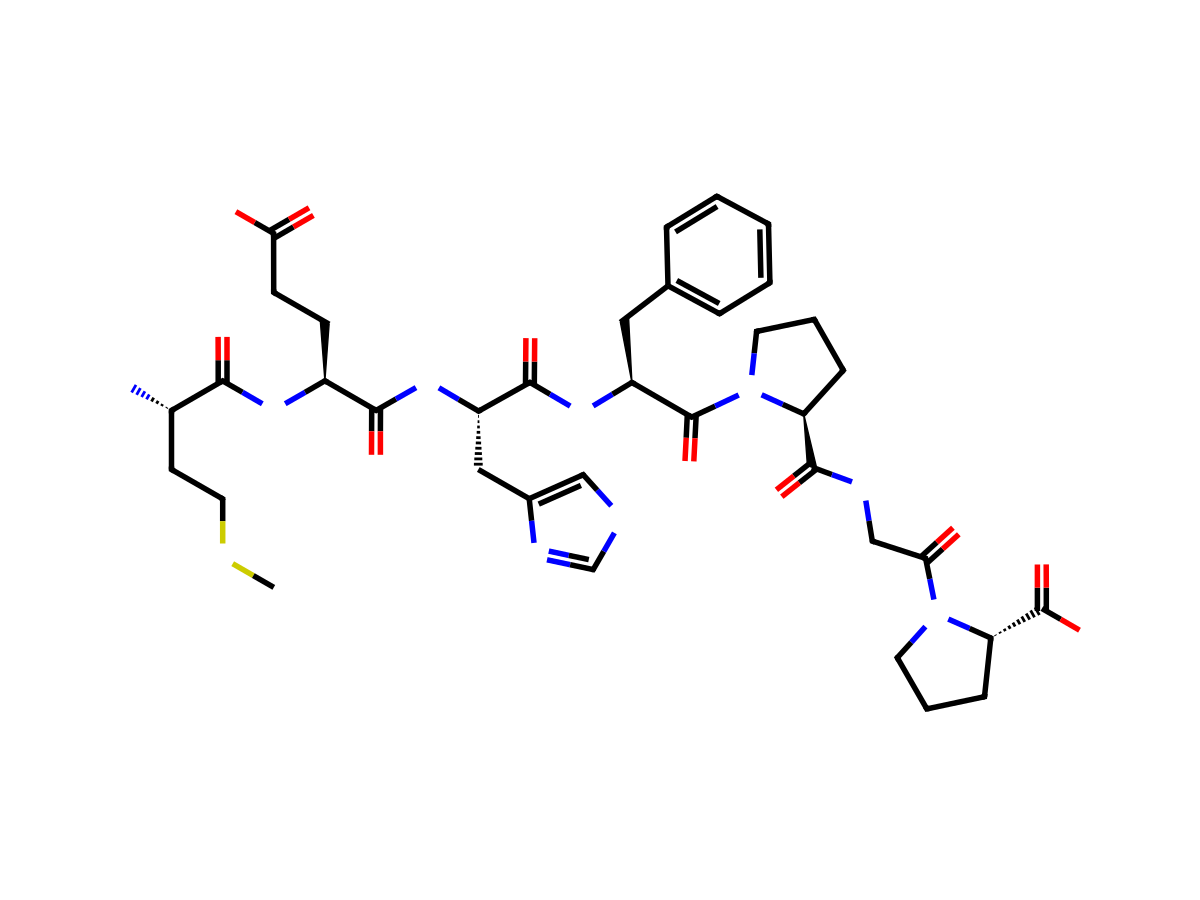
The Pro-Gly-Pro tail is the fragment that persists after metabolism.
Nose-to-brain delivery was measured for Semax in rats. Tritium-labelled Semax, label on the C-terminal proline, was given intranasally:6
For researchers
| Measurement | Value |
|---|---|
| Radioactivity per gram of brain, at 2 minutes | 0.093% of the administered dose6 |
| Fraction still intact peptide | About 80%6 |
| Equivalent human measurement | None exists |
Radioactivity reached the brain within two minutes, at 0.093% of the administered dose per gram. The fraction that crosses in a person has not been measured.
Pro-Gly-Pro predominates in biological samples relative to intact Semax plus its other metabolites.6 The tail is what is left over.
And Pro-Gly-Pro is not inert. Semax and Pro-Gly-Pro both activate transcription of neurotrophins and their receptor genes after cerebral ischaemia; the fragment has activity of its own.13
The three residues added to stop digestion are therefore also the fragment that survives, and they are independently active. Some of the activity of the compound may come from the stabilising tail.
Route changes the effect
Intranasal administration outperformed intraperitoneal for passive-avoidance learning, while an analgesic effect seen after injection did not appear at all after nasal administration.4
A smaller exposure would be expected to produce a weaker version of the same effect, not a different set of effects. Findings from injected Semax therefore cannot be read across to the intranasal route, and most of the rodent pharmacology was done by injection.
Effects in animal models are described as lasting 20 to 24 hours after a single intranasal dose.1 Plasma residence is a small fraction of that.
When half-life and duration of effect differ by that margin, no schedule of administration can be derived from the pharmacology. This page publishes none.
Safety and standards
The reported nasal discoloration figure could not be traced to primary data.
A figure circulates in the secondary literature that about 10% of patients develop discoloration of the nasal cavity, alongside increased blood glucose in around 7.4% of diabetics.4
For researchers
The chain is third-hand. The independent review quotes a 2013 Russian review for the figure, and states in the same document that it could not access the primary human data.4
And a second index disagrees. A compound database cataloguing 27 papers on Semax does not record nasal discoloration at all; its listed adverse effects are mild nasal irritation, occasional headache, overstimulation, and mild fatigue.16
Two independent secondary sources disagree, and the higher figure has the weaker chain of sourcing. Both are reported here.
Long-term safety data in healthy people do not exist. Russian clinical use is long, but the safety record from it comes from non-blinded practice.4
The FDA's bulk substances listing states a safety position:14
Compounded drugs containing semax "may pose risk for immunogenicity for certain routes of administration due to the potential for aggregation and peptide-related impurities. FDA has no, or limited, safety-related information for proposed routes of administration. Therefore, the agency lacks sufficient information to know whether the drug would cause harm if administered to humans."14
This is a statement of insufficient information, not a finding of harm. The agency applies the same wording to many substances on the list.
A warning that Semax may lower the seizure threshold via melanocortin activity, with epilepsy as a contraindication, has been repeated in secondary sources.
The stated rationale does not hold against the sequence. If the melanocortin pharmacophore is not intact, the mechanism given for the caution does not exist, and no source supports it.
Regulatory status
Status by country
Where regulators list this compound, country by country. A country with no line has not been checked yet.
No country or sport list has been checked yet
Not yet checked. North America: Canada, Mexico, United States. South America: Argentina, Brazil. Europe: European Union (central authorisation), Belgium, France, Germany, Italy, Netherlands, Russia, Spain, Switzerland, United Kingdom. Africa: Egypt, Nigeria, South Africa. Asia: China, India, Japan, South Korea, Thailand, United Arab Emirates. Oceania: Australia, New Zealand.
Sport (WADA) applies worldwide, not a country
| WADA Prohibited List 2026 | Not yet checked |
|---|
Information only, not legal advice. Not verified for any individual situation. Status changes; check the date and the source.
The same records as data: JSON and CSV, with a version and a change log.
Checked and missing
Four commonly made claims and the evidence behind them.
- Dopamine increase. The study cited for this finding measured no change in dopamine or its metabolites from Semax alone7
- BDNF increase. Every BDNF measurement on this page is from rodent brain tissue, elevated at three hours and not at twenty-four, and downward in one region while upward in another1011
- Cortisol or adrenal axis effects. Semax does not act on the adrenal axis. This follows from the structure of the sequence9
- Human evidence. The controlled human work is in stroke patients, plus 24 healthy volunteers in a scanner4
Limits of the evidence.
- The primary human data are not accessible outside the originating system, including to the neuroscientists who formally reviewed them.4
- The literature is concentrated in the institute that developed the compound. Not quantified as a percentage on this page, because the calculation has not been run.1
- Almost all mechanism is rodent, much of it by a route different from the clinical one, and effects are region- and time-dependent in ways summaries drop.1011
- The binding site is unidentified. A Kd without a named protein is a real measurement of an unknown thing.8
- The testing dataset is shop-selected, so it describes published batches rather than the market.17
- Melanocortin receptor activity in either direction, and the seizure-threshold caution built on it, are not supported by the sequence9
Sources19
This page cites 19 sources, numbered to match the small numbers in the text above. Each one links to the paper or record. Where a source states its design, a tag says so (a human trial, an animal study, a cell study, a review); the tag names the design and is not a grade. Each source also links back to where it is cited above.
- 01Semax development history, sequence rationale and effect duration. The compound was developed at the Institute of Molecular Genetics of the Russian Academy of Sciences in the late 1980s from the ACTH(4-10) fragment, with the C-terminal…no read date recordedCited 10 times, back to the text12345678and 2 moreSemax development history, sequence rationale and effect duration. The compound was developed at the Institute of Molecular Genetics of the Russian Academy of Sciences in the late 1980s from the ACTH(4-10) fragment, with the C-terminal Pro-Gly-Pro added to resist carboxypeptidase degradation. Effects in animal models are described as persisting 20 to 24 hours after a single intranasal dose at 0.015 to 0.050 mg/kg, against a plasma residence far shorter, which is the pharmacokinetic/pharmacodynamic disconnect this page describes. Background compiled from the peer-reviewed literature at references 4, 6, 7, 8, 10 and 11, all of which originate wholly or partly from that institute.
- 02PubChem compound record CID 9811102, titled "ACTH (4-7), Pro-Gly-Pro-", retrieved 12 August 2026.read 12 Aug 2026Cited 10 times, back to the text12345678and 2 more
Full text
PubChem compound record CID 9811102, titled "ACTH (4-7), Pro-Gly-Pro-", retrieved 12 August 2026. C37H51N9O10S, molecular weight 813.9, InChIKey AFEHBIGDWIGTEH-AQRCPPRCSA-N. The second InChIKey block is AQRCPPRCSA rather than UHFFFAOYSA, confirming the stereochemistry-defined record. Also the source for the finding that PubChem CID 11917320, the identifier published on vendor pages for this compound, returns C24H36O3 at 372.5 g/mol, a hydroxyacetyl steroid of an entirely different chemical class. Both records read directly at source. - 03PubChem compound record CID 172638603, N-acetyl semax amidate, retrieved 12 August 2026.read 12 Aug 2026Back to the text1
Full text
PubChem compound record CID 172638603, N-acetyl semax amidate, retrieved 12 August 2026. C39H54N10O10S, molecular weight 855.0, InChIKey QQOAKFVAEDCKGY-HPMAGDRPSA-N. Stereochemistry-defined. Consistent with acetylation adding C2H2O and amidation exchanging a hydroxyl for an amine against the parent peptide at reference 2. - 04Alzheimer's Drug Discovery Foundation, Cognitive Vitality Report on Semax, written for researchers. Independent, neuroscientist-authored, and not funded by any seller of the compound. Source for both quoted conclusions, for the human study…no read date recordedCited 25 times, back to the text12345678and 17 more
Full text
Alzheimer's Drug Discovery Foundation, Cognitive Vitality Report on Semax, written for researchers. Independent, neuroscientist-authored, and not funded by any seller of the compound. Source for both quoted conclusions, for the human study table including the Lebedeva 2018 24-person imaging study, the Gusev 1997 and 2017 stroke studies, the meta-analysis figures and the explicit statements that the reviewers were unable to access the Russian-language primary data; for the adverse-effect figures attributed to the Kolomin 2013 review including nasal discoloration in approximately 10% and raised blood glucose in approximately 7.4% of diabetics; for the BDNF timing at three hours but not twenty-four; for the MPTP model results in both directions; for the route-dependent difference between intranasal and intraperitoneal administration; and for the Russian and CIS regulatory positions. - 05Bossak-Ahmad et al., N-terminus acetylation of Semax and its effect on copper(II) and zinc(II) coordination, Journal of Inorganic Biochemistry, 2016, PMID 27586814.PMID 27586814no read date recordedBack to the text1
Full text
Bossak-Ahmad et al., N-terminus acetylation of Semax and its effect on copper(II) and zinc(II) coordination, Journal of Inorganic Biochemistry, 2016, PMID 27586814. The only primary paper located on the acetylated analogue. It concerns metal-ion coordination chemistry and is not a pharmacokinetic study. Cited here as the sole primary literature on N-acetyl semax amidate, in support of the finding that no published half-life, comparative pharmacokinetic or potency study for that molecule could be located. Search terms and databases recorded on the page. - 06Shevchenko et al., Russian Journal of Bioorganic Chemistry, 2006, PMID 16523722, doi 10.1134/S1068162006010055.AnimalPMID 16523722no read date recordedCited 7 times, back to the text1234567
Full text
Shevchenko et al., Russian Journal of Bioorganic Chemistry, 2006, PMID 16523722, doi 10.1134/S1068162006010055. Tritium-labelled Semax at 56 Ci/mmol with the label on the C-terminal proline, administered intranasally to rats at 50 µg/kg. Source for 0.093% of administered radioactivity per gram of brain at two minutes, for approximately 80% of that being intact peptide, and for the finding that Pro-Gly-Pro predominates in biological samples relative to total Semax plus metabolites. - 07Eremin, Kudrin, Saransaari, Oja, Grivennikov, Myasoedov and Rayevsky, Semax, an ACTH(4-10) analogue with nootropic properties, activates dopaminergic and serotoninergic brain systems in rodents, Neurochemical Research…AnimalPMID 16362768read 12 Aug 2026Cited 10 times, back to the text12345678and 2 more
Full text
Eremin, Kudrin, Saransaari, Oja, Grivennikov, Myasoedov and Rayevsky, Semax, an ACTH(4-10) analogue with nootropic properties, activates dopaminergic and serotoninergic brain systems in rodents, Neurochemical Research 2005;30(12):1493-1500, PMID 16362768, doi 10.1007/s11064-005-8826-8. Abstract read in full at source 12 August 2026. Source for striatal 5-HIAA up 25% in tissue at two hours and up to 180% extracellularly over one to four hours; for the finding, in the authors' words, that the peptide "failed to alter the tissue and extracellular concentrations of dopamine and its metabolites"; and for the enhancement of d-amphetamine's effects on extracellular dopamine and locomotor activity when Semax was given twenty minutes beforehand. The paper's title asserts activation of dopaminergic systems and its own results record no dopamine change from Semax alone. This record's indexed chemical list also carries CAS 80714-61-0 against the substance name "ACTH (4-7), Pro-Gly-Pro-", which is the third independent confirmation of this compound's identity. Study conducted in male C57BL mice at 0.15 mg/kg intraperitoneally. - 08Dolotov et al., binding of Semax to plasma membranes of rat forebrain basal nuclei, Journal of Neurochemistry 2006, PMID 15344653.AnimalPMID 15344653no read date recordedCited 3 times, back to the text123
Full text
Dolotov et al., binding of Semax to plasma membranes of rat forebrain basal nuclei, Journal of Neurochemistry 2006, PMID 15344653. Source for Kd = 2.41 ± 1.02 × 10⁻⁹ M, described as specific, reversible, time-dependent and calcium-dependent. The molecular identity of the binding site is not established in this paper or, so far as could be found, anywhere else. - 09Melanocortin receptor structure-activity relationships. The minimal pharmacophore required to activate any melanocortin receptor is the tetrapeptide His-Phe-Arg-Trp, conserved across the endogenous melanocortins; this is settled…no read date recordedCited 4 times, back to the text1234
Full text
Melanocortin receptor structure-activity relationships. The minimal pharmacophore required to activate any melanocortin receptor is the tetrapeptide His-Phe-Arg-Trp, conserved across the endogenous melanocortins; this is settled structure-activity work supported by multiple independent sources. MC2R, the receptor mediating ACTH's adrenal effects, additionally requires the tetrabasic address sequence Lys-Lys-Arg-Arg-Pro at positions 15 to 19, evidenced functionally by ACTH(1-24) driving glucocorticoid production where ACTH(1-16) does not. Semax carries His and Phe at the ACTH 6 and 7 positions and Pro-Gly-Pro where Arg and Trp would sit, so neither motif is intact. Cited as the structural basis for the compound's absence of hormonal activity, and as the basis for removing from this page a previously carried claim of MC4R activity in either direction and the seizure-threshold caution derived from it. No assay demonstrating melanocortin receptor agonism or antagonism by Semax was located. - 10Dolotov et al., Semax, an analog of ACTH(4-10) with cognitive effects, regulates BDNF and trkB expression in the rat hippocampus, Brain Research 2006, PMID 16996037.AnimalPMID 16996037no read date recordedCited 5 times, back to the text12345
Full text
Dolotov et al., Semax, an analog of ACTH(4-10) with cognitive effects, regulates BDNF and trkB expression in the rat hippocampus, Brain Research 2006, PMID 16996037. Single intranasal dose of 50 µg/kg in rat. Source for BDNF protein up 1.4-fold, TrkB phosphorylation up 1.6-fold, exon III BDNF mRNA up 3-fold and TrkB mRNA up 2-fold in hippocampus. - 11Dolotov et al., SEMAX stimulates BDNF expression in rat brain in vivo, PMID 14556513, and Shadrina et al. on the temporal dynamics of NGF and BDNF expression under Semax in hippocampus, frontal cortex and retina, PMID 19662538 and PMID 18756821.AnimalPMID 14556513no read date recordedCited 3 times, back to the text123
Full text
Dolotov et al., SEMAX stimulates BDNF expression in rat brain in vivo, PMID 14556513, and Shadrina et al. on the temporal dynamics of NGF and BDNF expression under Semax in hippocampus, frontal cortex and retina, PMID 19662538 and PMID 18756821. Source for the region- and time-dependent pattern described on this page, including the decrease in both neurotrophin genes in hippocampus at twenty minutes alongside an increase in frontal cortex. - 12Bashkatova et al., Novel synthetic analogue of ACTH 4-10 (Semax) but not glycine prevents the enhanced nitric oxide generation in cerebral cortex of rats with incomplete global ischemia, PMID 11245825.AnimalPMID 11245825no read date recordedBack to the text1
Full text
Bashkatova et al., Novel synthetic analogue of ACTH 4-10 (Semax) but not glycine prevents the enhanced nitric oxide generation in cerebral cortex of rats with incomplete global ischemia, PMID 11245825. Cited for the post-ischaemic nitric oxide finding. - 13Semax and Pro-Gly-Pro activate transcription of neurotrophins and their receptor genes after cerebral ischaemia, PMID 19633950.AnimalPMID 19633950no read date recordedCited 2 times, back to the text12
Full text
Semax and Pro-Gly-Pro activate transcription of neurotrophins and their receptor genes after cerebral ischaemia, PMID 19633950. Cited for the finding that the Pro-Gly-Pro fragment has neurotrophin-related transcriptional activity independent of the parent peptide, which together with reference 6 supports this page's statement that the stabilising tail is both the predominant metabolite and pharmacologically active. - 14US Food and Drug Administration, Certain Bulk Drug Substances for Use in Compounding that May Present Significant Safety Risks, page content current as of 22 April 2026, read at source 12 August 2026. Semax (heptapeptide) appears in the…read 12 Aug 2026Cited 4 times, back to the text1234
Full text
US Food and Drug Administration, Certain Bulk Drug Substances for Use in Compounding that May Present Significant Safety Risks, page content current as of 22 April 2026, read at source 12 August 2026. Semax (heptapeptide) appears in the table headed "Bulk drug substances nominated but withdrawn", which the page states covers substances "previously in category 2 of the interim policies" that "were withdrawn by the nominators". The FDA's stated safety position is printed alongside it verbatim, quoted on this page. Removal from category 2 followed the withdrawal of the nomination and is not a change in the agency's safety assessment, and it does not place the substance on the 503A bulks list. - 15Molecular mass reconciliation performed for this page, 12 August 2026. The sequence Met-Glu-His-Phe-Pro-Gly-Pro was constructed computationally, its molecular formula asserted against the published C37H51N9O10S, and its average molecular…no read date recordedBack to the text1
Full text
Molecular mass reconciliation performed for this page, 12 August 2026. The sequence Met-Glu-His-Phe-Pro-Gly-Pro was constructed computationally, its molecular formula asserted against the published C37H51N9O10S, and its average molecular mass computed at 813.93 against the published 813.9, a difference of 0.03 and inside this library's 0.1 tolerance. The skeletal structure displayed in the infobox was generated from that same verified structure rather than retrieved from a third party, and was checked at the size this page displays it. Working retained in the vault. - 16A publicly maintained compound index cataloguing 27 papers on Semax across 24 journals from 1986 to 2025, classified as 2 human, 7 animal and 18 unclassified. Used on this page only for the shape of the literature and as a second…no read date recordedCited 4 times, back to the text1234
Full text
A publicly maintained compound index cataloguing 27 papers on Semax across 24 journals from 1986 to 2025, classified as 2 human, 7 animal and 18 unclassified. Used on this page only for the shape of the literature and as a second independent secondary source on reported adverse effects, where it records mild nasal irritation, occasional headache, overstimulation in some people and mild fatigue, and does not record nasal discoloration. It is not cited for pharmacology. Two mechanistic claims taken from it failed verification against primary sources and are not carried on this page; see reference 9. The index carries affiliate relationships with sellers of the compounds it lists and states so. - 17Independent peptide testing and review platform, established 2024, states no advertising, sponsorship or affiliate relationships. Compound page and methodology page both read at source 12 August 2026. Source for 274 Semax lab tests on file…read 12 Aug 2026Back to the text1
Full text
Independent peptide testing and review platform, established 2024, states no advertising, sponsorship or affiliate relationships. Compound page and methodology page both read at source 12 August 2026. Source for 274 Semax lab tests on file with a mean HPLC purity of 99.44% across the 263 carrying a purity value. The methodology page establishes that its published figures are measured HPLC purities and not pass rates, that submissions carry HPLC purity, stated versus tested quantity, testing laboratory, batch identifier and a certificate image, and that in-house vendor testing is not accepted. It also states that current lab data consists of certificates that shops choose to publish, that these may not represent every production batch, and that an anonymous purchase programme is still in development. ⚠ The platform's own compound page states that it purchases vials anonymously, which contradicts its methodology page; this page treats the methodology page as governing and reports the selection bias accordingly. - 18Russian state List of Vital and Essential Medicines for Medical Application. Semax appears on the list; the listing is maintained by government decree and revised periodically, most recently cited in the indexed literature under Decree No.…no read date recordedBack to the text1
Full text
Russian state List of Vital and Essential Medicines for Medical Application. Semax appears on the list; the listing is maintained by government decree and revised periodically, most recently cited in the indexed literature under Decree No. 2406-r of 12 October 2019. ⚠ Single-source. The frequently repeated dates of 1994 for initial registration and 2011 for addition to this list could not be confirmed against a primary Russian regulatory document from this environment, and the wider literature places phase II clinical work in the mid-1990s, which is difficult to reconcile with a 1994 registration. This page therefore states approximately thirty years of clinical use rather than a registration year. - 19US Food and Drug Administration, Pharmacy Compounding Advisory Committee meeting, 23 and 24 July 2026, at which Semax was among the peptide bulk drug substances considered for inclusion on the 503A bulks list. FDA briefing materials for…read 25 Jul 2026Back to the text1
Full text
US Food and Drug Administration, Pharmacy Compounding Advisory Committee meeting, 23 and 24 July 2026, at which Semax was among the peptide bulk drug substances considered for inclusion on the 503A bulks list. FDA briefing materials for that meeting record the agency proposing that semax acetate not be included. A committee vote is a recommendation to the agency and does not itself change the regulatory status of a substance; notice-and-comment rulemaking would be required. Meeting details verified against the FDA advisory committee calendar; the vote outcome is recorded in this project's vault against seven independent news sources, fact-checked 25 July 2026.
Where it sits
Where this compound is sold
Affiliate links. Coredex earns a commission if a reader buys through the links in this table. The commission has no influence on what the page above reports. The publisher also has a partner relationship with TheDhust. Read the full disclosure.
One vendor, TheDhust, is listed.