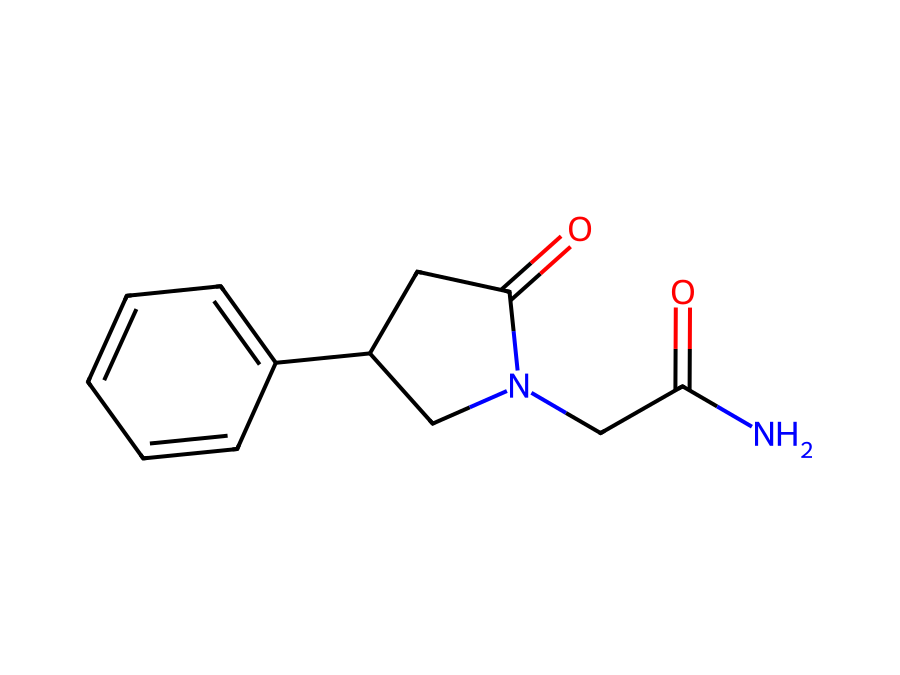
Phenylpiracetam
fonturacetam, carphedon, Phenotropil, 4-phenylpiracetam
Phenylpiracetam is piracetam with a phenyl ring added, which makes it more fat-soluble and gives it stimulant-like effects. It is a registered prescription medicine in Russia. Around sixteen human studies exist, almost all Russian, almost all in patients with stroke, epilepsy or exhaustion, and almost none of them blinded.
- Filed under: Think and work better
- Registered in Russia
- Sixteen studies, almost none blinded
- No controlled trial in healthy adults
- Named on the WADA list
- Compounds
- Cognition and neuroactive
- Racetam-like nootropics
- Phenyl derivative of piracetam
- Phenylpiracetam
Overview
The best summary is a 2025 meta-analysis of eleven reports and 549 patients with asthenia. No placebo-controlled trial in a healthy adult was found. The product is a 50:50 mixture of two mirror-image forms, only one of which carries the effect in animals, and a different molecule, phenylpiracetam hydrazide, is sometimes listed under this name.
A registered medicine with a pharmacological target in animals, forty years of clinical use in one country, and a 2025 meta-analysis of eleven reports in 549 patients with exhaustion reporting a large improvement on a fatigue scale with side effects averaging 5.5%
Little documented: side-effect reporting comes from open-label patient studies in one country, and no long-term controlled safety data exist in anybody, including healthy adults
Whether it does anything in a healthy person. One double-blind placebo-controlled trial could be found, in epilepsy patients, and none in healthy adults. The product is also a racemic mixture whose active half is the one half the animal work points at
Piracetam with a phenyl ring, which changes what it feels like.
Phenylpiracetam is a small molecule of 218 daltons: the piracetam skeleton with a phenyl group attached to the fourth carbon of its ring.1 That addition does two things. It makes the molecule more fat-soluble, so more of it reaches the brain, and it creates a stereocentre, which is the subject of the next section.
For researchers
It is a registered prescription medicine in Russia, sold as Phenotropil and more recently under a second brand, with a registration number and a prescription-only status.2 The clinical literature is the literature of a licensed national medicine studied in patients. In the United Kingdom it is an unlicensed medicine.
The origin story is not sourced. Phenylpiracetam is routinely described as developed for Soviet cosmonauts. What the primary literature contains is a Soviet pharmacology paper from 1983 and a synthesis paper cited to 1980, and neither abstract mentions spaceflight. A 2017 review states the space origin as fact while citing a paper that does not say it. This page does not repeat it; it traces to secondary sources repeating each other.34
Compound data
| Class | Racetam; 4-phenyl piracetam derivative1 |
| Formula | C12H14N2O2, 218.251 |
| InChIKey, racemate | LYONXVJRBWWGQO-UHFFFAOYSA-N1 |
| CAS | 77472-70-91 |
| UNII | 99QW5JU66Y1 |
| INN | Fonturacetam1 |
| Stereochemistry | Racemic. One stereocentre, sold as a 50:50 mixture15 |
| R-form | CID 781883, its own registry entry6 |
| Similar name, different molecule | Phenylpiracetam hydrazide, separate identifier1 |
| Target | Dopamine transporter, "the only significant molecular target found"7 |
| Model for that | Mouse tissue and in vitro only7 |
| Human receptor imaging | None7 |
| Half-life | 3 to 5 h, from a label copy, not a study8 |
| Russia | Registered prescription medicine2 |
| Marketing authorisation (MHRA) | None. An unlicensed medicine14 |
| Authorisation | By country, with sources |
| Selling it in the UK | An offence; possession is not14 |
| UK seizure, 2014 | 2,174 product units14 |
| US status | Unapproved new drug; not a supplement15 |
| Human studies found | 16, almost all Russian, almost all in patients9 |
| Double-blind placebo-controlled | 1, in epilepsy patients11 |
| In healthy adults | None controlled9 |
| Largest summary | 11 reports, 549 patients, asthenia12 |
| WADA | Named, S6.A, in competition10 |
The product is a racemic mixture, and phenylpiracetam hydrazide is a different compound.
First, the mixture. Because of that stereocentre, phenylpiracetam exists as two mirror-image forms, R and S. The medicine, and the compound in general use, is the 50:50 racemic mixture, which the primary pharmacology confirms: it “is clinically used in its racemic form”.5
For researchers
| Form | What it is |
|---|---|
| Phenylpiracetam | The racemate. What every study of the medicine used. Registry identity recorded as racemic1 |
| R-phenylpiracetam | The single form that carries the dopamine-transporter activity in the animal work, developed separately by a pharmaceutical company under a code name. Its own registry entry6 |
| S-phenylpiracetam | Disputed. One group found it much less potent at the transporter; another published a paper calling it a selective transporter inhibitor. Two research groups, two answers67 |
| Phenylpiracetam hydrazide | A DIFFERENT MOLECULE with its own separate registry identifier, and it is listed under the plain name in some product listings1 |
The hydrazide is a different compound with a different structure and no clinical literature at all. Product listings under the plain name included the hydrazide.1
And unlike the CJC-1295 case, where two molecules under one name differ three hundredfold in duration, here the two-forms question has no clinical answer at all: no human study has ever compared the single forms against the mixture. The single-form work is animal and in vitro.6
Evidence
Sixteen studies, about two thousand patients, and one blinded trial.
The count and the quality of the studies point in opposite directions. Searching across the English and Russian literature, including every transliteration of the name, produced sixteen individual human studies, fourteen indexed in the main biomedical database and two found only through a citation index.9
For researchers
| What the human literature is | |
|---|---|
| Studies found | 16, almost all Russian9 |
| Patients, where numbers are stated | About 2,000, dominated by one uncontrolled programme of 1,1709 |
| Populations | Stroke recovery, epilepsy, asthenia, chronic brain ischaemia. Patients, not healthy people9 |
| Double-blind placebo-controlled trials found | One, n=90, as add-on therapy in epilepsy, abstract only11 |
| In healthy adults | None of any design with a control group9 |
The best single summary is a 2025 meta-analysis. Across eleven reports and 549 patients with asthenia, a standard fatigue inventory fell by “an average of 16.3 points (95% CI: 8.85-23.85 points)”, with side effects averaging 5.5%.12
A meta-analysis inherits the design of what it pools. Pooling eleven mostly open-label and uncontrolled reports produces a precise-looking number describing a group of people who knew they were being treated, for a complaint measured by self-report, against no comparator. This is the main caveat, and the reason the compound is graded unestablished rather than effective. The constituent studies could not be opened, so even the pooled figure rests on one abstract.12
Sixteen studies and one blinded trial is the same shape this library found on its noopept and bromantane pages, and on selank, where seventeen human studies produced not one double-blind randomised trial. It is a feature of a body of literature rather than of any one compound.9
No controlled trial in healthy adults.
The entire evidence base is in patients with a diagnosis, not healthy adults. A drug that restores something lost is not thereby a drug that improves something intact.
For researchers
The absence was established rather than assumed, and the search is recorded so a reader can repeat it: the biomedical databases under every transliteration of the name, a citation index, and the trial registries. The one registry record naming it in healthy adults was registered after the study had already finished, has posted no results, and is not a test of efficacy.9
One double-blind placebo-controlled trial exists, in ninety epilepsy patients, as add-on therapy; its effect sizes were not retrievable from the abstract. There is one blinded trial, it is in patients with a neurological disease, and there are none in healthy people.11
Mechanism
A dopamine transporter inhibitor, in mice.
The racetams as a class have a reputation for having no identified target, which is one reason the category is treated sceptically. Phenylpiracetam is the partial exception, and the finding is specific. In radioligand profiling of the R-form, “DAT was the only significant molecular target found”: the dopamine transporter, the protein that clears dopamine out of the synapse.7
For researchers
The mechanism is better characterised than for most compounds in this group, and still thin. There is a named target, found by a method designed to find one, and the whole of that work is in animals and dishes. Whether the transporter effect is what a person taking the racemate experiences has never been measured in a person.7
On pharmacokinetics the position is worse. The figures in circulation, a half-life of three to five hours and essentially complete oral absorption, come from a copy of the Russian product label rather than from a peer-reviewed human study, and no independent human pharmacokinetic paper was found.8
Regulatory status
Regulatory record: Russia, the United Kingdom, the United States and WADA.
It is not a controlled drug in the United Kingdom. A text search of the Misuse of Drugs Act schedules and the Misuse of Drugs Regulations for the name and for every alias returned no entry.13
For researchers
In the United Kingdom it is an unlicensed medicine. The MHRA’s wording, from a 2014 enforcement announcement, is: “While it is not illegal to possess these medicines, sale and supply of a prescription only or unlicensed medicine is an offence”. The same operation seized 2,174 product units of phenylpiracetam among fifteen products, and the investigation began after a British source was found selling it.14
On the question of whether the psychoactive substances legislation reaches it, this page takes no position. A licensed or unlicensed medicinal product is excluded from that Act and governed by the medicines regulations instead, and a pharmacologically active central nervous system drug supplied for human use falls within the statutory definition of a medicinal product. This is a reading of the statute, not a regulator statement; no regulator statement applying it to this compound was found.13
In the United States it is not approved by the FDA and is not a permitted dietary supplement ingredient: a 2019 FDA warning letter named it among products marketed as unapproved new drugs, quoting a claim that it “may be an alternative for those with ADHD not wanting to resort to typical ADHD medications”.15
In sport it is named and it is prohibited in competition, as a non-specified stimulant, with the class preamble covering all optical isomers so both forms are caught. Non-specified is the harsher tier, because it is not a substance an athlete is likely to have taken inadvertently. A caveat on the source is in the gaps.10
Status by country
Where regulators list this compound, country by country. Each line names who listed it, the date it was read and the source. A country with no line has not been checked yet.
Not yet checked. North America: Canada, Mexico, United States. South America: Argentina, Brazil. Europe: European Union (central authorisation), Belgium, France, Germany, Italy, Netherlands, Russia, Spain, Switzerland, United Kingdom. Africa: Egypt, Nigeria, South Africa. Asia: China, India, Japan, South Korea, Thailand, United Arab Emirates. Oceania: Australia, New Zealand.
Sport (WADA) applies worldwide, not a country
| WADA Prohibited List 2026 | Reported status: prohibited in competition by WADA, as of 6 Nov 2026. Source: WADA Prohibited List 2026, as verified for this page (see its sources) source dated 1 Jan 2026 | S6.A, non-specified stimulants: prohibited in competition |
|---|
Information only, not legal advice. Not verified for any individual situation. Status changes; check the date and the source.
The same records as data: JSON and CSV, with a version and a change log.
Checked and missing
Five things said about it, against the record.
“Developed for Soviet cosmonauts.” Unsourced at primary level. A 1983 Soviet pharmacology paper and a 1980 synthesis paper exist, and neither abstract mentions spaceflight.34
For researchers
“Clinically proven.” Sixteen studies, one of them blinded, none of those in healthy adults.911
“A proven cognitive enhancer.” The measured outcome in the largest summary is a self-reported fatigue score in patients, pooled from mostly uncontrolled studies.12
“The R-form is the active one, so this works.” The R-form carries the transporter activity in animals. What is on sale is the 50:50 mixture, and the single forms have never been compared in a person.6
“Legal in the UK.” Not a controlled drug, which is not the same as authorised for sale. The MHRA seized 2,174 product units of it in 2014 and states that supplying an unlicensed medicine is an offence.14
What could not be read.
The eleven studies inside the meta-analysis could not be opened, and neither could six of the sixteen human studies, which carry no abstract at all, so their design and size are unknown. The pooled fatigue figure rests on one abstract.129
For researchers
The one blinded trial is an abstract with no retrievable effect size, so this page can say it exists and not what it found.11
The pharmacokinetics are from a label copy, not a study. No independent human pharmacokinetic paper was found, so the half-life and absorption figures in circulation are recorded as label values.8
The Russian registration year is not verified. A commercial register mirror shows one certificate dated 2008 and a newer one dated January 2025, and the state register’s own search returned no rows to an automated query, so no first-registration year is stated on this page.2
The anti-doping entry was not read in the source this library normally uses. The gazette reproduction was behind a bot wall throughout this pass. The classification rests on a federation reproduction of the list and on a peer-reviewed table naming the compound in that class against the 2025 list. The 2026 wording was not confirmed. The classification itself has been stable for years and the class preamble covering all optical isomers was read directly.10
No inhibition constant for the transporter was retrievable, the single-enantiomer papers being paywalled, so the mechanism section gives a target and a direction and no potency.7
Not checked in this pass: the Latvian registration status, whether any further warning letters name it, and the European medicines agency’s records. Recorded as unchecked rather than as clear.16
Sources16
This page cites 16 sources, numbered to match the small numbers in the text above. Each one links to the paper or record. Where a source states its design, a tag says so (a human trial, an animal study, a cell study, a review); the tag names the design and is not a grade. Each source also links back to where it is cited above.
- 01Identity. PubChem compound records read through the PUG-REST property endpoint on 6 November 2026: the racemate at CID 132441, molecular formula C12H14N2O2, molecular weight 218.25, InChIKey LYONXVJRBWWGQO-UHFFFAOYSA-N whose…read 6 Nov 2026Cited 12 times, back to the text12345678and 4 moreIdentity. PubChem compound records read through the PUG-REST property endpoint on 6 November 2026: the racemate at CID 132441, molecular formula C12H14N2O2, molecular weight 218.25, InChIKey LYONXVJRBWWGQO-UHFFFAOYSA-N whose undefined-stereochemistry second block is correct for a racemate, IUPAC name 2-(2-oxo-4-phenylpyrrolidin-1-yl)acetamide. The two single forms are separate records, the R form at CID 781883 and the S form at CID 781884, both with stereo-defined InChIKey blocks. US FDA Global Substance Registration System: unique ingredient identifier 99QW5JU66Y under the international nonproprietary name fonturacetam, with stereochemistry recorded as RACEMIC, CAS registry number 77472-70-9; the single forms carry their own identifiers and CAS numbers. The mass was reconciled independently from the formula: 12 carbons at 12.011 plus 14 hydrogens at 1.008 plus 2 nitrogens at 14.007 plus 2 oxygens at 15.999 gives 218.26, which agrees with 218.25. A further distinct substance, p-chlorophenylpiracetam, appears in the sport-supplement literature. The structure drawing on this page was generated locally from the racemate SMILES and its formula asserted against C12H14N2O2 before it was written.
- 02Russian registration status. The medicine is sold on prescription in Russia under the brand Phenotropil and more recently a second brand name, with a state registration number. A commercial register mirror, which is not the regulator…no read date recordedCited 3 times, back to the text123
Full text
Russian registration status. The medicine is sold on prescription in Russia under the brand Phenotropil and more recently a second brand name, with a state registration number. A commercial register mirror, which is not the regulator, shows a certificate page carrying a registration date in 2008 and a newer certificate dated 24 January 2025 for 50 mg tablets, while the URL for the older certificate contains a 2003 reference. - 03Soviet-era pharmacology. A 1983 Soviet pharmacology paper on the compound, and a synthesis paper cited to 1980, are the primary literature of its origin. This reference is cited for what the record does contain, and the page uses it to…no read date recordedCited 2 times, back to the text12
Full text
Soviet-era pharmacology. A 1983 Soviet pharmacology paper on the compound, and a synthesis paper cited to 1980, are the primary literature of its origin. This reference is cited for what the record does contain, and the page uses it to decline the widely repeated origin story rather than to support it. - 04The space-programme claim as it circulates. A 2017 review of the compound states the cosmonaut origin as fact while citing a paper whose abstract does not say it; the remaining sources asserting it are vendor pages and secondary reviews…no read date recordedCited 2 times, back to the text12
Full text
The space-programme claim as it circulates. A 2017 review of the compound states the cosmonaut origin as fact while citing a paper whose abstract does not say it; the remaining sources asserting it are vendor pages and secondary reviews repeating one another. Recorded here so the claim can be traced, and specifically so it is NOT used as a sourced fact in any script or page. This matters beyond pedantry: the story is the single most repeated selling point for the compound. - 05Zvejniece L, et al. Pharmacology of the R and S enantiomers of phenotropil, 2011. Quoted from the abstract for the fact the page needs: phenotropil "is clinically used in its racemic form". This is the primary confirmation that every…no read date recordedCited 2 times, back to the text12
Full text
Zvejniece L, et al. Pharmacology of the R and S enantiomers of phenotropil, 2011. Quoted from the abstract for the fact the page needs: phenotropil "is clinically used in its racemic form". This is the primary confirmation that every clinical study of the medicine, and every product on sale, is the 50:50 mixture rather than a single form. Abstract only. - 06The single enantiomers. The R form was developed separately by a pharmaceutical company under a code name and appears as a synonym on its own PubChem record; a 2015 paper describes that compound explicitly as the R form. On the s form the…no read date recordedCited 5 times, back to the text12345
Full text
The single enantiomers. The R form was developed separately by a pharmaceutical company under a code name and appears as a synonym on its own PubChem record; a 2015 paper describes that compound explicitly as the R form. On the s form the literature disagrees: the company’s own work describes it as much less potent at the dopamine transporter, while a Latvian group published a paper whose title calls S-phenylpiracetam a selective dopamine transporter inhibitor. Two groups, two answers, and this page records the disagreement rather than choosing. Abstracts only; the full texts are paywalled. - 07Target identification. Radioligand profiling of R-phenylpiracetam against a receptor and transporter panel, in mouse tissue, reported that "DAT was the only significant molecular target found". Direction: inhibition of the dopamine…Animalno read date recordedCited 10 times, back to the text12345678and 2 more
Full text
Target identification. Radioligand profiling of R-phenylpiracetam against a receptor and transporter panel, in mouse tissue, reported that "DAT was the only significant molecular target found". Direction: inhibition of the dopamine transporter, which prolongs synaptic dopamine and places the compound in the same broad mechanistic family as the licensed stimulants. Abstract only. - 08
- 09The human evidence count, and the absence log behind it. Searching the main biomedical database and a citation index under every transliteration of the name, namely phenylpiracetam, 4-phenylpiracetam, fonturacetam, carphedon, carphedone…no read date recordedCited 11 times, back to the text12345678and 3 more
Full text
The human evidence count, and the absence log behind it. Searching the main biomedical database and a citation index under every transliteration of the name, namely phenylpiracetam, 4-phenylpiracetam, fonturacetam, carphedon, carphedone, karfedon, fenotropil and phenotropil, produced SIXTEEN individual human studies, fourteen indexed in the biomedical database and two found only through the citation index. Populations are stroke recovery, epilepsy, asthenia and chronic brain ischaemia, that is patients with a diagnosis rather than healthy volunteers, and the total patient count where numbers are stated is about two thousand, dominated by one uncontrolled programme of 1,170 people. SIX of the sixteen carry no abstract at all, so their design and size are unknown. No controlled trial of any design in healthy adults was found in those databases or in the trial registries; the one registry record naming the compound in healthy adults was registered after the study had already completed, has posted no results, and is not an efficacy test. The searches are recorded so a reader can repeat them, which is the standard this library holds for stating an absence. - 10Anti-doping. The compound is named as a non-specified stimulant, prohibited in competition, in the entry "Fonturacetam [4-phenylpiracetam (carphedon)]", and the class preamble reads "All stimulants, including all optical isomers, e.g. d-…no read date recordedCited 4 times, back to the text1234
Full text
Anti-doping. The compound is named as a non-specified stimulant, prohibited in competition, in the entry "Fonturacetam [4-phenylpiracetam (carphedon)]", and the class preamble reads "All stimulants, including all optical isomers, e.g. d- and l- where relevant, are prohibited", so both single forms are caught as well as the mixture. The section note records that substances in this subsection are non-specified, which attracts the harsher sanction because they are not substances an athlete is likely to have taken inadvertently. The classification has been stable for years, and the 2026 wording should still be confirmed by hand before being quoted as such. - 11The one blinded trial. A double-blind placebo-controlled study of the compound as add-on therapy in 90 patients with epilepsy. It is cited for one purpose: to prevent this page making the stronger and false claim that no placebo-controlled evidence of any kind exists.Human RCTno read date recordedCited 5 times, back to the text12345
- 12The 2025 meta-analysis of asthenia. Eleven articles pooled, 549 patients, 200 mg a day for a month, with the Multidimensional Fatigue Inventory falling by "an average of 16.3 points (95% CI: 8.85-23.85 points)" and side effects that…Review or meta-analysisno read date recordedCited 5 times, back to the text12345
Full text
The 2025 meta-analysis of asthenia. Eleven articles pooled, 549 patients, 200 mg a day for a month, with the Multidimensional Fatigue Inventory falling by "an average of 16.3 points (95% CI: 8.85-23.85 points)" and side effects that "averaged 5.5%". Abstract only: the eleven constituent studies could not be opened, so the pooled figure rests on a single abstract and its design cannot be inspected. The caveat this page attaches is not editorial colour but a statement about method: pooling mostly open-label and uncontrolled reports of a self-reported outcome, with no comparator, produces a precise-looking number about people who knew they were being treated. It is the best summary of this literature that exists and that is the problem. - 13Legal status, United Kingdom. The Misuse of Drugs Act 1971 Schedule 2 and the Misuse of Drugs Regulations 2001 Schedules 1 to 5 were fetched from legislation.gov.uk and searched on 6 November 2026 for piracetam, phenylpiracetam, carphedon…read 6 Nov 2026Cited 2 times, back to the text12
Full text
Legal status, United Kingdom. The Misuse of Drugs Act 1971 Schedule 2 and the Misuse of Drugs Regulations 2001 Schedules 1 to 5 were fetched from legislation.gov.uk and searched on 6 November 2026 for piracetam, phenylpiracetam, carphedon, fonturacetam and racetam: no hit in any of them, so it is not a controlled drug. On the Psychoactive Substances Act 2016: that Act defines a psychoactive substance by its effect on mental functioning, and its Schedule 1 exempts medicinal products as defined by the Human Medicines Regulations 2012, whose definition covers any substance used with a view to modifying a physiological function by pharmacological action. A pharmacologically active central nervous system drug sold for human use falls within that definition and is therefore governed by the medicines regulations rather than that Act. This is a reading of the statutory text and not legal advice, and no Home Office or regulator statement applying it to this compound specifically was found; the Advisory Council’s 2024 work programme mentions cognitive enhancers as a general concern and names no compound. - 14Enforcement and United Kingdom status. A regulator announcement of 24 October 2014 recording the seizure of experimental so-called smart drugs, which lists "2174 units of Phenylpiracetam" among fifteen products and states that the…no read date recordedCited 5 times, back to the text12345
Full text
Enforcement and United Kingdom status. A regulator announcement of 24 October 2014 recording the seizure of experimental so-called smart drugs, which lists "2174 units of Phenylpiracetam" among fifteen products and states that the investigation began after a United Kingdom source was found selling "the unlicensed Russian cognitive enhancement drug phenylpiracetam". Quoted verbatim for the legal position this page rests on: "While it is not illegal to possess these medicines, sale and supply of a prescription only or unlicensed medicine is an offence." Note on the negative: the regulator’s product database is a JavaScript application and was not queried programmatically, so the absence of a United Kingdom licence rests on the regulator’s own description of the compound as unlicensed rather than on a database query. - 15United States status. A 2019 regulator warning letter to a nootropics seller names phenylpiracetam among products marketed as unapproved new drugs, with a footnote that it is not a dietary supplement, and quotes the seller’s claim that it…no read date recordedCited 2 times, back to the text12
Full text
United States status. A 2019 regulator warning letter to a nootropics seller names phenylpiracetam among products marketed as unapproved new drugs, with a footnote that it is not a dietary supplement, and quotes the seller’s claim that it "may be an alternative for those with ADHD not wanting to resort to typical ADHD medications". The agency’s warning-letter search is not scriptable and further letters naming the compound may exist. - 16Vanhee C, et al, 2025. A survey involving twelve official European and Australian medicines control laboratories, which describes phenylpiracetam, noopept and phenibut as non-authorised drugs available on prescription only in Russia, and…no read date recordedBack to the text1
Full text
Vanhee C, et al, 2025. A survey involving twelve official European and Australian medicines control laboratories, which describes phenylpiracetam, noopept and phenibut as non-authorised drugs available on prescription only in Russia, and records them being intercepted as large bulk quantities of raw material. Supports the page’s statement about what the supply chain looks like. Abstract and reported findings only. Not checked in this pass: the Latvian registration status of a product reported to be sold there, whether further warning letters name the compound, and the European medicines agency’s own records.
Where it sits
Related pages
| Noopept | The same position for the same reason, from the same literature: decades of studies, almost none blinded |
| Bromantane | Another Russian registered medicine, and the closest comparison for both the evidence shape and the stimulant classification |
| Selank | Seventeen human studies and not one double-blind trial |
| Caffeine | Another stimulant used for work, with the strongest evidence in this goal |
| CJC-1295 | Another case of two molecules under one name, where the difference was three hundredfold |
| Modafinil | A prescription focus drug with a better-tested, smaller effect |
Primary sources
Don’t take our word for it. Read the study.