Coredex
Contents
OverviewEvidenceMechanismSafetyStatusCheckedSourcesWhere it sitsSources to read

SS-31

Elamipretide, Forzinity, MTP-131, Bendavia, Ocuvia

SS-31 (elamipretide) is a four-residue peptide that binds the mitochondrial lipid cardiolipin, approved by the FDA in September 2025 as Forzinity for Barth syndrome. The trial behind the approval enrolled twelve people and missed both primary endpoints, and a separate Phase 3 in 218 people missed the same two endpoints.

  • Tetrapeptide
  • Mitochondrial
  • Subcutaneous
  • Approved by the FDA in 2025 for Barth syndrome
  1. Compounds
  2. Longevity and cell ageing
  3. Mitochondria-targeted peptides
  4. SS-31

11 sources last source read 6 Aug 2026 page reviewed 22 Nov 2026

Overview

In its favour

An approved medicine as of September 2025, with a well-characterised pharmacology

Recorded harm

Nothing serious was recorded in the trial

Not settled

Twelve people, both primary endpoints missed, and approval came on a secondary endpoint that only moved open-label

A four-residue peptide that binds a lipid in the inner mitochondrial membrane.

SS-31 is elamipretide. Four amino acids, developed by Stealth BioTherapeutics,⁠4 and since 19 September 2025 an approved medicine in the United States under the name Forzinity.⁠1

For researchers

The approved indication is narrow: to improve muscle strength in adult and paediatric patients with Barth syndrome weighing at least 30 kg.⁠1 Barth syndrome is an ultra-rare X-linked genetic disorder affecting cardiolipin remodelling.⁠8

SS-31 is the second approved medicine in this library after PT-141. In both cases the approval is in a narrow population, and a separate purpose was tested in other trials. For SS-31, that purpose was tested twice and the primary endpoints were missed both times.

Compound data

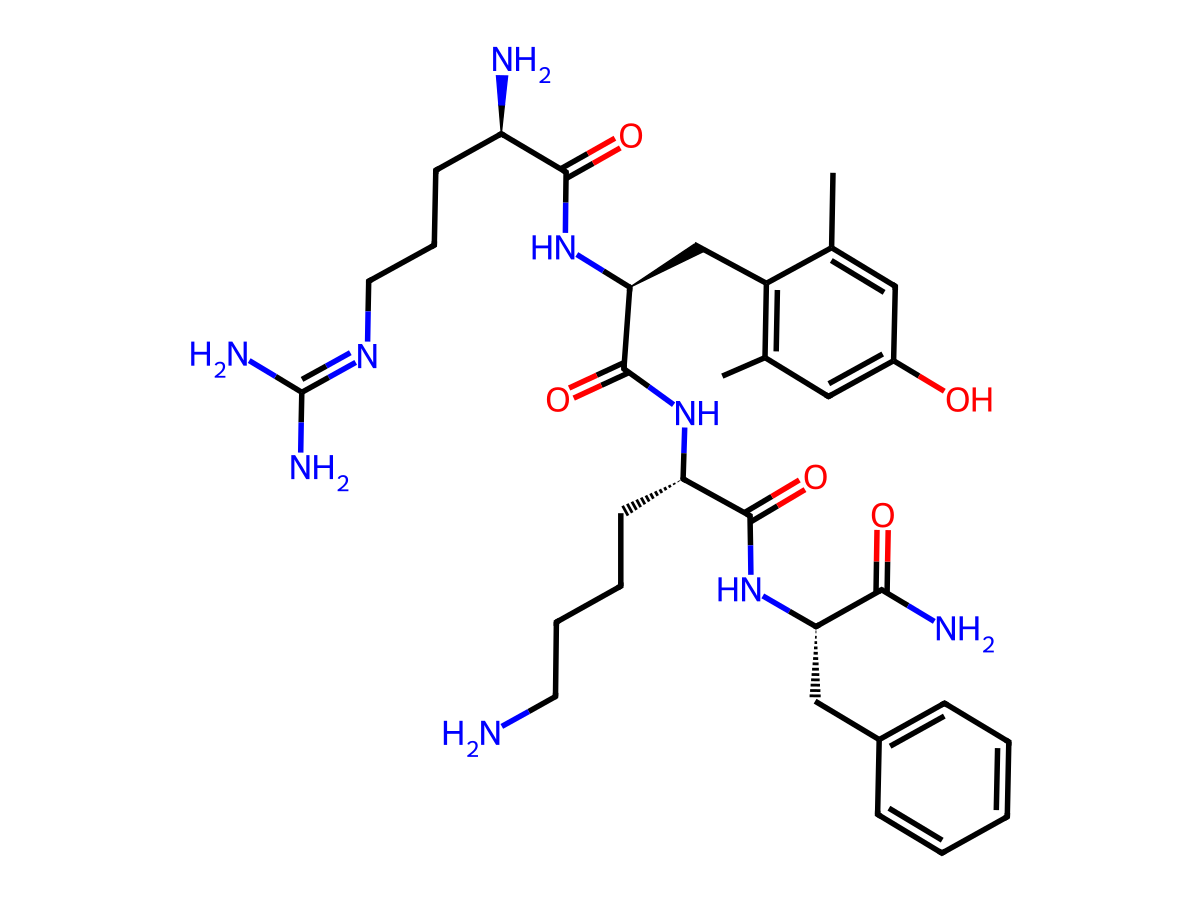
rD-Arg
DmtdiMe-Tyr
KLys
FPhe-NH2
BasicHydroxylNonpolar
Four residues. The arginine is the D form, every other residue is L, and the tyrosine carries two methyl groups. Both modifications exist to stop peptidases clearing it⁠1
ClassMitochondrial cardiolipin binder⁠1
SequenceD-Arg-2,6-dimethyl-Tyr-Lys-Phe-NH2⁠1
Formula, free baseC32H49N9O5, 639.8⁠2
Formula, saltC32H49N9O5.3HCl, 749.2⁠1
PubChemCID 11764719⁠2
InChIKeySFVLTCAESLKEHH-WKAQUBQDSA-N⁠2
CAS736992-21-5⁠2
Counter-ionThree hydrochlorides, for three basic sites⁠1
Net peptide85.5% in the licensed product⁠1
TargetCardiolipin, a phospholipid. Not a receptor⁠1
BioavailabilityAbout 92%, subcutaneous⁠1
Protein bindingAbout 39%⁠1
MetabolitesM1 tripeptide, M2 dipeptide, both inactive1
ClearanceRenal, about 100% recovered in urine by 48 h⁠1
StorageLicensed product 2 to 8 °C, discard 8 days after opening⁠1

Evidence at a glance

ApprovedYes, 19 September 2025, as Forzinity⁠3
Type of approvalAccelerated, on an intermediate endpoint⁠1
IndicationMuscle strength in Barth syndrome, 30 kg or more⁠1
Registration trial12 patients, crossover⁠1
Primary endpointsBoth missed: 6MWT and Total Fatigue Score⁠1
Approval endpointKnee extensor strength, a secondary endpoint, improving only in the open-label phase⁠1
Largest trialMMPOWER-3, n = 218. Failed⁠5
6MWT in MMPOWER-3−3.2 m, p = 0.695
Healthy adultsNo trials

Regulatory status

USApproved medicine. Accelerated approval 19 September 2025 as Forzinity, for muscle strength in Barth syndrome at 30 kg or more. Continued approval may be contingent on confirmatory trials. In October 2024 FDA reviewers stated the evidence did not establish effectiveness; an advisory committee subsequently voted 10 to 6 in favour⁠137
ManufacturerStealth BioTherapeutics Inc., Needham, Massachusetts⁠14
Great BritainNo authorisation in Great Britain
SportNot named on the 2026 Prohibited List. As with PT-141, the S0 catch-all requires a substance to have no approval by any regulatory health authority, and this now has FDA approval. Stated as a derivation from the published S0 wording, not a WADA ruling⁠11

Related

PT-141The other approved medicine in this library; approval is in a narrow population
MOTS-cAnother mitochondrial compound
RetatrutideA large positive trial
BPC-157Evidence tiers and sources discussed
TB-500Three molecules sold under one name
TesamorelinApproved, and it met its endpoints
NAD+ / NMNAnother mitochondrial compound; a surrogate-endpoint case
ZiconotideApproved on three trials whose effect differed across them
CompareCompare on the same axes
Methylene BlueAnother mitochondrial compound, licensed for a different condition

Every name resolves to a single molecule.

Some compounds have one name covering several molecules: CJC-1295 covers two, TB-500 covers three, and PT-141 sits one functional group from melanotan II.

For researchers

SS-31 does not have that problem. Every name it trades under resolves to a single PubChem record.⁠2

Name searchedResolves to
ElamipretideCID 11764719
SS-31CID 11764719
MTP-131CID 11764719
Bendavia, OcuviaCID 11764719
CAS 736992-21-5CID 11764719

One molecule: C32H49N9O5, 639.8 g/mol, InChIKey SFVLTCAESLKEHH-WKAQUBQDSA-N.⁠2 The sequence is D-Arg-2,6-dimethyl-Tyr-Lys-Phe-NH2, and every residue is the L form except the arginine, which is D.⁠1

Salt form and net peptide content

The approved product is elamipretide hydrochloride, and the label specifies how much of it is peptide.⁠1

From the label, section 11

The label's peptide and salt amounts give a net peptide content of 85.5%. Nearly 15% of the weighed material is hydrochloride.10

The reason is derivable. The molecular formula of the salt is C32H49N9O5.3HCl at 749.2 against a free base of 639.8: three hydrochlorides per molecule, because the peptide carries three basic sites, an arginine, a lysine and the free N-terminus.⁠1

For comparison, the approved PT-141 label gives 92.6% for an acetate salt. Neither figure reflects a manufacturing failure; both show that the mass of powder is not the mass of peptide.

Evidence

Twelve people, and both primary endpoints missed.

LabAnimalHuman, controlledApprovedPrimary endpoints met

Evidence found: lab; animal; human, controlled; approved.

The entire clinical development programme behind the Barth syndrome approval is, in the label's own words, 12 male patients aged 12 to 35 with genetically confirmed Barth syndrome. Eleven of the twelve were Caucasian.⁠1

For researchers

They took part in a randomised, double-blind, placebo-controlled crossover trial: 12 weeks on drug, a 4-week washout, 12 weeks on placebo, in one order or the other. Ten completed it and entered an open-label extension.⁠1

Quoted directly from the label, section 14

"The primary endpoints for the randomized trial were distance walked during 6-minute walk test and Total Fatigue Score on the Barth syndrome Symptom Assessment. FORZINITY was not superior to placebo on these primary endpoints."

Walking distance and fatigue are the two primary endpoints. They are also the outcomes most often attributed to SS-31 in non-medical use.

And the same two endpoints failed again, in eighteen times as many people

Separately, MMPOWER-3 tested elamipretide in 218 people with primary mitochondrial myopathy: 109 on drug, 109 on placebo, 24 weeks.⁠5

EndpointResult
6-minute walk testLeast-squares mean difference −3.2 metres, p = 0.69
Total Fatigue ScoreAlso missed

Both co-primary endpoints missed, in the wrong direction, at a p-value of 0.69. A prespecified subgroup with nuclear DNA variants showed improvement on the 6-minute walk test, but the authors describe that as post hoc and hypothesis generating, and it is reported here on the same terms.⁠6

Key finding

Walking distance and fatigue have now been tested in a 12-person controlled crossover and a 218-person Phase 3. Both missed.

Endurance, fatigue and exercise capacity have been formally measured twice without a benefit being found, in the two populations with the strongest mechanistic reason to respond. The outcome is not unstudied: it was studied, and the results were negative.

A secondary endpoint that did not move until the placebo arm was removed.

Given both primary endpoints failed, the approval needs explaining. The label explains it, and the explanation is unusually candid.⁠1

For researchers

Knee extensor muscle strength, measured by handheld dynamometry, was one of the secondary endpoints. The label states:

Label, section 14

"Increases in knee extensor muscle strength were not observed during the randomized trial but were observed during the extension period."

The extension period is open-label and single-arm. No placebo. Everyone knew what they were taking.⁠1

PhaseVisitnMedian change in strength
Randomised, controlledWeek 12, placebo12−5 N
Week 12, elamipretide12+4 N
Open-label, no controlWeek 1210+34 N
Week 249+68 N
Week 1688+63 N

In the controlled phase the difference between drug and placebo was 9 newtons of median change, against a baseline median of 124 newtons. In the uncontrolled phase, the numbers move substantially.⁠1

What accelerated approval means here, stated fairly

This is an accelerated approval on an intermediate clinical endpoint. The label says so on its first page, and adds that "continued approval for this indication may be contingent upon verification and description of clinical benefit in a confirmatory trial".⁠1

There is a reasonable case for the decision. Barth syndrome is ultra-rare, there is no alternative treatment, a placebo-controlled trial of hundreds of patients is not possible when the disease affects so few people, and regulators are explicitly empowered to accept intermediate endpoints in exactly this situation. In October 2024 the FDA's own reviewers said the evidence did not establish effectiveness; an advisory committee then voted 10 to 6 that it did.⁠7

None of that makes it evidence for people without Barth syndrome. An accelerated approval in twelve people with a specific genetic cardiolipin defect is a narrow foundation.

Mechanism

It binds a lipid rather than a receptor.

Most compounds in this library either activate a receptor or have no known target. SS-31 does neither. The label describes it as a mitochondrial cardiolipin binder that "localizes to the inner mitochondrial membrane and improves mitochondrial morphology and function".⁠1

For researchers
Elamipretide
Cationic and lipophilic. Concentrates in the inner mitochondrial membrane without needing a transporter or a receptor⁠1
Cardiolipin
A phospholipid unique to the inner mitochondrial membrane, essential to the structure of the electron transport chain. The target is a fat, not a protein19
Morphology
Cristae structure is stabilised, which is the physical arrangement the respiratory complexes sit in⁠1
Function
Improved mitochondrial function, in the label's phrasing. No downstream human outcome is claimed by the label beyond knee extensor strength1
Why the target being a lipid is relevant

Cardiolipin is present in every mitochondrion. It is not restricted to a diseased tissue, which is the mechanistic reason the compound was tested in heart failure, kidney injury, macular degeneration and mitochondrial myopathy in turn.

A mechanism that plausibly applies to every cell is easy to describe as general "mitochondrial health". A broad mechanism is not evidence of a broad effect, and this compound has a clear record of what happened when the breadth was tested.

Barth syndrome is the exception that explains the approval: it is a disorder of cardiolipin remodelling specifically. The one place the drug was approved is the one place the target is the disease.

Well-characterised pharmacokinetics with renal clearance.

ParameterValue, subcutaneous administration
Time to peak0.5 to 1 hour⁠1
BioavailabilityAbout 92%, subcutaneous⁠1
Dose proportionalityProportional, minimal accumulation1
Volume of distributionAbout 0.5 L/kg, total body water⁠1
Protein bindingAbout 39%⁠1
MetabolismSequential C-terminal degradation to inactive M1 tripeptide and M2 dipeptide. No hepatic metabolism1
ExcretionAbout 100% recovered in urine by 48 hours⁠1
For researchers
The renal point is the practical one

Clearance is essentially entirely renal, and the label recommends a reduced dose in severe renal impairment.⁠1 Exposure rises 39%, 75% and 125% across mild, moderate and severe renal impairment, and the inactive metabolites accumulate far more sharply, up to 280% and 640%.

Renal function is therefore the pharmacokinetic variable the label identifies as relevant.

Safety and standards

Mostly injection site reactions, in twelve people.

The safety database is the same twelve patients, which limits what any percentage below can show.⁠1

For researchers
ReactionElamipretide
n = 12
Placebo
n = 12
Any local administration reaction100%67%
Injection site erythema100%25%
Injection site pain75%42%
Injection site induration67%17%
Injection site pruritus67%17%
Injection site bruising25%0

Every patient on drug had an injection site reaction, which was the dominant adverse effect.⁠1

  • Serious allergic reaction is a labelled warning, including serious allergic reactions requiring emergency intervention, with rash, papular lesions, eczematous dermatitis and cough. Reactions may occur minutes to months after starting. Serious allergic reaction is the only contraindication⁠1
  • Eosinophilia was noted frequently with administration of 30 days or more, peaking around 90 days and returning to baseline after 6 to 12 months or on stopping. Not associated with clinical manifestations⁠1
  • Benzyl alcohol. The product contains benzyl alcohol as a preservative and carries a warning about fatal gasping syndrome in neonates.⁠1
  • No carcinogenicity studies have been conducted. Genotoxicity assays were negative, and fertility was unaffected in rats at roughly 5 times clinical exposure⁠1

Regulatory status

Status by country

Where regulators list this compound, country by country. A country with no line has not been checked yet.

No country or sport list has been checked yet

Not yet checked. North America: Canada, Mexico, United States. South America: Argentina, Brazil. Europe: European Union (central authorisation), Belgium, France, Germany, Italy, Netherlands, Russia, Spain, Switzerland, United Kingdom. Africa: Egypt, Nigeria, South Africa. Asia: China, India, Japan, South Korea, Thailand, United Arab Emirates. Oceania: Australia, New Zealand.

Sport (WADA) applies worldwide, not a country

WADA Prohibited List 2026Not yet checked

Information only, not legal advice. Not verified for any individual situation. Status changes; check the date and the source.

The same records as data: JSON and CSV, with a version and a change log.

Checked and missing

Claims against the published record.

  • Walking distance. Tested in 12 people and in 218 people. Missed in both.⁠15
  • Fatigue. Same two trials, same result.⁠15
  • Mitochondrial function in general. The one approved indication is a disorder of cardiolipin remodelling, and the drug binds cardiolipin.⁠1

Limits of the evidence.

  • The approval rests on 12 patients, all male, 11 of 12 Caucasian, aged 12 to 35.⁠1
  • The approval endpoint did not improve during the controlled phase. It improved in an open-label, single-arm extension.⁠1
  • It is an accelerated approval and continued approval may depend on confirmatory trials.⁠1
  • Both primary endpoints failed in the registration trial, and the same two endpoints failed in a 218-person Phase 3.⁠15
  • No data at all in healthy adults for any performance outcome.
  • No carcinogenicity studies have been conducted.⁠1
For researchers
What was searched for and not found

A trial of elamipretide in healthy adults for performance, energy or endurance. Searches for elamipretide healthy volunteers exercise capacity, SS-31 performance trial, and elamipretide athletic endurance return the Barth syndrome programme, the mitochondrial myopathy programme, and preclinical work. No controlled trial in healthy people was found.

Sources11

This page cites 11 sources, numbered to match the small numbers in the text above. Each one links to the paper or record. Where a source states its design, a tag says so (a human trial, an animal study, a cell study, a review); the tag names the design and is not a grade. Each source also links back to where it is cited above.

  1. 01
    US Food and Drug Administration. FORZINITY (elamipretide) injection prescribing information, NDA 215244, Reference ID 5662523, revised 09/2025.read 6 Aug 2026
    Full text
    US Food and Drug Administration. FORZINITY (elamipretide) injection prescribing information, NDA 215244, Reference ID 5662523, revised 09/2025. Read in full at source on 6 August 2026. Source for the indication and its accelerated-approval basis on knee extensor muscle strength as an intermediate clinical endpoint (section 1), the 40 mg once-daily subcutaneous dose and renal dose reduction (2.1, 2.2), the hypersensitivity contraindication (4), benzyl alcohol and hypersensitivity warnings (5.1, 5.2), the adverse reaction table and eosinophilia (6.1), the chemical name, molecular formula C32H49N9O5.3HCl at 749.2, the sequence D-Arg-2,6-dimethyl-Tyr-Lys-Phe-NH2 and the statement that each 0.5 mL dose contains 40 mg elamipretide equivalent to 46.8 mg elamipretide hydrochloride (11), the cardiolipin-binding mechanism (12.1), pharmacokinetics including 92% bioavailability, 39% protein binding, inactive M1 and M2 metabolites and essentially complete urinary recovery (12.3), the absence of carcinogenicity studies (13.1), and the clinical studies section including the 12-patient crossover design, the statement that FORZINITY was not superior to placebo on both primary endpoints, and Table 3 showing knee extensor strength changes across the randomised and open-label periods (14).
    Cited 57 times, back to the text12345678and 49 more
  2. 02
    PubChem compound record CID 11764719, elamipretide, retrieved via the PUG-REST property endpoint 6 August 2026.read 6 Aug 2026
    Full text
    PubChem compound record CID 11764719, elamipretide, retrieved via the PUG-REST property endpoint 6 August 2026. C32H49N9O5, molecular weight 639.8, InChIKey SFVLTCAESLKEHH-WKAQUBQDSA-N, CAS 736992-21-5. The names elamipretide, SS-31, MTP-131, Bendavia and Ocuvia all resolve to this single record.
    Cited 6 times, back to the text123456
  3. 03
    US Food and Drug Administration accelerated approval of elamipretide, 19 September 2025, marketed as FORZINITY, to improve muscle strength in adult and paediatric patients with Barth syndrome weighing at least 30 kg.no read date recordedCited 2 times, back to the text12
  4. 04
    Stealth BioTherapeutics Inc., Needham, Massachusetts, the manufacturer named on the approved label, and the sponsor of the elamipretide development programme across Barth syndrome, primary mitochondrial myopathy and ophthalmic indications.no read date recordedCited 2 times, back to the text12
  5. 05
    MMPOWER-3. Efficacy and Safety of Elamipretide in Individuals With Primary Mitochondrial Myopathy: a randomised clinical trial. Neurology, 2023. 218 participants randomised 1:1, 24 weeks. Both co-primary endpoints missed: the 6-minute walk…Human RCTno read date recorded
    Full text
    MMPOWER-3. Efficacy and Safety of Elamipretide in Individuals With Primary Mitochondrial Myopathy: a randomised clinical trial. Neurology, 2023. 218 participants randomised 1:1, 24 weeks. Both co-primary endpoints missed: the 6-minute walk test showed a least-squares mean difference of −3.2 metres at p = 0.69, and the Total Fatigue Score was also not met.
    Cited 6 times, back to the text123456
  6. 06
    Genotype-specific effects of elamipretide in patients with primary mitochondrial myopathy: a post hoc analysis of the MMPOWER-3 trial. Orphanet Journal of Rare Diseases, 2024. The prespecified nuclear DNA subgroup showed improvement on the…no read date recorded
    Full text
    Genotype-specific effects of elamipretide in patients with primary mitochondrial myopathy: a post hoc analysis of the MMPOWER-3 trial. Orphanet Journal of Rare Diseases, 2024. The prespecified nuclear DNA subgroup showed improvement on the 6-minute walk test, which the authors describe as encouraging and hypothesis generating. Reported here on those terms only.
    Back to the text1
  7. 07
    FDA Cardiovascular and Renal Drugs Advisory Committee proceedings on elamipretide for Barth syndrome. In October 2024 FDA staff stated they did not believe the available evidence established effectiveness; the committee subsequently voted…no read date recorded
    Full text
    FDA Cardiovascular and Renal Drugs Advisory Committee proceedings on elamipretide for Barth syndrome. In October 2024 FDA staff stated they did not believe the available evidence established effectiveness; the committee subsequently voted 10 to 6 that elamipretide is effective for the treatment of Barth syndrome.
    Cited 2 times, back to the text12
  8. 08
    Barth syndrome is an ultra-rare X-linked recessive disorder of cardiolipin remodelling, characterised in the approved labelling as a genetic condition not likely to affect females. Referenced here to explain why the approved population is not a general one.no read date recordedBack to the text1
  9. 09
    Cardiolipin is a phospholipid found in the inner mitochondrial membrane and is required for normal structure and function of the electron transport chain. The approved label describes elamipretide as a cardiolipin binder that localises to…no read date recorded
    Full text
    Cardiolipin is a phospholipid found in the inner mitochondrial membrane and is required for normal structure and function of the electron transport chain. The approved label describes elamipretide as a cardiolipin binder that localises to the inner mitochondrial membrane and improves mitochondrial morphology and function, which is the sole mechanistic claim made in the labelling.
    Back to the text1
  10. 10
    Independent reconstruction performed for this page, 6 August 2026. The structure was rebuilt from the PubChem isomeric SMILES for CID 11764719 and the molecular formula asserted as C32H49N9O5 at 639.80 before the structure image was drawn…no read date recorded
    Full text
    Independent reconstruction performed for this page, 6 August 2026. The structure was rebuilt from the PubChem isomeric SMILES for CID 11764719 and the molecular formula asserted as C32H49N9O5 at 639.80 before the structure image was drawn, then rendered at the final displayed width to confirm visibility. The net peptide content figure of 85.5% is 40 divided by 46.8 from the label, and the three-hydrochloride stoichiometry was checked against the salt molecular weight of 749.2 versus the free base at 639.8. The daily-cost arithmetic is the label's 40 mg daily dose multiplied by the median price at reference 8. Working retained in the vault.
    Back to the text1
  11. 11
    World Anti-Doping Agency, 2026 Prohibited List. Elamipretide is not named on the List. Section S0 prohibits at all times any pharmacological substance not addressed by a subsequent section and with no current approval by any governmental…no read date recorded
    Full text
    World Anti-Doping Agency, 2026 Prohibited List. Elamipretide is not named on the List. Section S0 prohibits at all times any pharmacological substance not addressed by a subsequent section and with no current approval by any governmental regulatory health authority for human therapeutic use. Elamipretide now holds FDA approval, so the S0 test is not met on its face. Stated as a derivation from the published S0 wording rather than a ruling by WADA, and direct confirmation is recommended for anyone subject to testing.
    Back to the text1

Where it sits

Primary sources

Don’t take our word for it. Read the study.