Coredex
Contents
Where to buyOverviewEvidenceMechanismStatusCheckedSourcesWhere it sitsStudies

PT-141

Bremelanotide, Vyleesi, PT 141, bremelanotide acetate

Bremelanotide is a cyclic heptapeptide approved by the FDA in 2019 for premenopausal women with acquired, generalised hypoactive sexual desire disorder. Two Phase 3 trials in 1,247 women moved desire scores but not the number of satisfying sexual events; evidence in men is a 25-person crossover from 2004.

  • Cyclic heptapeptide
  • Filed under: Sexual health
  • Subcutaneous
  • Approved by the FDA in 2019 for women with HSDD

Where to buy, code BENTheDhust, ships to the United States

  1. Compounds
  2. Melanocortin system
  3. Melanocortin receptor agonists
  4. MC4R agonist
  5. PT-141

14 sources 2 registered trials named in the sources last source read 6 Aug 2026 page reviewed 22 Nov 2026

Where to buy

TheDhust

  • US shipping
  • Affiliate link
Use codeenter it at checkout

Affiliate link. Coredex earns a commission if you buy through it. It does not change what you pay or what this page reports, and listing a vendor is not a recommendation. Each vendor’s own listing says what an item is sold as (a supplement, a medicine or research material); read it before you order. Read the full disclosure. Full vendor table.

Overview

In its favour

An approved medicine with two 24-week randomised trials in 1,247 women behind it

Recorded harm

Nausea is common, and 38% developed focal skin darkening in a daily-use study

Not settled

Desire scores moved and the number of satisfying sexual events did not, p=0.76. The men's evidence is a 25-person crossover from 2004

A licensed melanocortin agonist.

PT-141 is bremelanotide, marketed as Vyleesi. The US Food and Drug Administration approved it on 21 June 2019 for the treatment of premenopausal women with acquired, generalised hypoactive sexual desire disorder.⁠8 It has a full regulatory dossier, which most compounds in this library lack.

For researchers

The approved label states its own limits of use:⁠1

Limitations of use, quoted from the approved label

"VYLEESI is not indicated for the treatment of HSDD in postmenopausal women or in men."

"VYLEESI is not indicated to enhance sexual performance."

Compound data

NleAc-
DAsp
HHis
fD-Phe
RArg
WTrp
KLys
BasicAcidicNonpolar
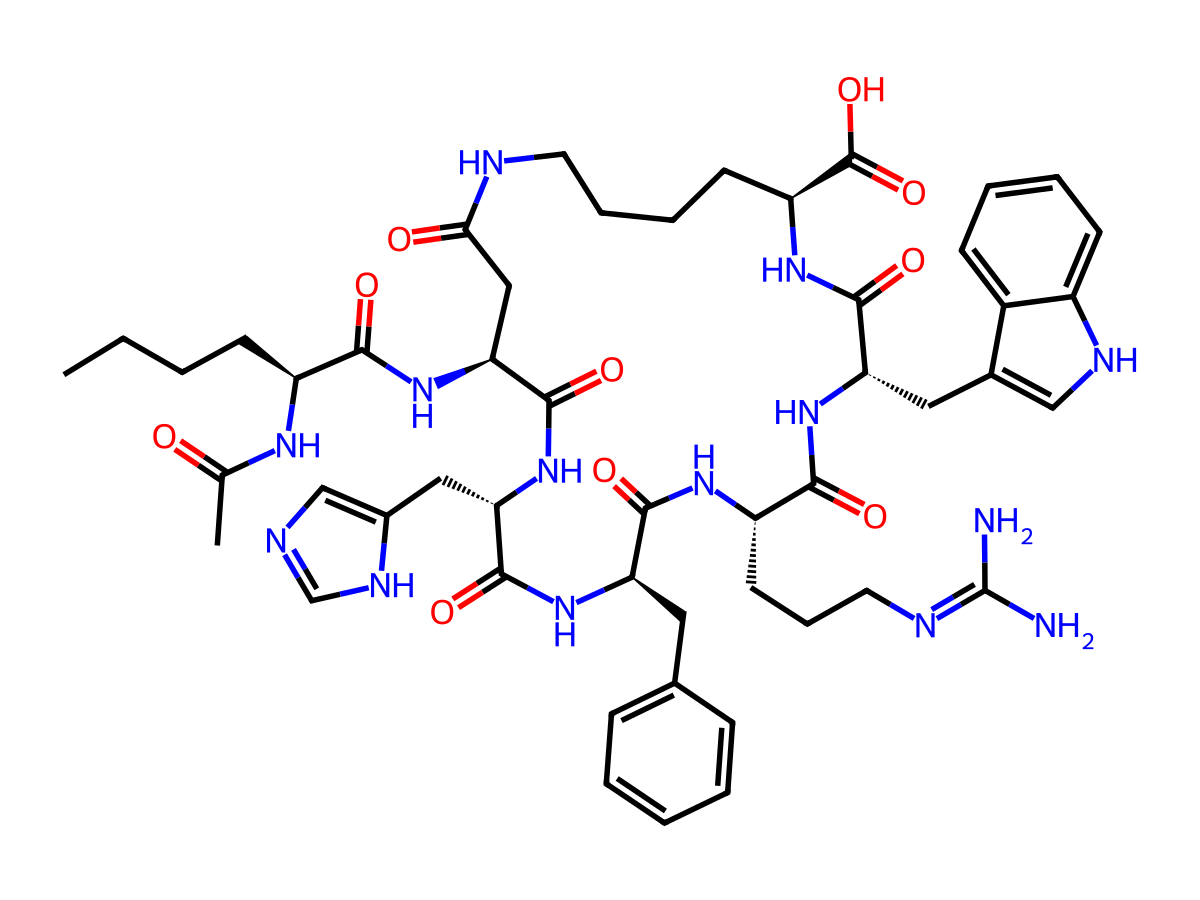
Seven residues, cyclised by a lactam bridge between the aspartate and the lysine. Position 4 is D-phenylalanine, not the L-form, and that inversion plus the ring is what makes the peptide resist the enzymes that would otherwise clear it⁠1
ClassCyclic heptapeptide, melanocortin receptor agonist⁠1
StructureAc-Nle-cyclo-(Asp-His-D-Phe-Arg-Trp-Lys-OH)⁠1
FormulaC50H68N14O10, 1025.2⁠2
Salt formAcetate, 1 to 2 equivalents⁠1
PubChemCID 9941379⁠2
InChIKeyFFHBJDQSGDNCIV-MFVUMRCOSA-N⁠2
CAS189691-06-3⁠2
UNII6Y24O4F92S⁠2
Basic residuesTwo, arginine and lysine, plus histidine
Net peptide92.6% in the licensed product, as the share of peptide in the acetate salt⁠1
Half-life2.7 h (1.9 to 4.0)⁠1
BioavailabilityAbout 100%, subcutaneous⁠1
Protein binding21%⁠1
MetabolismHydrolysis of the cyclic peptide amide bond⁠1
Related moleculeMelanotan II, C50H69N15O9, 1024.2. Bremelanotide is its active metabolite⁠314
StorageLicensed product at or below 25 °C, do not freeze, protect from light⁠1

Evidence at a glance

ApprovedYes. FDA, 21 June 2019, as Vyleesi⁠8
IndicationPremenopausal women, acquired generalised HSDD⁠1
Phase 3 trialsTwo, identical, 24 weeks, placebo-controlled⁠6
Subjects1,247 women⁠1
Primary endpointsBoth met, on questionnaires⁠1
Behavioural endpointNot met. p = 0.76 and 0.70⁠1
Effect sizeCohen's d 0.39 desire, 0.27 distress⁠7
Trials in menNone completed at Phase 310

Regulatory status

USApproved medicine. FDA approved 21 June 2019 as Vyleesi, for premenopausal women with acquired, generalised HSDD. Not approved in men, not approved in postmenopausal women, and not approved to enhance sexual performance18
SportNot named on the 2026 Prohibited List, and the S0 catch-all does not obviously apply either, because S0 requires a substance to have no current approval by any regulatory health authority, and this one has FDA approval. That is a derivation from the S0 text rather than a WADA ruling⁠12

Related

SemaxA melanocortin-derived peptide; bremelanotide carries the full melanocortin pharmacophore
GHK-CuThe other page that needs two Signatures instead of one
MOTS-cHuman evidence that belongs to an analogue
TB-500Two molecules sold under one name
RetatrutideAnother compound with controlled trial evidence
BPC-157A preclinical-stage peptide for comparison
SS-31Another approved medicine in the library
TesamorelinA third approved medicine in the library
CompareView beside other compounds on the same axes
SetmelanotideA licensed member of the same receptor family
TadalafilA sexual-health medicine acting on blood flow rather than desire

One functional group from melanotan II.

Bremelanotide is a cyclic heptapeptide. The label gives its structure explicitly:⁠1

For researchers

Ac-Nle-cyclo-(Asp-His-D-Phe-Arg-Trp-Lys-OH), xCH3COOH, where 1 ≤ x ≤ 2

MoleculeFormulaMassWhat it is
Bremelanotide
CID 9941379
C50H68N14O101025.2The free base, with a free acid at the carboxyl terminus. This is PT-141⁠2
Melanotan II
CID 92432
C50H69N15O91024.2Same backbone with an amide terminus instead. A different molecule, 0.98 Da lighter3
Bremelanotide acetate
CID 91971505
C52H72N14O121085.2The acetate salt form⁠4

Bremelanotide is the active metabolite of melanotan II, differing only by the loss of the C-terminal amide.⁠14 Swapping an amide for a hydroxyl is minus one nitrogen, minus one hydrogen, plus one oxygen, which is +0.984 Da. That reconciles 1024.2 to 1025.2.⁠13

Telling the two molecules apart

A mass spectrometer can separate the two. One dalton on a 1,025 dalton peptide is a routine difference to resolve. The stated molecular weights, 1024 and 1025, are adjacent integers and are often conflated.

The InChIKey distinguishes them: the connectivity blocks differ, FFHBJDQSGDNCIV against JDKLPDJLXHXHNV, while the stereochemistry blocks are identical. The same identity problem appears for CJC-1295 and TB-500.

The counter-ion

Peptide products are usually salts, so the mass of the salt exceeds the mass of the peptide.

The label states that each pre-filled syringe contains bremelanotide, equivalent to a slightly larger mass of bremelanotide acetate.⁠1 That ratio is 92.6%. The remaining 7.4% of the weighed material is acetate, in a product manufactured to pharmaceutical standard.

Evidence

Two questionnaire endpoints moved; satisfying sexual events did not.

The approval rests on two identical Phase 3 trials, NCT02333071 and NCT02338960, both 24 weeks, randomised, double-blind and placebo-controlled, in 1,247 premenopausal women with acquired, generalised HSDD. Mean age 39.⁠156

For researchers
LabAnimalHuman, controlledApprovedIndependent replication

Evidence found: lab; animal; human, controlled; approved.

Co-primary endpoint 1: desire

The FSFI desire domain runs from 1.2 to 6.0. Patients started at about 2.0.⁠1

 Study 1
bremelanotide
Study 1
placebo
Study 2
bremelanotide
Study 2
placebo
Mean baseline2.12.02.02.1
Mean change+0.5+0.2+0.6+0.2
p-value0.0002 <0.0001 

The difference over placebo is 0.3 and 0.4 points on a 4.8-point range. Both differences were statistically significant.

The responder threshold

The label defines a responder as a patient achieving at least a 1.2-point increase in the desire score.⁠1

The mean change on drug was 0.5 to 0.6, less than half of that threshold. Averages can conceal individual responders who improved by more.

Co-primary endpoint 2: distress

Bother from low desire, scored 0 to 4, fell by 0.7 on drug against 0.4 on placebo in both studies. The responder threshold here was a 1-point decrease.⁠1

Satisfying sexual events

Both trials also counted satisfying sexual events, a secondary endpoint.⁠1

 Study 1
bremelanotide
Study 1
placebo
Study 2
bremelanotide
Study 2
placebo
Mean change in events0.0−0.10.00.0
p-value0.76 0.70 
Questionnaire and behavioural endpoints

Reported desire rose and reported distress fell. The number of satisfying sexual events did not change in either trial. The approval therefore rests on validated questionnaire instruments rather than on the behavioural count.

Completion and discontinuation

  • 18% discontinued because of adverse reactions, against 2% on placebo⁠1
  • Premature discontinuation of the 24-week period overall ran at 40% against 13% in Study 1 and 39% against 25% in Study 2
  • Serious adverse reactions occurred in 1.1% of treated patients and 0.5% on placebo

Adverse reactions

ReactionBremelanotide
n = 627
Placebo
n = 620
Nausea40.0%1.3%
Flushing20.3%0.3%
Injection site reactions13.2%8.4%
Headache11.3%1.9%
Vomiting4.8%0.2%

Nausea required anti-emetic medication in 13% of patients and caused 8% to leave the trial. It was reported by 21% after the first dose and fell to around 3% on subsequent doses.⁠1

The label also records a single case of acute hepatitis in the open-label extension, with transaminases above 40 times the upper limit of normal, resolving four months after stopping, with no alternative cause identified.⁠1 In animal reproductive studies, post-implantation loss in dogs was elevated three to eight-fold at every dose tested, with no developmental no-effect level established in either species studied.⁠1

1,247 women in Phase 3, and 25 men in a 2004 crossover.

The controlled efficacy data was measured in premenopausal women. Use in men is described by smaller and earlier studies.

For researchers
PopulationWhat exists
Premenopausal women, HSDDTwo Phase 3 trials, 1,247 subjects, randomised, double-blind, placebo-controlled. FDA approved15
Men, erectile dysfunctionA 2004 double-blind crossover in 25 men who responded poorly to sildenafil, plus a safety crossover with 49 subjects dosed. No Phase 3 and no approval in men10
Men, recent clinical useUncontrolled case series from sexual medicine clinics, reported as conference abstracts. Self-reported satisfaction, no control group⁠11
Postmenopausal womenOutside the approved indication⁠1

An approval applies to a specific molecule in a specific population for a specific purpose. The 2019 approval concerns premenopausal women with HSDD, and the male evidence is a 25-person crossover from 2004.

Kisspeptin, another peptide studied for sexual function, has two randomised placebo-controlled trials with brain-imaging endpoints. Both used a longer form of the peptide, given intravenously, in patients.

Mechanism

It acts centrally on melanocortin receptors, and the label states the mechanism is unknown.

Bremelanotide is not a PDE5 inhibitor. PDE5 inhibitors such as sildenafil act on vascular smooth muscle. Bremelanotide acts centrally, on melanocortin receptors in the brain.⁠1

For researchers

The label gives the receptor order of potency directly:

MC1R
Highest potency. Expressed on melanocytes. Binding here "leads to melanin expression and increased pigmentation", in the label's own words⁠1
MC4R
Second. Neurons expressing MC4R sit throughout the central nervous system. This is the receptor the therapeutic rationale rests on⁠1
MC3R MC5R, MC2R
Third, fourth and fifth. The label describes activation as nonselective across all five subtypes⁠1
Effect
"The mechanism by which VYLEESI improves HSDD in women is unknown."⁠1
MC1R activity and pigmentation

Some secondary sources describe PT-141 as having reduced MC1R activity compared with melanotan II. The approved label ranks MC1R first in the order of potency and says that binding at MC1R increases pigmentation.⁠1 The label also carries a dedicated warning section for focal skin darkening.

Focal skin darkening and dosing frequency

The label devotes a warnings section to focal skin darkening. The incidence depends on how often the drug is used.⁠1

Use patternDeveloped focal skin darkening
At the approved monthly maximum1%, against none on placebo
Daily use over 8 days38%
A further 8 consecutive daysa further 14% developed new changes

Reported sites include the face, the gingiva and the breasts. Patients with darker skin were more likely to develop it.

From the label, section 5.2

"Resolution of the focal hyperpigmentation was not confirmed in all patients after discontinuation of VYLEESI."

Exposure rises less than dose-proportionally and peak concentration reaches a plateau.

The pharmacokinetics are well characterised, because they were submitted for approval.⁠1

For researchers
ParameterValue after the approved subcutaneous dose
Half-life2.7 hours (range 1.9 to 4.0)
Time to peak1.0 hour (range 0.5 to 1.0)
BioavailabilityAbout 100%, subcutaneous
Cmax / AUC72.8 ng/mL, 276 h*ng/mL
Volume of distribution25.0 ± 5.8 L
Protein binding21%
Excretion64.8% urine, 22.8% faeces
Dose-response

Exposure rises less than dose-proportionally, and mean Cmax reaches a plateau at roughly 4.3 times the approved dose.⁠1

Above that point, higher doses did not raise peak concentration further. The label associates higher exposure with more nausea, flushing, a longer period of raised blood pressure and, on the evidence above, more pigmentation.

Bremelanotide was originally developed as a nasal spray. The FDA halted the intranasal trials in 2007 over increases in blood pressure, with significant variability in plasma levels, and the formulation was abandoned in 2008.⁠9 The subcutaneous autoinjector that reached approval replaced that first formulation.

Regulatory status

Status by country

Where regulators list this compound, country by country. A country with no line has not been checked yet.

No country or sport list has been checked yet

Not yet checked. North America: Canada, Mexico, United States. South America: Argentina, Brazil. Europe: European Union (central authorisation), Belgium, France, Germany, Italy, Netherlands, Russia, Spain, Switzerland, United Kingdom. Africa: Egypt, Nigeria, South Africa. Asia: China, India, Japan, South Korea, Thailand, United Arab Emirates. Oceania: Australia, New Zealand.

Sport (WADA) applies worldwide, not a country

WADA Prohibited List 2026Not yet checked

Information only, not legal advice. Not verified for any individual situation. Status changes; check the date and the source.

The same records as data: JSON and CSV, with a version and a change log.

Checked and missing

What the evidence does not cover.

  • All controlled efficacy data is in premenopausal women with a specific diagnosis. None of it transfers to men or to postmenopausal women.⁠1
  • The co-primary endpoints were questionnaires. The behavioural endpoint did not change.⁠1
  • Dropout was high, at around 40% in the treatment arms, which complicates interpretation of a 24-week result.⁠1
  • There is no validated minimal clinically important difference published for the FSFI desire domain, so the observed change cannot be judged against an agreed threshold.⁠13
  • No long-term data beyond the 52-week open-label extension.⁠1
For researchers
What was searched for and not found

A Phase 3 trial of bremelanotide in men. Searches for bremelanotide erectile dysfunction phase 3, PT-141 men randomised controlled trial, and bremelanotide male sexual dysfunction approval return the 2004 crossover, early safety studies, and uncontrolled clinic case series presented as conference abstracts. No completed Phase 3 in men was found, and no approval in men in any jurisdiction.

A validated MCID for the FSFI desire domain. Searched and not located in the returned literature. The 1.2-point responder threshold used in these trials was defined for these studies by anchoring, and is not a general standard.⁠1

Sources14

This page cites 14 sources, numbered to match the small numbers in the text above. Each one links to the paper or record. Where a source states its design, a tag says so (a human trial, an animal study, a cell study, a review); the tag names the design and is not a grade. Each source also links back to where it is cited above.

  1. 01
    US Food and Drug Administration. VYLEESI (bremelanotide injection) prescribing information, NDA 210557, Reference ID 4452852, revised 06/2019.read 6 Aug 2026
    Full text
    US Food and Drug Administration. VYLEESI (bremelanotide injection) prescribing information, NDA 210557, Reference ID 4452852, revised 06/2019. Read in full at source on 6 August 2026. Source for the indication and limitations of use (section 1), dosing and the 8-dose monthly ceiling (2.1), the contraindication in uncontrolled hypertension and known cardiovascular disease (4), transient blood pressure and heart rate effects (5.1), focal hyperpigmentation including the 1%, 38% and further 14% figures and the statement that resolution was not confirmed in all patients (5.2), nausea at 40% with 13% requiring anti-emetics and 8% discontinuing (5.3), the adverse reaction table and the acute hepatitis case (6.1), the naltrexone interaction (7.2), animal reproductive toxicity with no NOEL set (8.1), the structure, acetate salt and the 1.75 mg peptide per 1.89 mg acetate statement (11), the receptor order of potency MC1R, MC4R, MC3R, MC5R, MC2R and the statement that the mechanism is unknown (12.1), pharmacokinetics including the 2.7 hour half-life and the Cmax plateau at 7.5 mg (12.3), and the Phase 3 results including the FSFI desire and FSDS-DAO tables, the 1.2-point responder threshold, the discontinuation rates and the null satisfying-sexual-events result (14).
    Cited 43 times, back to the text12345678and 35 more
  2. 02
    PubChem compound record CID 9941379, bremelanotide, retrieved via the PUG-REST property endpoint 6 August 2026.read 6 Aug 2026
    Full text
    PubChem compound record CID 9941379, bremelanotide, retrieved via the PUG-REST property endpoint 6 August 2026. C50H68N14O10, molecular weight 1025.2, InChIKey FFHBJDQSGDNCIV-MFVUMRCOSA-N, CAS 189691-06-3, UNII 6Y24O4F92S. The synonym list for this record includes "PT-141 free base".
    Cited 6 times, back to the text123456
  3. 03
    PubChem compound record CID 92432, melanotan-II, retrieved 6 August 2026.read 6 Aug 2026
    Full text
    PubChem compound record CID 92432, melanotan-II, retrieved 6 August 2026. C50H69N15O9, molecular weight 1024.2, InChIKey JDKLPDJLXHXHNV-MFVUMRCOSA-N. Note that the second InChIKey block is identical to that of bremelanotide, which is the stereochemistry layer, while the first block differs because the connectivity differs.
    Cited 2 times, back to the text12
  4. 04
    PubChem compound record CID 91971505, bremelanotide acetate, retrieved 6 August 2026. C52H72N14O12, molecular weight 1085.2.read 6 Aug 2026Back to the text1
  5. 05
    Kingsberg SA, Clayton AH, Portman D, et al. Bremelanotide for the Treatment of Hypoactive Sexual Desire Disorder: Two Randomized Phase 3 Trials. Obstet Gynecol 2019;134(5):899-908.Human RCTPMID 31599840no read date recorded
    Full text
    Kingsberg SA, Clayton AH, Portman D, et al. Bremelanotide for the Treatment of Hypoactive Sexual Desire Disorder: Two Randomized Phase 3 Trials. Obstet Gynecol 2019;134(5):899-908. PMID 31599840. The published report of the RECONNECT studies.
    Cited 2 times, back to the text12
  6. 06
    ClinicalTrials.gov registrations NCT02333071 and NCT02338960, the two identical Phase 3 trials named in section 14 of the label, each with a 24-week double-blind phase and a 52-week open-label extension.NCT02333071no read date recordedCited 2 times, back to the text12
  7. 07
    Simon JA, et al. Effect size of bremelanotide treatment in the Phase 3 RECONNECT studies. J Sex Med 2019, abstract 194. Source for the Cohen's d values of 0.39 for the FSFI desire domain and 0.27 for FSDS-DAO item 13 in the combined studies.no read date recorded
    Full text
    Simon JA, et al. Effect size of bremelanotide treatment in the Phase 3 RECONNECT studies. J Sex Med 2019, abstract 194. Source for the Cohen's d values of 0.39 for the FSFI desire domain and 0.27 for FSDS-DAO item 13 in the combined studies. Reported as an abstract rather than a full paper, which is why the label's own tables are used for the primary figures on this page.
    Back to the text1
  8. 08
    US Food and Drug Administration. Approval of NDA 210557, 21 June 2019, and the accompanying announcement of a new treatment for hypoactive sexual desire disorder in premenopausal women.no read date recordedCited 3 times, back to the text123
  9. 09
    Development history of the intranasal formulation. Phase II intranasal trials were placed on hold by the FDA in 2007 following increases in blood pressure, with significant variability in plasma concentrations, and the intranasal programme…no read date recorded
    Full text
    Development history of the intranasal formulation. Phase II intranasal trials were placed on hold by the FDA in 2007 following increases in blood pressure, with significant variability in plasma concentrations, and the intranasal programme was discontinued in 2008 in favour of subcutaneous administration.
    Back to the text1
  10. 10
    Diamond LE, et al. Double-blind, placebo-controlled crossover evaluation of subcutaneous bremelanotide in men with erectile dysfunction responding poorly to sildenafil, 2004. Twenty-five subjects. Mean duration of base rigidity at or above…Human RCTno read date recorded
    Full text
    Diamond LE, et al. Double-blind, placebo-controlled crossover evaluation of subcutaneous bremelanotide in men with erectile dysfunction responding poorly to sildenafil, 2004. Twenty-five subjects. Mean duration of base rigidity at or above 80% was 14 minutes at 4 mg and 17 minutes at 6 mg against 2 minutes for placebo. A separate multiple-dose crossover safety study dosed 49 subjects. Neither is a Phase 3 trial and neither supported an approval in men.
    Cited 2 times, back to the text12
  11. 11
    Use of bremelanotide in men with sexual dysfunction at a sexual medicine clinic. Conference abstracts, Journal of Sexual Medicine and Journal of Urology, 2024. Uncontrolled case series with self-reported outcomes and no placebo comparison.…Human observationalno read date recorded
    Full text
    Use of bremelanotide in men with sexual dysfunction at a sexual medicine clinic. Conference abstracts, Journal of Sexual Medicine and Journal of Urology, 2024. Uncontrolled case series with self-reported outcomes and no placebo comparison. Included here to characterise what evidence exists for male use, not as support for efficacy.
    Back to the text1
  12. 12
    World Anti-Doping Agency, 2026 Prohibited List. Bremelanotide is not named on the List. Section S0 prohibits at all times any pharmacological substance not addressed by a subsequent section and with no current approval by any governmental…no read date recorded
    Full text
    World Anti-Doping Agency, 2026 Prohibited List. Bremelanotide is not named on the List. Section S0 prohibits at all times any pharmacological substance not addressed by a subsequent section and with no current approval by any governmental regulatory health authority for human therapeutic use. Bremelanotide holds FDA approval, so the S0 test is not met on its face. This page states that as a derivation from the published S0 wording, not as a ruling by WADA, and recommends direct confirmation by anyone subject to testing.
    Back to the text1
  13. 13
    Independent reconstruction and arithmetic performed for this page, 6 August 2026. The structure was rebuilt from the PubChem isomeric SMILES for CID 9941379 and the molecular formula asserted as C50H68N14O10 at 1025.18 before the structure…no read date recorded
    Full text
    Independent reconstruction and arithmetic performed for this page, 6 August 2026. The structure was rebuilt from the PubChem isomeric SMILES for CID 9941379 and the molecular formula asserted as C50H68N14O10 at 1025.18 before the structure image was drawn, and rendered at the final displayed width to confirm visibility. The amide to hydroxyl substitution separating melanotan II from bremelanotide was computed as minus one nitrogen, minus one hydrogen, plus one oxygen, giving +0.984 Da, which reconciles 1024.2 to 1025.2. Searches for a validated minimal clinically important difference for the FSFI desire domain returned none. Working retained in the vault.
    Cited 2 times, back to the text12
  14. 14
    Bremelanotide pharmacology monograph literature, describing bremelanotide as the active metabolite of melanotan-II, from which it differs by the absence of the C-terminal amide group. Used for the metabolite relationship only. No vendor or…no read date recorded
    Full text
    Bremelanotide pharmacology monograph literature, describing bremelanotide as the active metabolite of melanotan-II, from which it differs by the absence of the C-terminal amide group. Used for the metabolite relationship only. No vendor or comparison site is cited anywhere on this page, in line with this library's source policy.
    Cited 2 times, back to the text12

Where it sits

Primary studies

Don’t take our word for it. Read the study.

Read first: 05.

Where this compound is sold

Affiliate links. Coredex earns a commission if a reader buys through the links in this table. The commission has no influence on what the page above reports. The publisher also has a partner relationship with TheDhust. Read the full disclosure.

One vendor, TheDhust, is listed.

VendorProduct and sizePublic lab report
TheDhustPT-141, 10 mgNot published