GHK-Cu
Glycyl-L-histidyl-L-lysine copper(II), copper tripeptide-1, prezatide copper, GHK, Cu-GHK
GHK-Cu is a copper-binding tripeptide found in human plasma, with fifty years of human evidence that is entirely for topical use. No injected use has been published in a person, which makes this the only page here that has to carry two Signatures instead of one.
- Copper tripeptide
- Skin and wound repair
- Topical studied; injected not studied in humans
Where to buy, code BENTheDhust, ships to the United States
- Compounds
- Repair and tissue peptides
- Copper peptides
- GHK-Cu
Where to buy
TheDhust
- GHK-Cu, 50 mg, 100 mgView at TheDhust
Affiliate link. Coredex earns a commission if you buy through it. It does not change what you pay or what this page reports, and listing a vendor is not a recommendation. Each vendor’s own listing says what an item is sold as (a supplement, a medicine or research material); read it before you order. Read the full disclosure. Full vendor table.
Overview
Every human trial is of a topical cream, and the molecule is present in human plasma
It raises matrix-degrading enzymes as well as collagen synthesis in cell culture
Every human trial is topical. The injected route has no human evidence
A three-amino-acid peptide present in human plasma.
GHK is a tripeptide, glycine then histidine then lysine. Three residues, which makes it one of the four shortest peptides in this library, alongside AHK-Cu, KPV and Pinealon. Retatrutide has thirty-nine. It binds copper tightly, and the copper complex is the form studied and marketed.1
For researchers
It is made in the body. It was isolated from human plasma in 1973 and its concentration falls with age, from roughly 200 ng/mL at twenty to about 80 ng/mL at sixty.2
The body holds a regulated amount of this peptide. The mechanism section below describes a dose-response in human cells in which the lowest concentration tested had the largest effect.
Compound data
| Class | Copper-binding tripeptide, endogenous2 |
| Sequence | Gly-His-Lys |
| Cosmetic name | Copper tripeptide-1 (INCI) |
| Drug name | Prezatide copper |
| Free peptide | C14H24N6O4, 340.3810 |
| Complex | C14H22CuN6O4, 401.9114 |
| PubChem | CID 73587 (peptide, L-form)10 |
| InChIKey | MVORZMQFXBLMHM-QWRGUYRKSA-N10 |
| CAS | 49557-75-7 (peptide), 89030-95-5 (complex) |
| UNII | 39TG2H631E, 6BJQ43T1I9 |
| Copper donors | Three nitrogens: terminal amine, Gly-His amide, imidazole4 |
| Cu binding | Competes with albumin. At equimolar concentrations about 42% of the copper bound the peptide, the rest stayed on albumin4 |
| Plasma level | Approx. 200 ng/mL at age 20, 80 ng/mL at 602 |
| Basic residues | Two, lysine plus the free N-terminus. Fewer than most peptides here, so proportionally less counter-ion |
| Appearance | Deep blue powder or solution. The colour is the copper |
| Stability | Sensitive to pH and light. The complex dissociates outside a narrow pH range |
Evidence at a glance
| Discovered | 1973, isolated from human plasma2 |
| Human trials, topical | Yes. Small, short, industry-funded67 |
| Human trials, injected | None published |
| Largest topical trial | 71 volunteers, 12 weeks. Book chapter, not peer-reviewed7 |
| Best controlled trial | 40 women, 8 weeks, randomised double-blind6 |
| Independent replication | Limited. Major reviews share one author, who sold the product1 |
| Approved anywhere | No, as a medicine. Widely sold as a cosmetic ingredient |
Regulatory status
| US | Not an approved medicine. On 22 April 2026 the FDA removed GHK-Cu (except for injectable routes) from Category 1 of the 503A bulks list, because the nominations were withdrawn, not because a question was answered. On 5 May 2026 one nominator clarified it had withdrawn only the injectable route, and the non-injectable entry was added back to Category 112 |
| Not approval | Removal from a list is not authorisation. A further advisory committee meeting covering GHK-Cu is expected by February 202712 |
| Sport | Not named on the 2026 Prohibited List. Category S0 prohibits at all times any pharmacological substance with no current approval by any regulatory health authority for human therapeutic use. An injectable GHK-Cu product has none, which is the basis on which BPC-157 is named in S011 |
| Age | Nothing in this library is intended for anyone under 18 |
Related
| BPC-157 + TB-500 + GHK-Cu | The three-peptide blend; no study of the three together was found |
| BPC-157 + TB-500 + KPV + GHK-Cu | The four-peptide blend; no study of the four together was found |
| Semax | Peptide page |
| Compare | Side-by-side comparison on the same axes |
| TB-500 | Discoverer also founded a company developing the compound |
| BPC-157 | Evidence from a single research group; named in WADA S0 |
| MOTS-c | Endogenous peptide |
| Retatrutide | Formula arithmetic check against a circulating mass |
| CJC-1295 | Growth hormone secretagogue |
| PT-141 | The other page that needs two Signatures instead of one |
| SS-31 | Evidence split by population |
| NAD+ / NMN | Endogenous molecule; evidence split by molecule |
| Tesamorelin | Approved GHRH analogue |
Four public database records, three different molecular formulas.
The compound has a CAS number, an international non-proprietary name, and entries in the world's largest public chemistry database. Those records do not agree with each other about its formula and mass.
For researchers
| Record | Formula | Mass | What it contains |
|---|---|---|---|
| CID 73587 | C14H24N6O4 | 340.38 | The free tripeptide, L-stereochemistry defined. The correct record for GHK itself10 |
| CID 342538 | C14H24N6O4 | 340.38 | Same molecule, stereochemistry undefined. The InChIKey ends -UHFFFAOYSA-, which is the tell10 |
| CID 378611 | C14H24CuN6O4 | 403.92 | Titled as the copper complex. It is a tripeptide and a copper atom listed side by side, with no bond between them and nothing deprotonated10 |
| CID 71587328 | C14H23CuN6O4+ | 402.92 | Prezatide copper, CAS 89030-95-5. Carboxylate deprotonated, Cu2+ present, net charge +1, still not bonded10 |
| Literature | C14H22CuN6O4 | 401.91 | The actual coordination complex. Copper displaces two protons when it binds. This is the figure given in the literature, and it appears in none of the four records above |
Take the free peptide at 340.38, remove two hydrogens at 1.008 each, add copper at 63.546. The result is 401.91. That is what a copper atom does when it chelates a peptide: it does not sit next to it, it displaces protons and takes their place.14
The discrepancy is about two grams per mole. If the public registries disagree on the formula of a fifty-year-old molecule with an INN name, a quoted mass to four figures is not by itself confirmation of identity.
The same arithmetic check found that a mass in wide circulation for retatrutide reconciles with no possible sequence.
AHK-Cu is a related copper tripeptide, alanine-histidine-lysine rather than glycine-histidine-lysine. GHK-Cu has fifty years of literature; AHK-Cu has one study, from 2007, in a dish. Much of what is published under AHK-Cu’s name is GHK-Cu’s record.
Evidence
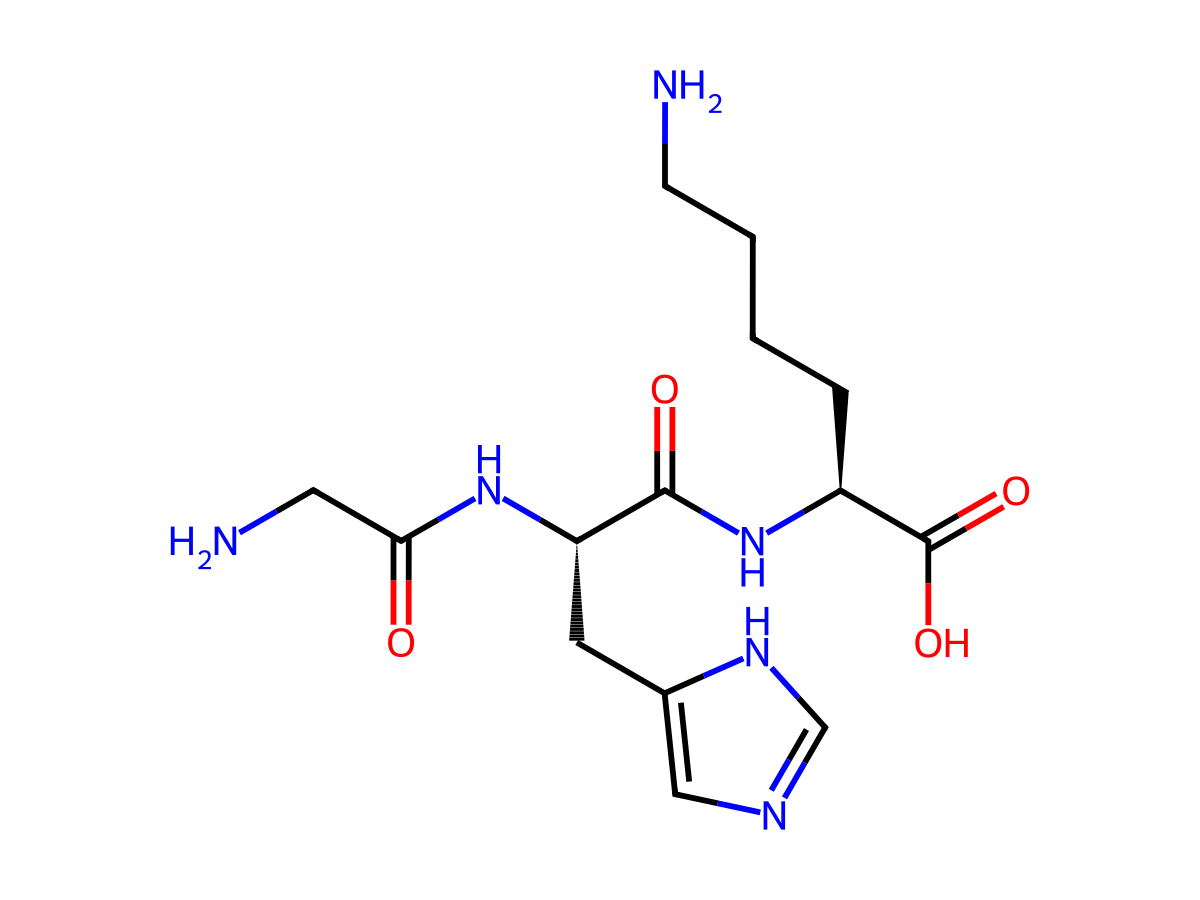
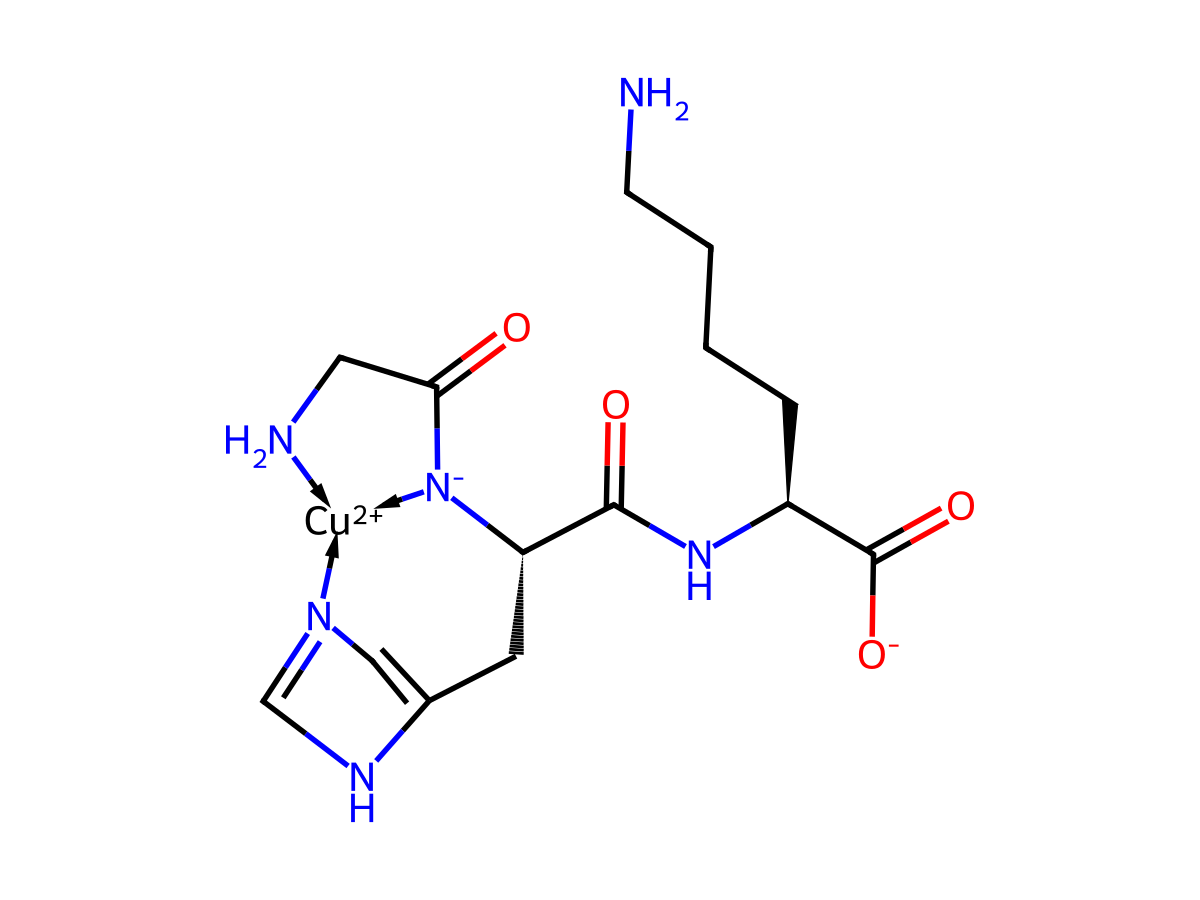
The free peptide and the copper complex have different structures.
The literature writes GHK where it frequently means GHK-Cu. Both are drawn below, from the published connection table rather than copied.14
For researchers
The three nitrogens are the molecule
Copper is not bolted to the outside of this peptide. It is clamped by three nitrogen atoms drawn from all three residues: the free amine at the glycine end, the amide nitrogen linking glycine to histidine, and one ring nitrogen of the histidine imidazole.4 That is why the sequence is glycine-histidine-lysine and not some other three residues. Change any of them and the clamp stops working.
The two protons missing from the complex formula are displaced by the copper binding.
Every human trial is of a cream.
There is controlled human evidence for GHK-Cu, and all of it is topical. No trial of injected GHK-Cu in a human being has been published.
For researchers
Evidence found: lab; animal; human, topical.
| Badenhorst 2016 | 40 women, aged 40 to 65, 8 weeks, randomised, double-blind, split-face. Wrinkle volume fell 55.8% relative to the vehicle control. See the caveats below6 |
| Finkey 2005 | The 71-volunteer, 12-week study everyone cites. It is a book chapter, not a peer-reviewed paper, and the underlying data was a conference abstract78 |
| Mortazavi 2024 | Review of topical GHK. Concludes the controlled facial studies have small samples and short duration and that further research is required13 |
| Animal work | Extensive. In 24 rats with ischaemic wounds, area fell 64.5% by day 13 against 45.6% for vehicle and 28.2% untreated. Also a topical gel9 |
| Injected, in humans | Nothing. No published trial of any size. |
What the 55.8% represents
The 55.8% is the most quoted number about this compound. Wrinkle volume did not fall by 55.8%. The table from the paper follows.6
| Arm | Change in wrinkle volume at 8 weeks |
|---|---|
| GHK-Cu serum | −24.1% from baseline |
| Vehicle control | −15.0% from baseline |
| The headline | 55.8% is the difference between those two arms, expressed as a proportion. Not the change in either arm |
The vehicle control arm changed by 15.0%, most of the active arm's change.
Limitations of the strongest study
- It cannot separate the peptide from its delivery system. The active arm was GHK-Cu inside a lipid nano-carrier. The control was the serum with neither. There was no carrier-only arm, so the trial cannot attribute the result to the peptide. The paper's own discussion says the nano-carrier was what mattered6
- The funder made the product. The study was funded by the company whose commercial serum was the active arm. The paper discloses this6
- The journal carries an OMICS DOI prefix. It is published under an imprint OMICS uses. In 2019 a US federal court entered a $50.1 million judgment against OMICS on the FTC's case that it claimed rigorous peer review it did not provide15
The most cited number about this compound rests on one industry-funded study, in a journal with that history, of a formulation rather than the molecule.
Authorship of the major reviews
Loren Pickart isolated GHK from human plasma in 1973 and proposed the copper-uptake mechanism in Nature in 1980. He also founded a copper peptide skincare company in 1994 and held the wound-healing patent, and he is the author of the major reviews everyone cites, in 2008, 2015 and 2018.12 He died in 2023.
BPC-157 has the same structural problem, where most of the mechanistic work comes from a single research group. Here the researcher also owned a company selling the compound. The major reviews are therefore not independent of the product.
Limitations of the evidence
- No human trial of the injected route exists, at any dose, for any indication.
- The strongest topical trial tested a formulation, with no carrier-only arm to separate the peptide from its delivery system.
- The most cited human study is a book chapter resting on a conference abstract, by authors at the company selling the product.
- The major reviews share one author, who held the patent and owned the company.
- Cell culture concentrations are not tissue concentrations, and the latter have not been measured in a person.
- No long-term safety data for repeated injection, including no data on copper accumulation.
What we looked for and did not find
A human trial of injected GHK-Cu. Searches for GHK-Cu injection human trial, GHK-Cu subcutaneous clinical, copper tripeptide systemic administration humans and prezatide copper clinical trial return topical studies, animal studies, and cell work. No published human trial of any parenteral route was found.
For researchers
A bonded structure record for the complex. All four PubChem records for GHK and its copper form are either the bare peptide or a disconnected mixture. None of them depicts copper bonded to the peptide, which is why the complex on this page was constructed from the coordination chemistry in the literature and checked against the published formula rather than copied from a database.414
GHK-Cu named on the WADA Prohibited List. It does not appear by name; see the regulatory panel for how Category S0 applies.
Mechanism
It raises matrix degradation as well as matrix synthesis.
GHK-Cu stimulates collagen in fibroblast culture at picomolar to nanomolar concentrations.5 It also acts on matrix degradation.
For researchers
In the one study that tested a concentration range in human cells, the lowest concentration produced the largest effect on gene expression, and higher concentrations produced less.6 Higher concentrations did not give a larger effect.
In fibroblast culture, GHK-Cu raises MMP-2.36 In the rat wound study, treated wounds had lower MMP-2 and MMP-9 than controls.9 Those are opposite directions, in different models, and both are real results.
These findings are consistent with a remodelling signal rather than a collagen stimulant alone: up in cell culture, down in an inflamed wound. The effect cannot be predicted from the mechanism alone, so cell data do not extrapolate directly to skin or joint tissue.
Copper transfer from albumin, measured in 1981
The systemic story for GHK-Cu is that it shuttles copper into cells. That requires it to take copper off albumin, the most abundant protein in plasma and the body's own copper carrier. The experiment has been done.
At equal concentrations of peptide and albumin, about 42% of the copper ended up on the peptide.4 It competes, which is the interesting finding. It also loses: albumin is present in blood at grams per litre.
Two caveats apply. The measurement was made at 6 °C, not body temperature, and at equimolar concentrations. It is a ceiling on the systemic argument, not a description of injection in vivo.
Regulatory status
Status by country
Where regulators list this compound, country by country. A country with no line has not been checked yet.
No country or sport list has been checked yet
Not yet checked. North America: Canada, Mexico, United States. South America: Argentina, Brazil. Europe: European Union (central authorisation), Belgium, France, Germany, Italy, Netherlands, Russia, Spain, Switzerland, United Kingdom. Africa: Egypt, Nigeria, South Africa. Asia: China, India, Japan, South Korea, Thailand, United Arab Emirates. Oceania: Australia, New Zealand.
Sport (WADA) applies worldwide, not a country
| WADA Prohibited List 2026 | Not yet checked |
|---|
Information only, not legal advice. Not verified for any individual situation. Status changes; check the date and the source.
The same records as data: JSON and CSV, with a version and a change log.
Sources15
This page cites 15 sources, numbered to match the small numbers in the text above. Each one links to the paper or record. Where a source states its design, a tag says so (a human trial, an animal study, a cell study, a review); the tag names the design and is not a grade. Each source also links back to where it is cited above.
- 01Pickart L, Margolina A. Regenerative and protective actions of the GHK-Cu peptide in the light of the new gene data. Int J Mol Sci 2018;19:1987.mdpi.comno read date recordedCited 3 times, back to the text123Pickart L, Margolina A. Regenerative and protective actions of the GHK-Cu peptide in the light of the new gene data. Int J Mol Sci 2018;19:1987. Source for the gene-modulation account and for the authorship concentration noted on this page. Pickart founded Skin Biology in 1994 and held the wound-healing patent.
- 02Pickart L. The human tri-peptide GHK and tissue remodeling. J Biomater Sci Polym Ed 2008;19:969-988.pubmed.ncbi.nlm.nih.govno read date recordedCited 5 times, back to the text12345
Full text
Pickart L. The human tri-peptide GHK and tissue remodeling. J Biomater Sci Polym Ed 2008;19:969-988. Source for the 1973 isolation from human plasma and the decline in plasma GHK from approximately 200 ng/mL at age 20 to approximately 80 ng/mL at age 60. - 03Siméon A, Emonard H, Hornebeck W, Maquart FX. The tripeptide-copper complex glycyl-L-histidyl-L-lysine-Cu2+ stimulates matrix metalloproteinase-2 expression by fibroblast cultures. Life Sci 2000;67:2257-2265.pubmed.ncbi.nlm.nih.govno read date recordedCited 3 times, back to the text123
Full text
Siméon A, Emonard H, Hornebeck W, Maquart FX. The tripeptide-copper complex glycyl-L-histidyl-L-lysine-Cu2+ stimulates matrix metalloproteinase-2 expression by fibroblast cultures. Life Sci 2000;67:2257-2265. Source for the MMP-2 upregulation that runs alongside the collagen effect. - 04Lau SJ, Sarkar B. The interaction of copper(II) and glycyl-L-histidyl-L-lysine, a growth-modulating tripeptide from plasma. Biochem J 1981;199:649-656.portlandpress.comno read date recordedCited 7 times, back to the text1234567
Full text
Lau SJ, Sarkar B. The interaction of copper(II) and glycyl-L-histidyl-L-lysine, a growth-modulating tripeptide from plasma. Biochem J 1981;199:649-656. Potentiometric titration and visible-absorption spectrophotometry at 25 °C in 0.15 M NaCl. Source for the competition result: at pH 7.5 and 6 °C, with albumin and peptide at equimolar concentrations, approximately 42% of the copper was bound to the peptide. Source also for the coordination chemistry underlying the three-nitrogen donor set used to construct the complex on this page. - 05Maquart FX, Pickart L, Laurent M, Gillery P, Monboisse JC, Borel JP. Stimulation of collagen synthesis in fibroblast cultures by the tripeptide-copper complex glycyl-L-histidyl-L-lysine-Cu2+. FEBS Lett 1988;238:343-346.pubmed.ncbi.nlm.nih.govno read date recordedBack to the text1
Full text
Maquart FX, Pickart L, Laurent M, Gillery P, Monboisse JC, Borel JP. Stimulation of collagen synthesis in fibroblast cultures by the tripeptide-copper complex glycyl-L-histidyl-L-lysine-Cu2+. FEBS Lett 1988;238:343-346. Source for collagen stimulation in fibroblast culture at picomolar to nanomolar concentrations. - 06Badenhorst T, Svirskis D, Merrilees M, Bolke L, Wu Z. Effects of GHK-Cu on MMP and TIMP expression, collagen and elastin production, and facial wrinkle parameters. J Aging Sci 2016;4:166.Human RCTDOI 10.4172/2329-8847.1000166no read date recordedCited 11 times, back to the text12345678and 3 more
Full text
Badenhorst T, Svirskis D, Merrilees M, Bolke L, Wu Z. Effects of GHK-Cu on MMP and TIMP expression, collagen and elastin production, and facial wrinkle parameters. J Aging Sci 2016;4:166. DOI 10.4172/2329-8847.1000166. Source for the 40-subject randomised double-blind split-face trial, the arm-level figures of −24.1% for the GHK-Cu serum and −15.0% for the vehicle control, the 55.8% between-arm difference, the MMP and TIMP expression data and the inverse dose-response. The disclosure states the study was funded by Snowberry New Zealand Ltd, which supplied the commercial serum used as the active arm. There was no carrier-only control arm. - 07Finkey MB, Appa Y, Bhandarkar S. "Copper Peptide and Skin." In: Elsner P, Maibach HI, eds. Cosmeceuticals and Active Cosmetics. New York: Taylor & Francis, 2005:549-564. The widely cited 12-week topical study.no read date recordedCited 3 times, back to the text123
Full text
Finkey MB, Appa Y, Bhandarkar S. "Copper Peptide and Skin." In: Elsner P, Maibach HI, eds. Cosmeceuticals and Active Cosmetics. New York: Taylor & Francis, 2005:549-564. The widely cited 12-week topical study. It is a book chapter rather than a peer-reviewed research paper. Badenhorst and colleagues cite the underlying trial as 71 volunteers; secondary sources commonly report 67. - 08Leyden J, Stevens T, Finkey M, Barkovic S. Skin care benefits of copper peptide containing facial cream. American Academy of Dermatology 60th Annual Meeting, New Orleans, 2002. Conference abstract. The primary presentation of the data…no read date recordedBack to the text1
Full text
Leyden J, Stevens T, Finkey M, Barkovic S. Skin care benefits of copper peptide containing facial cream. American Academy of Dermatology 60th Annual Meeting, New Orleans, 2002. Conference abstract. The primary presentation of the data later written up in reference 7. Never published as a full paper. - 09Canapp SO Jr, Farese JP, Schultz GS, et al. The effect of topical tripeptide-copper complex on healing of ischemic open wounds. Vet Surg 2003;32:515-523.Animalonlinelibrary.wiley.comno read date recordedCited 2 times, back to the text12
Full text
Canapp SO Jr, Farese JP, Schultz GS, et al. The effect of topical tripeptide-copper complex on healing of ischemic open wounds. Vet Surg 2003;32:515-523. Twenty-four Sprague-Dawley rats, full-thickness wounds within an ischaemic bipedicle skin flap, treated with a topical 2% gel. Source for the day-13 wound area reduction of 64.5% against 45.6% for vehicle and 28.2% untreated, and for the reduced TNF-alpha, MMP-2 and MMP-9 concentrations in treated wounds that run opposite to the cell-culture findings at references 3 and 6. The gel was a commercial product of the company then holding the copper peptide technology. - 10PubChem compound records, retrieved 1 August 2026 via the PUG-REST property endpoint. CID 73587, glycyl-L-histidyl-L-lysine, C14H24N6O4, 340.38, InChIKey MVORZMQFXBLMHM-QWRGUYRKSA-N, stereochemistry defined.pubchem.ncbi.nlm.nih.govread 1 Aug 2026Cited 8 times, back to the text12345678
Full text
PubChem compound records, retrieved 1 August 2026 via the PUG-REST property endpoint. CID 73587, glycyl-L-histidyl-L-lysine, C14H24N6O4, 340.38, InChIKey MVORZMQFXBLMHM-QWRGUYRKSA-N, stereochemistry defined. CID 342538, same formula and mass, InChIKey MVORZMQFXBLMHM-UHFFFAOYSA-N, stereochemistry undefined. CID 378611, C14H24CuN6O4, 403.92, a disconnected peptide-and-copper mixture. CID 71587328, prezatide copper, CAS 89030-95-5, C14H23CuN6O4+, 402.92, net charge +1. - 11World Anti-Doping Agency. The 2026 Prohibited List, International Standard, in force 1 January 2026. Section S0, Non-Approved Substances, page 4, read directly from the published list on 1 August 2026: any pharmacological substance not…wada-ama.orgread 1 Aug 2026Back to the text1
Full text
World Anti-Doping Agency. The 2026 Prohibited List, International Standard, in force 1 January 2026. Section S0, Non-Approved Substances, page 4, read directly from the published list on 1 August 2026: any pharmacological substance not addressed by a subsequent section of the List and with no current approval by any governmental regulatory health authority for human therapeutic use is prohibited at all times. The section names BPC-157 among its examples. GHK-Cu is not named anywhere on the List. - 12US Food and Drug Administration, 503A bulk drug substances list. In April 2026 the FDA removed twelve peptides from Category 2 (GHK-Cu for injectable routes among them) and, on 22 April 2026, removed GHK-Cu (except for injectable routes)…no read date recordedCited 2 times, back to the text12
Full text
US Food and Drug Administration, 503A bulk drug substances list. In April 2026 the FDA removed twelve peptides from Category 2 (GHK-Cu for injectable routes among them) and, on 22 April 2026, removed GHK-Cu (except for injectable routes) from Category 1; on 5 May 2026 a nominator clarified that it had withdrawn only the injectable route and the non-injectable entry was added back to Category 1 (FDA list updated 14 May 2026); in each case because the nominations were withdrawn by the nominators. The Pharmacy Compounding Advisory Committee met on 23 and 24 July 2026 on seven peptides and recommended six; GHK-Cu was not among the seven. A further committee meeting covering five substances including GHK-Cu is expected by February 2027. See also the regulatory section of the BPC-157 page. - 13Mortazavi SMJ, et al. Topical GHK as an anti-wrinkle peptide, a review. BioImpacts 2024. Concludes that the controlled facial studies have small samples and short duration and that further research is required.no read date recordedBack to the text1
- 14Independent reconstruction performed for this page, 1 August 2026. The free tripeptide was built two ways, from the published SMILES for CID 73587 and independently from the sequence Gly-His-Lys; both return C14H24N6O4 at 340.38 and the same InChIKey.no read date recordedCited 4 times, back to the text1234
Full text
Independent reconstruction performed for this page, 1 August 2026. The free tripeptide was built two ways, from the published SMILES for CID 73587 and independently from the sequence Gly-His-Lys; both return C14H24N6O4 at 340.38 and the same InChIKey. The coordination complex was constructed from the three-nitrogen donor set in reference 4, with the amide nitrogen and the carboxyl group deprotonated, and returns C14H22CuN6O4 at 401.91, matching the mass quoted in the commercial and review literature and none of the four PubChem records. Working retained in the vault. - 15Federal Trade Commission. Court rules in FTC's favor against academic publisher OMICS Group; imposes $50.1 million judgment. April 2019. The court found OMICS deceptively claimed rigorous peer review and prominent editorial boards.ftc.govno read date recordedBack to the text1
Full text
Federal Trade Commission. Court rules in FTC's favor against academic publisher OMICS Group; imposes $50.1 million judgment. April 2019. The court found OMICS deceptively claimed rigorous peer review and prominent editorial boards. The journal at reference 6 carries the DOI prefix 10.4172, which is registered to OMICS, and is published under the Walsh Medical Media imprint that OMICS uses. This is stated as context for weighing the source and is not a claim about the conduct of that study's authors.
Where it sits
Where this compound is sold
Affiliate links. Coredex earns a commission if a reader buys through the links in this table. The commission has no influence on what the page above reports. The publisher also has a partner relationship with TheDhust. Read the full disclosure.
One vendor, TheDhust, is listed.
| Vendor | Product and size | Public lab report |
|---|---|---|
| TheDhust | GHK-Cu, 50 mg, 100 mg | Not published |